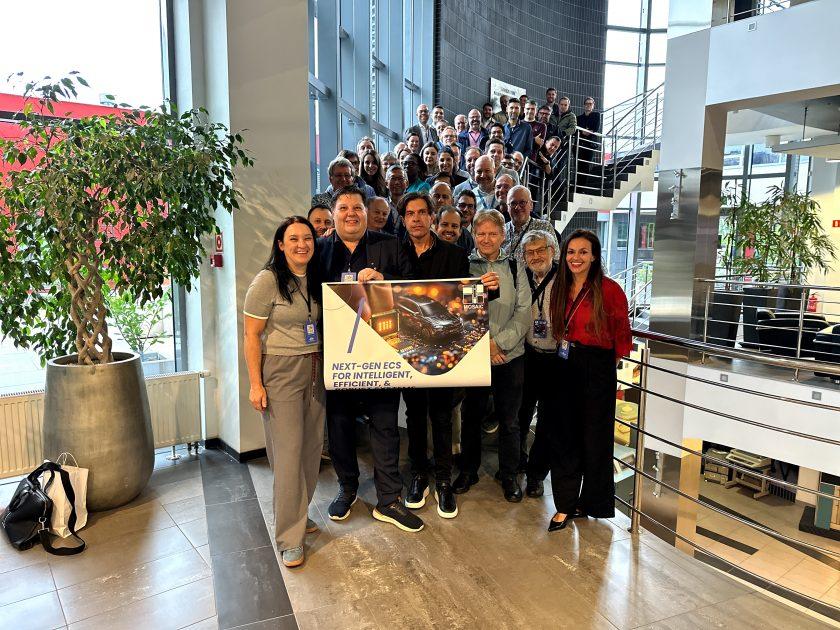
As of July 1st, 2025, the Institute of Electronics and Computer Science (hereinafter – EDI) has started the implementation of the Horizon Europe Chips Joint Undertaking project “A mosaic of essential electronic components and systems (ECS) for our automated digital future in industry and mobility” (hereinafter – MOSAIC).
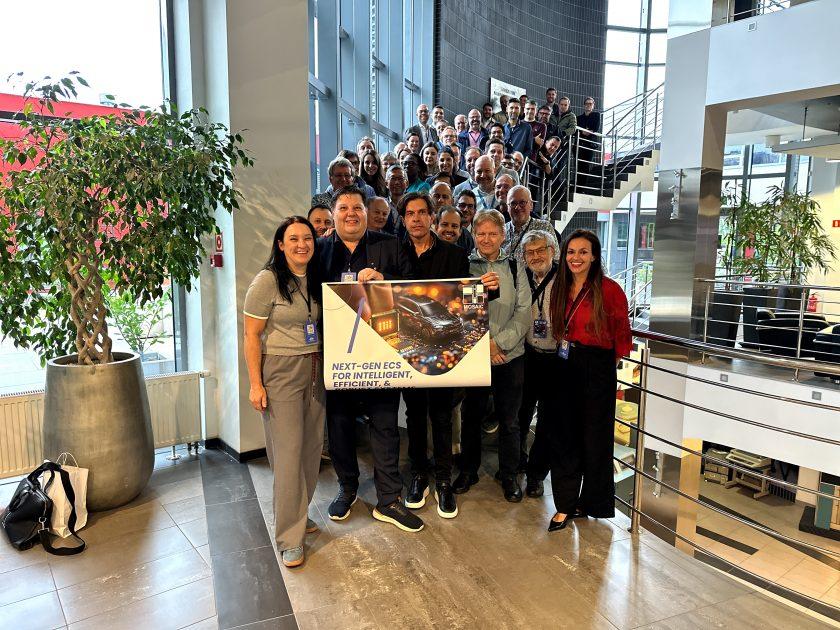
MOSAIC addresses a grand challenge for European competitiveness: technological independence and filled fabs in the landscape of automated systems. By fostering innovation in Electronic Components and Systems (ECS), MOSAIC aims to propel Europe to excellence and digital autonomy, directly linked to the EU Chips Act.
The project achieves this through a comprehensive strategy. It will develop next-generation ECS offering superior, cognitive system intelligence, enabling energy efficiency and robustness. These results will be tailored to the demands of automated systems, enabling rapid data processing and intuitive, AI-enabled decision- making.
MOSAIC tackles the challenge of integrating diverse perception hardware configurations, ensuring that automated systems can perceive their surroundings in a non-invasive manner, avoiding a single point of failure, with unparalleled accuracy and decreased complexity. Additionally, the project emphasizes standardized communication protocols and interoperability, fostering a collaborative ecosystem across several industries, namely automotive, aerospace, maritime, industrial automation and infrastructures. By spearheading such advancements, MOSAIC empowers European ECS manufacturers to gain a competitive advantage.
These innovations will be showcased in 31 advanced technical demonstrations, including:
- Global perception using 360° distributed radar;
- AI-enabled reasoning through magnetic field signals;
- Resilient communications via non-terrestrial networks.
MOSAIC leverages a pan-European consortium with 46 partners from 15 countries encompassing the entire ECS value chain, ensuring a comprehensive effort towards filling the European fabs and ensuring digital sovereignty.
In essence, MOSAIC is an investment in Europe’s future – a secure digital future of technological leadership, economic prosperity, and strategic independence.
EDI Deputy Director for Development and Leading Researcher Dr. Kaspars Ozols emphasize: “MOSAIC marks a significant step toward strengthening Europe’s technological sovereignty in the field of Electronic Components and Systems. Through close collaboration across industries and countries, we aim to develop intelligent, energy-efficient, and resilient solutions that will drive the next generation of automated systems. At EDI, we are proud to work alongside industry leaders such as Infineon, NXP, AVL, TTTech, and many others, contributing our expertise in quantum sensing, radar, embedded systems, and AI to help shape a secure and competitive digital future for Europe.”
EDI will contribute by developing a cooperative radar perception architecture and quantum sensor technologies, optimizing antennas, microwave circuits, and reducing energy consumption.
Head of the Integrated Circuits and Systems laboratory, Dr. Rihards Novickis, insists that: “MOSAIC is a significant step towards improving the maturity of the quantum sensing technology. MOSAIC provides an opportunity to further reduce the costs of ultra-precise magnetometers while improving the overall maturity and even performance. These factors facilitate the adoption of the novel sensing technology by new markets. Specifically in MOSAIC, we will explore non-invasive multi-phase current measurements.”
EDI researcher, Edgars Lielāmurs, highlights the growing importance of next-generation automotive mmWave radar technologies: “Within the MOSAIC project, we are focusing on advancing emerging automotive millimeter-wave (mmWave) radar technologies. Latest EU fabricated mmWave radar chips are reaching higher maturity needed for SAE L2+ driving safety and automated driving functions. In response, close collaboration between research institutions and OEMs is essential to develop signal processing and perception algorithms tailored for 4D radar data. Moreover, in the field of cooperative perception and V2X communication, there are still very few integrated solutions combining vehicle-based and infrastructure-mounted mmWave radars. Together with our research and industry partners, EDI is developing advanced computing technologies for safer next-generation radar-equipped vehicles and roadside radar systems.”
The project is implemented in collaboration with multiple Horizon Europe Chips-JU projects such as A-IQ Ready, ARCHIMEDES, Cynergy4MIE, EcoMobility, ShapeFuture and others.