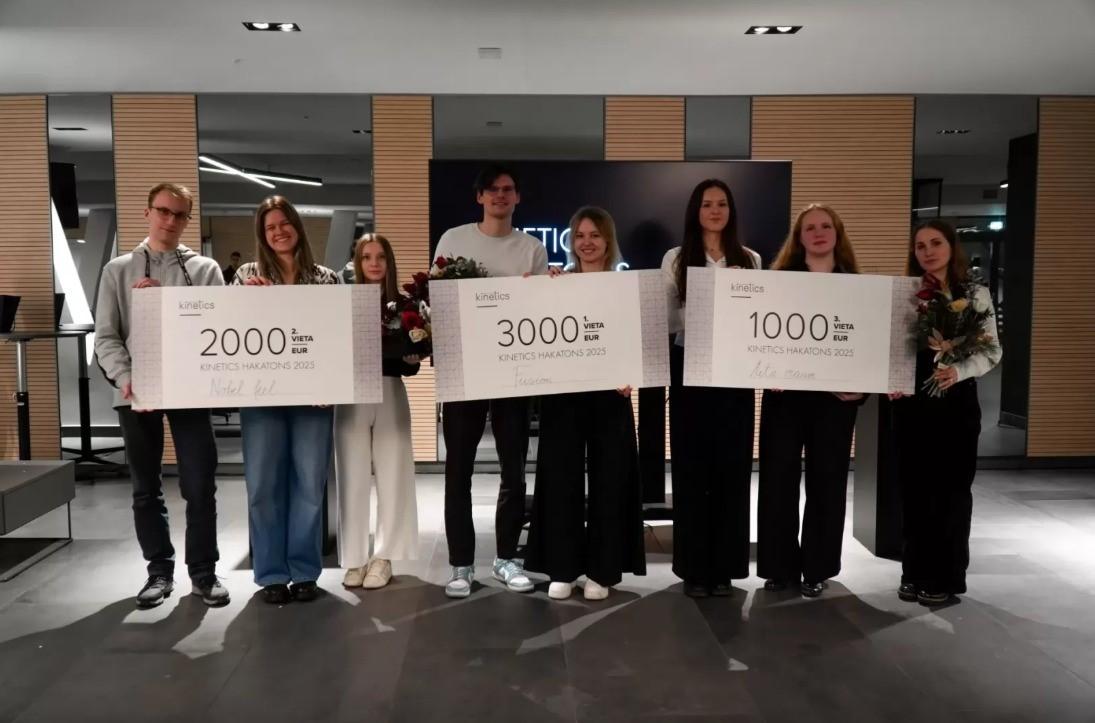
New technologies for curing nail polish coatings, methods for testing the durability of polish materials, and testing the adhesion of new nail coatings using bovine hooves as an analog for human nails — these are the award-winning innovative ideas from students of Riga Technical University (RTU) and University of Latvia (UL). They presented these ideas at a hackathon organized by Kinetics Nail Systems, where participants were tasked with developing solutions for gel nail polish technologies.

First Place and €3,000 Scholarship
The first-place winners were Kristiāna Lejniece, Jurģis Lillais, and Henriks Dundurs, fourth-year students at the Faculty of Natural Sciences and Technology (DTF) of Riga Technical University (RTU). They proposed replacing ultraviolet (UV) lamps used for curing nail coatings with an innovative infrared (IR) pulse technology, using zinc particles as IR absorbers to achieve faster, safer, and higher-quality polymerization.
Second Place and €2,000 Scholarship
Second place went to students from the Faculty of Medicine and Life Sciences, University of Latvia (LU) — Ričards Jaunzems, Marks Poļanskis, Marta Sīle, and Anastasija Minzare. They presented innovative ideas for alternative adhesion testing methods under realistic environmental conditions, aiming for more accurate assessments of material durability.
Third Place and €1,000 Scholarship
Third place was awarded to Anna Apine, Elizabete Ruska, and Tīna Marija Zaļaiskalna, third-year students at RTU DTF, who proposed a new approach to testing nail coating adhesion using bovine hooves as a realistic analog for human nails, as they contain α-keratin and are structurally similar to human nails.
“This hackathon is an excellent example of successful collaboration between universities and local companies, providing students with broader opportunities to explore potential future workplaces during their studies and to tackle challenges faced by professionals in the field,” emphasizes Professor Māris Turks, Dean of RTU DTF.
This was the second Kinetics Nail Systems hackathon inviting chemistry students. The goal of the hackathon is to promote the field of chemistry, demonstrate the wide range of career opportunities after graduation, and give students a unique experience stepping into the role of a chemist in a production company’s Research & Development laboratory.
This year, participants could develop solutions in one of three research directions. Those choosing the thermal radiation track explored ways to cure gel polish without UV lamps. Those on the adhesion track sought new methods for testing adhesion, while the stability track focused on faster ways to predict the shelf life of gel polishes.
Students developed their ideas for future nail care solutions over several stages from November 3 to December 5. This year, participants had the opportunity to work with mentors, visit the Kinetics production facility, explore the R&D laboratories, observe production lines, and take part in nail polish and cream masterclasses led by company chemists. At the conclusion of the hackathon on December 5, student teams presented their ideas to a jury consisting of RTU senior faculty and representatives from Kinetics. A total of 15 student teams participated in the hackathon.
The event was organized by the Kinetics Science Foundation, demonstrating the company’s commitment to supporting the next generation of professionals with scholarships and expert guidance. Kinetics is one of the leading manufacturers of UV-cured coatings in Europe for the cosmetics industry.