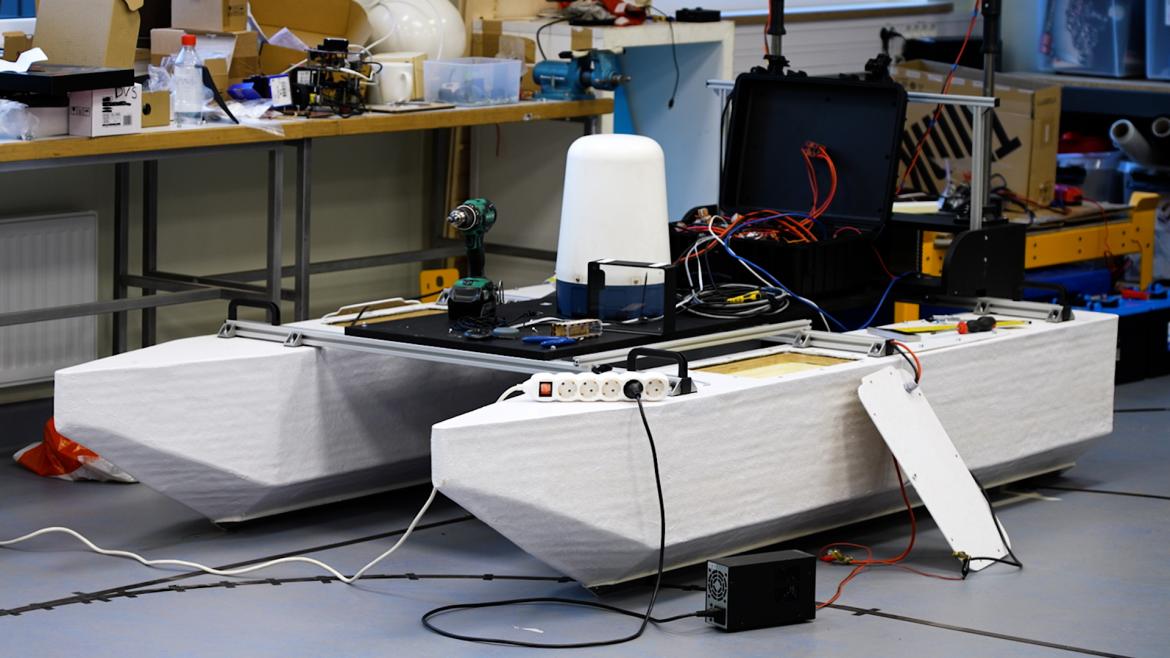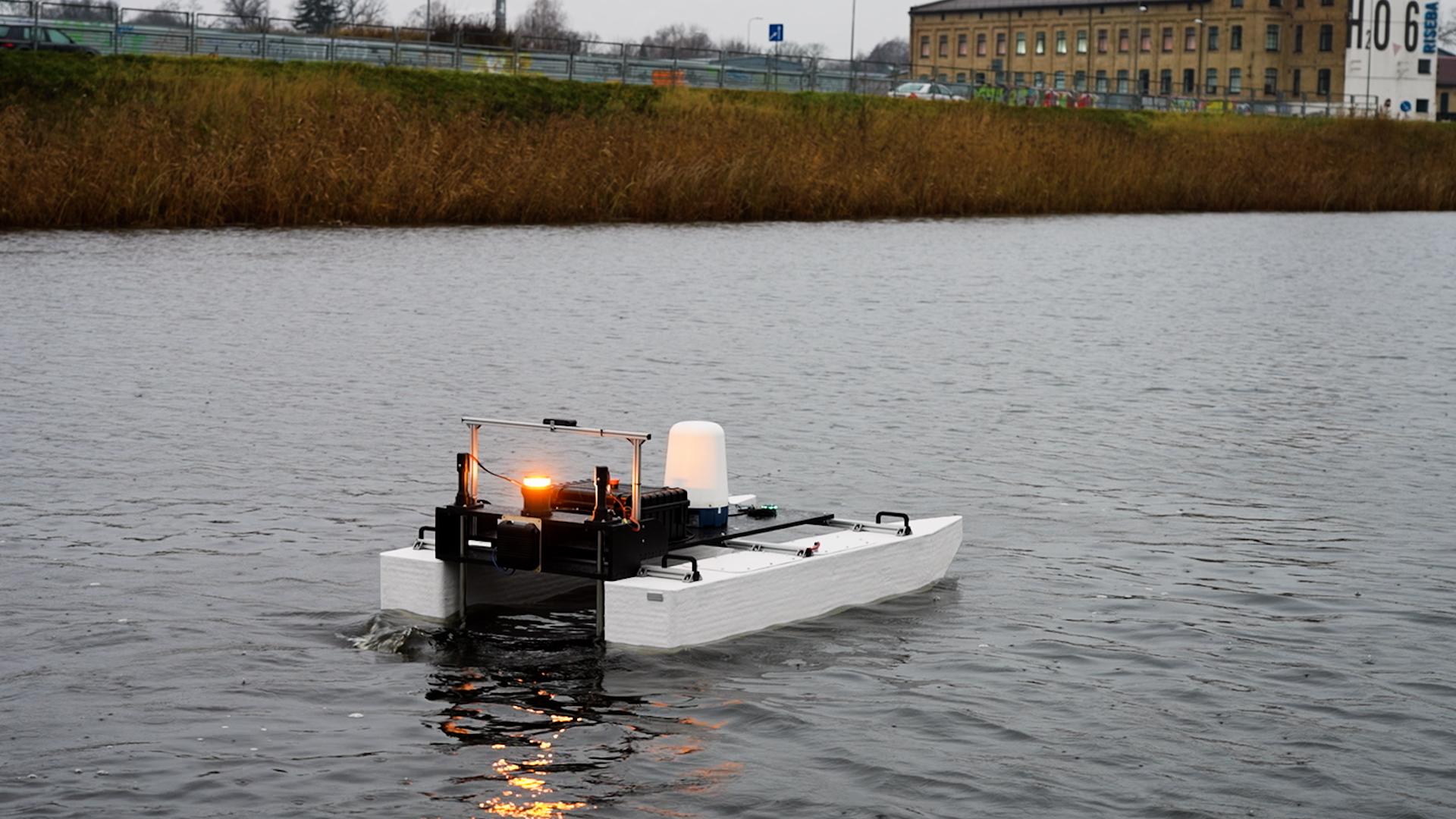
Students from the Riga Technical University (RTU) Faculty of Computer Science, Information Technology, and Energy, under the guidance of researcher Artūrs Ivanovs, are developing an autonomous watercraft system for radar odometry and water mapping. The watercraft has already undergone multiple successful tests in the Zunda Canal, with ongoing improvements to enable survey, monitoring, and other missions in open waters under challenging weather conditions.
"Autonomous watercraft and platforms are rapidly evolving worldwide and have broad applications, such as inspecting underwater cables, offshore wind farms, and monitoring various habitats. These systems can replace human operations in hazardous conditions. In Latvia, there is significant demand for seabed and river mapping, underwater terrain analysis, and ecosystem monitoring," says Artūrs Ivanovs, a researcher at RTU Faculty of Computer Science, Information Technology, and Energy Applied Computer Systems Institute.
Under his leadership, students have developed the second iteration of the watercraft, named Ronis 2. This catamaran, made of fiberglass and polystyrene foam, is equipped with multiple GPS antennas, radars, and sensors for navigation in various conditions and for data collection. The watercraft is operated through a mobile network, with a modular connection device providing connectivity to the mobile network and a base station. Ronis can autonomously navigate along a predefined route without pilot intervention. It is also equipped with a camera, allowing a pilot to take control manually to navigate through complex obstacles and avoid collisions. The pilot can operate the craft from hundreds or even thousands of kilometers away.
The team plans to further enhance the watercraft’s autonomy and data collection capabilities. Collaborating with international specialists, they are also interested in advancing the remote-control system to facilitate long-term operations of autonomous watercraft in international waters. Additionally, they aim to foster the marine technology community in Latvia by bringing together various stakeholders, collaborating on, and testing new technologies. The developed solution has already been presented to major technology and maritime companies as well as research institutions.
"The Baltic Sea is one of the most polluted in the world, so we cannot wait - we must create technological solutions to address this," emphasizes Ivanovs.
Students are also planning to participate in competitions and contests. This year, RTU student and scientific assistant Daniels Gorovojs, along with RTU alumna and scientific assistant Aija Monika Vainiņa, participated in one of Europe’s most popular pre-acceleration programs, EIT JumpStarter. In the finals, they presented an idea for an integrated sensor system for autonomous watercraft to automatically monitor fish farms, improving efficiency and reducing operational risks. This idea won first place.
RTU scientific assistant Māris Galauskis is also involved in the development of the autonomous watercraft.