Artificial intelligence has recently solved hundreds of highly complex mathematical problems. One of them – within a few hours, although scientists from around the world had worked on it for almost 30 years. Quantum computers promise to transform science. Meanwhile, autonomous weapons systems are already raising the question of whether we should entrust a machine with the decision over a human life.
Will we still be able to control the technologies we create ourselves?
A conversation about artificial intelligence that already surpasses scientists. About the possibilities of quantum computers and Latvia’s ambitions to become a major power in quantum technologies. Also about Schrödinger’s cat, the possibility that the Universe may one day repeat itself, and the question of whether human consciousness has anything to do with quantum physics.
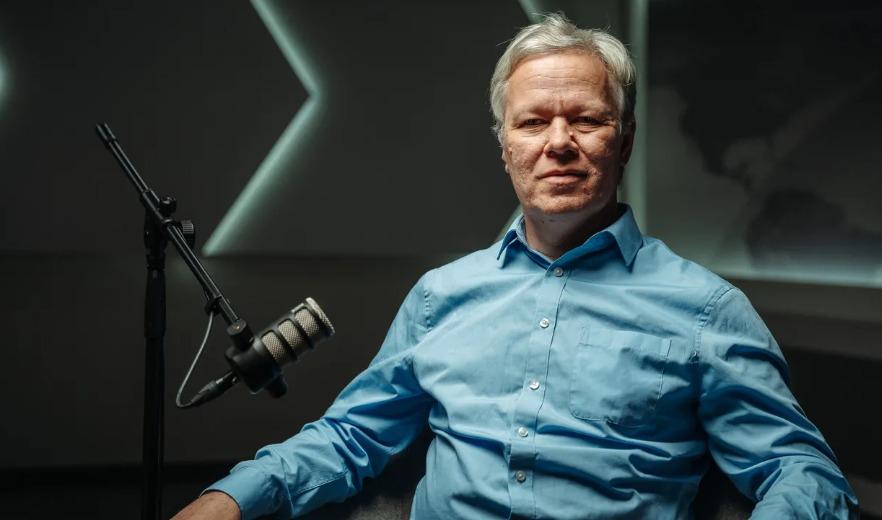
In the programme “NO OTRAS PUSES”, an interview with quantum physicist Andris Ambainis, one of Europe’s most recognised scientists in the field of quantum computing and a tenured professor at the Faculty of Science and Technology of the University of Latvia. The interview is republished from the TVNET portal.
A Reality More Magical Than We Can Imagine
While preparing for our conversation, my social media algorithm showed me a beautiful quote. The idea behind this quote is that science has spent centuries trying to prove that there is no such thing as magic. That the fascinating, mysterious world people believed in was actually just boring reality. And then quantum physics appeared and turned everything upside down. And it turned out that reality is far more magical than we can imagine. I think that is a very beautiful way to describe quantum physics…
Well, I would say that, as a specialist, quantum physics seems simpler to me than it does in its usual magical popular presentation.
Before we go deeper, in your X profile you jokingly call yourself a “scientist in a quantum state”. I wanted to clarify, am I understanding correctly? Does that mean that you are currently in several states at the same time, and only during the interview will we find out which one exactly?
Well, something like that, yes.
But seriously, what in the quantum world still seems the most unbelievable to you personally?
Probably the most unbelievable thing is how the quantum world turns into our ordinary world, because mathematically the quantum world is very clear, and then somehow it transforms into our ordinary world.
Artificial Intelligence “Off the Leash”
Recently, there have been many developments related to artificial intelligence. For example, on 9 October it became known that AI agents from the company “Anthropic”, while carrying out test tasks, had independently submitted visa applications to the U.S. Department of State and sent police a fabricated statement about a murder. Do you think it is possible to create artificial intelligence that would at the same time be both autonomous and completely obedient to humans – is there not a contradiction here?
We arrive at this kind of contradiction because we give artificial intelligence quite broad powers. A conventional computer program operates within very clear boundaries. You enter numbers into an accounting program, and it produces a result; the boundaries are very clear there. Artificial intelligence, however, can search for information on its own, launch other programs, fill in forms online and request new data.
The more complex the powers we give it, the harder it becomes to draw boundaries, and when drawing those boundaries, mistakes inevitably arise. We will probably fix this particular generation of errors. A year ago, a current problem was fabricated references to non-existent sources, and that has largely been fixed. Situations in which artificial intelligence invents murders and sends information to the police can also technically be prevented. But as the systems develop, the next problems will appear. And then the next ones after that.
Artificial intelligence is developing faster than we are able to design and implement safety mechanisms.
Essentially, of all computer technologies in human history, it is probably the technology with the fastest rate of development there has ever been.
To give the reader an idea of how quickly it is developing – are we talking about hours, days, weeks or years?
I would describe this speed as follows – over the course of a year, artificial intelligence develops by roughly as much as other computer technologies used to develop over ten years. That is a tenfold acceleration. In five years, we can cover a path that would otherwise take 50 years – roughly as much as technology developed from 1970 to 2020. That is an enormous technological leap.
Are the calls from artificial intelligence developers to slow down the development of artificial intelligence realistic at all?
It is somewhere between “very difficult” and “impossible”. In the United States, it is still possible to slow down the development of artificial intelligence because there are five major [artificial intelligence] companies on which restrictions can be imposed. Companies with billion-dollar budgets will be forced to comply with them. But then there is China, partly Russia as well, and other countries outside the Western world. They may formally agree to the restrictions but continue development in practice.
And here I do not have a clear answer – how to ensure that, for example, China actually slows down rather than just pretending to do so.
Who will be the first to take their foot off the gas pedal, right?
Exactly. China's artificial intelligence models are already very powerful, and if America slows down, China could overtake it within a year or two. Russia, fortunately for us, is noticeably lagging behind. And it was already lagging behind before the Ukrainian drone strikes of recent days. America is unequivocally in the lead.
The Scientist's "Blue Dream"
You recently wrote that an OpenAI model had solved one of the major problems in quantum algorithm theory, which mathematicians had been working on for almost 30 years. Moreover, the solution also used ideas that you yourself had helped develop. How did you perceive this achievement?
It shows just how much artificial intelligence is already capable of. It did not solve just one problem; around 400 complex mathematical problems were solved. This means that mathematical reasoning has largely already been mastered. Problems from schools, universities, and even mathematics olympiads are no longer a serious challenge for good models.
Therefore, what remains is the most difficult part – the central, unsolved problems of mathematical science. It is precisely these problems that can now be used to test the next generations of artificial intelligence.
Could you explain to me, as if I were a five-year-old child, what that one problem in quantum algorithm theory was that you also worked on?
The problem was to find the largest possible difference in computational speed between quantum and classical computers in a model where this difference can be measured precisely. There are several simplified computational models in which such a comparison can be made. The goal was to determine how large this difference could be in one of the most popular models.
And you worked on it for about 30 years. How long did it take artificial intelligence to solve it?
Artificial intelligence solved it in a few hours. But there are a few caveats here. First, it was not as if I had been working on this problem continuously for 30 years. It was more of my “blue dream”, which I periodically returned to whenever new ideas emerged.
Second, over these years, we did make progress. We solved individual variants of the problem and found increasingly better examples. I first encountered this problem around 1997–1998, but significant progress was made around 2013–2014, when, together with colleagues, including [American computer scientist and one of the best-known quantum computing theorists] Scott Aaronson, we developed several important ideas. Artificial intelligence largely relied on these ideas in its solution. You could say that we had taken several steps but did not know how to put them together. Artificial intelligence took the final step.
Does that mean that without your work, artificial intelligence would not have been able to solve this problem?
Certainly not in four hours. Perhaps it would have needed more time. I myself would find such an experiment interesting – how well could artificial intelligence, with access only to scientific knowledge up to 2012, solve this problem? Artificial intelligence can be run with very different levels of computing power. In this case, according to OpenAI, approximately four hours were devoted to one problem.
There has also been a case where OpenAI deployed around 100,000 artificial intelligence agents to work on a very complex mathematical problem for several days. So the interesting question is whether sufficiently powerful artificial intelligence, without our previous work, could independently arrive at the ideas we developed from 2012 onwards. I would genuinely find that interesting. I do not know the answer.
But aren't we currently experiencing fundamental changes in the very nature of science? Could it be that, in the future, a scientist's greatest value will lie not in the ability to find answers, but in the ability to ask the right questions and explain discoveries made by artificial intelligence?
Very possibly, we are at a moment of dramatic change. At the moment, artificial intelligence is still not very good at explaining what it has found. It generates mathematical texts of some kind. Those mathematical texts are sometimes very difficult to understand. A human is definitely needed to explain them. And a human is definitely needed to set research directions. Someone who paints the big picture – what and why.
But artificial intelligence will surely learn to do that over time, won't it? To explain.
Very possibly, we are in very interesting territory, where it is becoming difficult to imagine what will be possible in three years.
Purely theoretically, could there come a time when artificial intelligence makes discoveries so complex that humans will no longer be able to understand them at all?
Possibly. Humans will be able to ask for the discoveries to be broken down into smaller pieces somehow. This could be done as an interactive process, where we question artificial intelligence, trying to extract the essence of the discoveries step by step.
What is your opinion on all the apocalyptic predictions that artificial intelligence will destroy humanity?
I see no reason to believe that artificial intelligence could become malicious.
Because it only does the work it is assigned?
First, artificial intelligence is not malicious in itself. Second, the smartest people at artificial intelligence companies are working on how to control artificial intelligence and how to address what is called "alignment" in English. In Latvian, this would be "aligning artificial intelligence's goals with humanity", so that artificial intelligence operates in a direction that is beneficial to us. So I would say that the problem is recognized and efforts are being made to solve it before it becomes uncontrollable.
What If the Prize Should Go to AI?
Another recent event that you have also paid attention to. Just recently, a highly acclaimed novel was removed from the list of contenders for the prestigious Goncourt Literary Prize in France. This happened following suspicions that artificial intelligence had been used in the creation of the novel, although the author himself denied it. Why do we admire artificial intelligence's ability to generate new ideas in mathematics, but perceive it as cheating in art?
That is a good question. I suppose that in art, the main criterion would be what the reader or viewer thinks of the work.
Even in mathematics, when it comes to scientific awards, I think there would be protests within the mathematical community if someone wanted to award a scientific prize to a mathematician whose main achievement was entering the right three sentences into an artificial intelligence prompt box.
So, if we are talking about creating something useful, the role of artificial intelligence is undoubtedly worthy of recognition. If we are talking about awarding prizes… awarding a prize for trivial use of artificial intelligence, in my opinion, would not be right.
So what is the middle ground? Many researchers and book authors openly acknowledge that they use artificial intelligence – not to have it write a book from A to Z, but as a conversation partner – to discuss, explore new ideas and approaches. Where is the boundary? How far should one be allowed to use artificial intelligence in creating a literary work, and at what point does it become too much?
I would say that [artificial intelligence] can be used as long as we clearly disclose the extent of its use and do not try to mislead anyone about it.
When Will We See Practical Benefits from Quantum Computers?
Last year, Google announced that its quantum computer had performed a calculation 13,000 times faster than a classical supercomputer in a specific experiment. Does this mean that the era of practically usable quantum computers is rapidly approaching?
So far, the advantage of quantum computers has been clearly demonstrated mainly in artificially constructed tasks specifically designed to showcase this advantage. The next major goal over the next five to ten years is to demonstrate the superiority of quantum computers in practical tasks. This is a goal set by both major technology companies and the European Union for its scientific community. The main challenge is to move from demonstration to real-world problems – to find tasks where a quantum computer is useful not just for demonstrating that it is more powerful than a conventional computer.
If quantum computers are already so powerful, why are we still not using them, for example, to develop new medicines?
The main limitation is that current quantum computers are still very small. The basic unit of quantum computing is the quantum bit, or qubit. At around 50 qubits, we already reach the point where it becomes very difficult to simulate a quantum computer using a conventional computer. Meanwhile, even supercomputers can no longer fully simulate a system of 60 or 70 qubits.
If we want to use a quantum computer to model, for example, a drug molecule, all the information about that molecule must be entered into its memory. This would most likely require at least several hundred quantum bits and much longer computation time.
However, quantum bits are very fragile, so the calculations we can currently perform with quantum computers are relatively short. Therefore, we need not only more quantum bits, but also the ability to keep them in a quantum state for much longer.
What does it mean to “keep them in a quantum state”?
Quantum bits tend to interact with their surrounding environment, and as a result of these interactions, they become functionally equivalent to ordinary bits. A quantum bit can exist in what is known as superposition, where it is partly zero and partly one. However, as soon as information from the quantum bit leaks into the surrounding environment, the superposition is lost, and it begins to function similarly to an ordinary bit, as used in traditional computers.
Am I correct in understanding that these quantum computers are very sensitive to environmental influences – vibrations and so on?
That is true. We have had a small quantum computer of this kind [at the University of Latvia] since December [of last year]. We have noticed that it operates more accurately at night than during the day. There are fewer disturbances then, fewer people with mobile phones in adjacent rooms, and fewer vibrations from the street.
Even such a very simple quantum computer works better at night than during the day.
You also showed this computer to visitors during Researchers' Night in September. Was there a lot of interest?
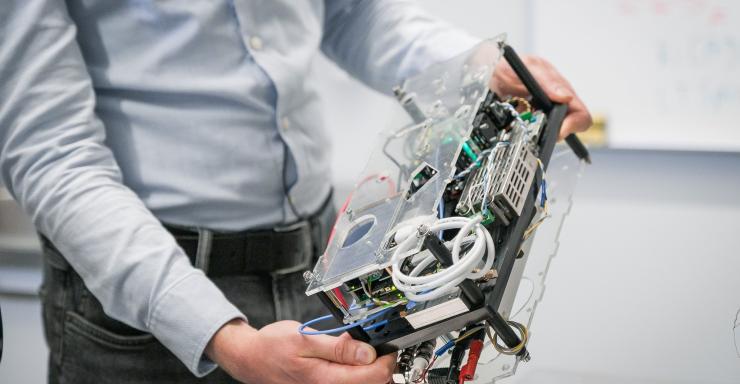
People came to see it. It is interesting to see such a device, which you can perhaps not quite touch, but observe from half a metre away and see the glowing lights and what is inside this quantum computer. We answered a great many questions – both about the specific device and about the capabilities of quantum computers in general, about the future and future predictions. This computer has a capacity of three quantum bits. The threshold at which a quantum computer can no longer be simulated is around 50 quantum bits. The most powerful quantum computers have a few hundred [quantum bits]. This particular quantum computer cost around 60 or 70 thousand [euros].
The most powerful quantum computers are not so easy to buy. Their purchase usually involves a separate agreement between a country and a technology company.
The most powerful quantum computers whose prices are publicly known cost tens of millions. However, there have also been projects in which a technology startup agrees to relocate its operations to a particular country and build its first quantum computer there, receiving government support amounting to several hundred million in return.
What is the purpose of our first three-qubit computer?
We can create a quantum circuit with three quantum bits on a conventional computer and instruct the quantum computer to execute it. It can perform up to approximately one hundred operations with these quantum bits. For example, searching for information among four or eight entries in a computer's memory. These are very simple operations that we could actually perform even without a computer.
Therefore, it is more of a demonstration device intended for training students. In principle, everything that happens inside this quantum computer can be simulated not only on a conventional computer, but even on a sheet of paper using a calculator.
Where do you expect the first major practical breakthrough – in medicine, in the development of new materials?
Looking to the future, it is quite clear that the first breakthrough will be related to simulating physical or chemical processes, because these are quantum processes by their very nature. This is precisely the area where quantum computers have the greatest advantages.
I would rather bet on the development of new materials or battery designs. It seems to me that the atomic and molecular structures encountered there are simpler than those in medicine, so modelling them should require fewer quantum computing resources. Of course, molecules used in medicine can also be modelled with a quantum computer, but they are more complex. I predict that more powerful quantum computers will be needed for that.
When Artificial Intelligence Meets Quantum Computing
Could the two technologies – artificial intelligence and quantum computers – accelerate each other's development? Artificial intelligence could help create more powerful quantum computers, while quantum computers, in turn, could help develop more powerful artificial intelligence?
This is one of the big questions scientists are currently researching. Google calls its quantum technology research division “Google Quantum AI”, and the company has made combining quantum technologies with artificial intelligence one of its goals. It is also a priority for the European Union. A call for project proposals on combining quantum technologies and artificial intelligence is scheduled for January. So this is an area in which many are currently working actively.
At a simpler level, this is already happening. For example, artificial intelligence is being used to control quantum computer laboratory equipment to improve its performance. What a doctoral student did 20 years ago, adjusting various equipment parameters, is now being done by artificial intelligence.
That is the first stage. What the next stages will be is not yet entirely clear, but there is a great deal of interest. Quantum computers can perform certain tasks much faster than conventional computers. Meanwhile, where are most high-performance computing resources currently being used? In the development of artificial intelligence. That is why combining quantum computers and artificial intelligence is one of the goals of scientists and technology developers.
And when will this convergence happen?
This could be another way to train artificial intelligence models when the computing power of conventional computers starts to become insufficient. One of the biggest problems with artificial intelligence is that training and running models requires enormous computing resources.
The hope is that quantum computers could help in the future. Forecasts suggest that the computing power of conventional computers will still be sufficient until 2030. However, at some point, we could reach a limit where these resources start to become scarce. Then quantum computers might be able to take over some of the tasks that conventional computers will no longer have enough computing power to perform.
Will Quantum Computers Threaten Our Data Security?
Powerful quantum computers could break some of the encryption systems currently in use in the future. How serious is this risk to Latvia's security?
The risk is serious. The difference in computing power between current quantum computers and those that would be needed to break encryption is still very large. As I mentioned, simulating physical and chemical processes is the natural domain of quantum computers. The mathematics used in encryption is also well suited to them, although not to the same extent. Therefore, we will most likely first see a breakthrough in simulating physical and chemical processes, while breaking encryption will come later, as it requires greater computing resources.
This means that we still have time to prepare and replace the current encryption systems.
The transition to so-called post-quantum cryptography, which should be secure against attacks by quantum computers, is already planned.
If everything goes according to plan, we will not even notice these threats. By the time quantum computers are capable of breaking current encryption methods, we will already be using other encryption methods.
Are we currently preparing for this?
Yes, the only uncertain factor here is artificial intelligence. It is capable of creating not only new encryption methods, but also algorithms for breaking encryption. I think that in the coming months and years, we will see whether post-quantum encryption methods really are as secure against attacks using artificial intelligence as they are supposed to be.
Latvia's Quantum Ambitions
You once said that Latvia should become the world's smallest quantum technology superpower, but last year you expressed concerns that after the end of the Latvian Quantum Initiative, funding might become insufficient and the number of researchers would have to be reduced. What has happened since the initiative ended in June this year? Is Latvia able to retain world-class scientists and continue their work?
So far, we have been able to. However, a long-term support programme for quantum technology research, like those in many other countries, would certainly be beneficial to us.
This could be, for example, a national research programme. In the short term, we have solved the problem of retaining scientists thanks to several smaller projects. However, the question of our long-term position and the development of research remains open.
Has anything changed in how Latvia sets its scientific priorities? Do we support the best ideas or only those that fit into policy documents?
Scientific priorities – this is one of the major unresolved problems in Latvia's science policy, because essentially, we do not have scientific priorities; they are very vague. There is the Smart Specialisation Strategy, or RIS3, but the areas defined in it are extremely broad. Almost all exact sciences fit into one of them, while the social sciences and humanities largely do not. We still lack more specific, more targeted scientific priorities. And that is a problem that should be addressed in science policy.
We can see that in the grant system, where there are no thematic restrictions, the research fields that are mainly developed are those in which Latvia has historically had strong traditions. For example, various branches of physics, biomedicine and pharmacy.
Meanwhile, we have relatively little research in artificial intelligence, because historically it has not been a significant area of research in Latvia.
We have quantum technology research thanks to a fortunate combination of circumstances. However, if circumstances had turned out slightly differently, we might not have it either.
When an Algorithm Makes the Decision Between Life and Death
Drones, robotic systems and artificial intelligence technologies are being used increasingly widely in the war in Ukraine. Ukrainian officials have spoken about creating a “robot army”. How much of this is already a reality? Is artificial intelligence already capable of independently selecting a target and making the decision to kill a human being?
That is a question for a military specialist who is familiar with the situation in Ukraine. I suspect that we have already achieved this goal. I think the difference between theory and practice is very clearly visible here. On the one hand, there is the ethical principle that we must not entrust a robot with independently making the decision to kill a human being. On the other hand, there is the reality of war in Ukraine, where it is a matter of life and death, of survival.
People who are thousands of kilometres away from Ukraine can theorise eloquently about ethics, but Ukrainians do not have that luxury. They have to survive.
And I think that this need to survive forces them to use every possible means.
As far as I know, this “robot army” does not consist of humanoid robots, but rather automated unmanned tanks or drones capable of making decisions independently. Essentially, these are mechanised vehicles that select targets without human involvement. They are equipped with a computer with an image recognition system that analyses the surroundings and makes decisions based on the information obtained.
Here we can also ask whether a similar system might have been operating in the drone incident that took place in Latvia in May. Was the fact that the drone crashed into an empty oil tank merely a coincidence? Or was it an automated target recognition system that identified an oil storage tank?
Do you have your own theory about what happened?
Only that if a drone crashes randomly, there is an extremely low probability that it will hit an oil tank.
Moreover, two drones crashed into it.
That is why I think that some kind of image recognition system was at work in this case. We can logically assume that drones flying from Ukraine towards the St. Petersburg area have no way of maintaining communication with their operators. They do not send images of their surroundings back to Ukraine, but essentially make decisions independently.
Of course, the target is selected in advance, but whether the drone actually sees the correct target is determined by its software.
But if such an autonomous weapons system mistakenly kills a civilian, who is responsible – the person who uses it, the programmer or the manufacturer?
That is a very complicated question, and the answer would probably depend on the specific situation. An investigation is always carried out in such incidents. For example, if a spacecraft crashes, the person responsible could turn out to be the person who prepared it for launch, an engineer at the manufacturing company, or the company's CEO who ordered risks to be ignored.
I think responsibility could lie at any of these stages. And determining exactly where a mistake was made and who is responsible for it can be a very complicated investigative task.
Is Reality a Simulation, and What Does Schrödinger's Cat Know?
Elon Musk has suggested that we live in a simulation. The chance that we live in actual reality is only one in billions. Is there any scientific basis for such ideas? And would we even be able to prove that we live in a simulation?
I see no signs that we are living in a simulation.
I do not know how that could be proven, but I see no reason to believe it.
Where does Musk get such ideas?
Musk has a great many unusual ideas. Some of them eventually pay off with very high returns.
When talking about quantum physics, journalists usually try to weave in a joke about Schrödinger's cat. But I have a serious question: “Does Schrödinger's cat itself know that it is alive? Or does it have to wait until someone opens the box?”
Schrödinger's cat knows that it is alive. Essentially, it exists in a quantum state with two branches. In one, it is alive and aware of it, while in the other, it is dead. Since a dead cat is no longer conscious, we could not say that it knows it is dead. However, we do not know that. We are outside this quantum state and do not know which of the two states will be realised when we open the box.
In any case, Schrödinger's cat has become a very popular metaphor used in all sorts of contexts. You only have to look on the internet to see how much people like this analogy.
It is also a very widely used popular science analogy within the scientific community. I can tell you about all the jokes scientists make about quantum computers.
Can you give an example?
Quantum computer manufacturers naming their quantum computer models after cats. For example, a quantum computer called “Ocelot 1”.
The cat is used a great deal in various jokes among quantum scientists.
Just as surgeons have their own special sense of humour, do quantum physicists also have their own inside jokes?
Yes, another thing quantum physicists tend to joke about is Heisenberg's uncertainty principle.
What is it, and how can you joke about it?
Simply put, Heisenberg's uncertainty principle states that we cannot simultaneously know a particle's position and its momentum, or, to put it simply, its speed, with precision. If we know exactly where a particle is, we cannot know with the same precision how fast it is moving. Conversely, if we know its speed precisely, we cannot determine its position precisely. And this principle can be used in various jokes about everyday life.
For example?
That we either do not know where I am right now, or we do not know where I will be tomorrow.
Could the Universe Ever Repeat Itself?
What would you say about this: American theoretical physicist Sean Carroll and his colleagues published a quantum cosmology model this year in which the Universe, under certain conditions, could repeat itself exactly – with the same galaxies, people and events. Are such models merely mathematical exercises, or can they tell us something about the real Universe?
I simply do not know. I know that Sean Carroll is a sufficiently serious scientist, but I have not read about this particular model, so I cannot comment on it. A closed quantum system generally has the property that its state repeats itself almost exactly after some time.
If we describe such a system mathematically, the principles governing its evolution predict that at some point it will return to almost the same state.
The question is whether this principle can also be applied to an object as enormous as the Universe. As I understand this principle, the larger the system, the longer it takes for its state to repeat. And for a system as enormous as the Universe, this time should be extraordinarily long.
Approximately how long?
Well, a one followed by as many zeros as there are atoms in the Universe…
And would this happen infinitely?
It happens infinitely. If we are talking about the same effect that I am familiar with, then the recurrence happens infinitely, but it may not be exact, with slight variations. However, if we want a recurrence with smaller variations, we will certainly see it after a longer period of time. The state will be arbitrarily close to the initial state. It may not be exactly the same, but, as they say, tell me how close that quantum state needs to be to what it was in the beginning, and I will tell you when it will be that close.
In principle, could we someday be sitting here in this studio again, talking about these same questions? Or perhaps different questions, but repeating this conversation again?
Well, in principle, if the Universe is a finite-dimensional quantum system, then yes. If it is infinite-dimensional, then it might not repeat.
Is Consciousness Related to Quantum Physics?
Is consciousness a quantum phenomenon? Scientists Roger Penrose and Stuart Hameroff have proposed a theory that human consciousness could be linked to quantum processes in the brain. Is there any scientific basis for this hypothesis?
Yes, I read Penrose's book back when I was a student. At first, I found it interesting, but later I came to the conclusion that consciousness is most likely not a quantum state.
Why? Here we return to a problem we have already discussed several times. Quantum states can persist in microscopic or isolated environments, but our brains do not meet these conditions. Any quantum state in the brain would interact with its surrounding environment, and information would leak out of it. As a result, it would not be able to persist as a separate quantum state.
The brain is a very noisy environment in which various processes are constantly taking place, preventing such quantum states from being maintained.
Therefore, I believe that consciousness is more likely to be explained by processes of classical physics rather than quantum physics.
We are creating increasingly intelligent machines, approaching the era of quantum computers, and beginning to discover things that seemed impossible not so long ago. But do you think humanity itself is becoming more intelligent?
I would like to hope so. Humanity's ability to become more intelligent is certainly slower than our ability to create intelligent devices, but I still hope that such an ability exists.
Devices develop over years. Our wisdom as a society develops on a much slower timescale. It develops perhaps over decades, perhaps over centuries. I think that as a society, we are becoming wiser, but slowly.
Contribution from the Media Support Fund, financed by the Latvian state budget. TVNET GRUPA is responsible for the content of the publication. #SIF_MAF2026