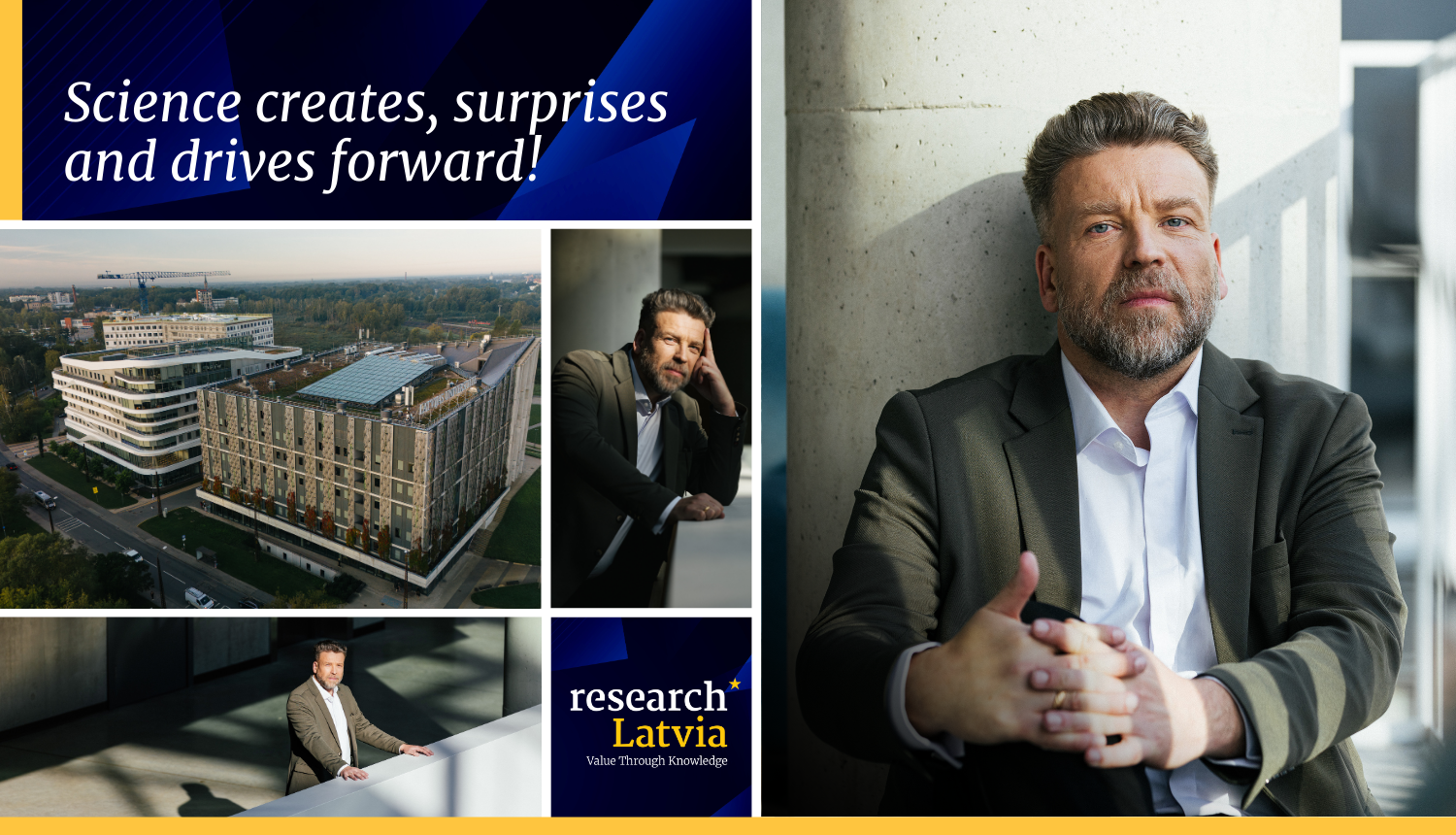
Philosophy is one of those branches of science that provides an opportunity to see the connections within society and to find answers to questions about human thinking, values, and cooperation. The study of this field reveals both the paths of past development and future perspectives. Dr. Phil. Raivis Bičevskis, a tenured professor at the Faculty of Humanities of the University of Latvia (UL), has worked extensively on these issues. He is a recognised philosopher in Latvia and abroad, whose work is dedicated to the study of social philosophy and to clarifying the internal logic of modern society.
As head of the Department of Philosophy and Ethics at the UL, Dr. Phil. R. Bičevskis outlines society’s portrait in his research, characterises its development directions, and reminds us that philosophy is “the art of reconstructing the whole, which is especially important even today.” The tenured professor emphasises that philosophy can create a link between science and society, providing a broader perspective on events and processes that affect each of us.
The humanities researcher is active in significant international and interdisciplinary expert communities and is a visiting professor at several prestigious European universities. He stresses that the University of Latvia is a unique place where it is possible to study both abstract ideas and complex phenomena that simultaneously concern nature and society: “This attracts people who are interested in the essence of things.”
An important part of Dr. phil. R. Bičevskis’ professional work involves inspiring students – he encourages young researchers to think critically and broadly, to seek connections between different disciplines, and not to fear questions that do not have immediate answers. His approach inspires the next generation not only to understand philosophy but also to use it as a tool for society’s self-understanding and for fostering dialogue.
"The problem I have been dealing with in recent years is the internal logic of modern society – whether it exists, whether we can discern inner regularities in the development of the last two centuries, which, once deciphered, allow us to draw the portrait of modern society and to look into the future, to see where it is heading,” explains Tenured Professor R. Bičevskis. “To see how far we have come, where we are as a society, and where we are as a university."
“The boundary between the known and the unknown is, of course, the boundary of fear, but also the boundary of hope; reaching this boundary is an adventure. A true scientist often dwells at this boundary, although crossing it happens only very rarely,” says Dr. Phil. R. Bičevskis.
His words remind us that the task of research is both to find answers and to ask questions that help society understand itself and move forward, making the humanities an integral part of contemporary research.
--
About the science calendar “Research Latvia 2025”
This activity is implemented within the ERDF project No. 1.1.1.1/1/24/I/001 “More Effective and Smarter Implementation and Management of Latvia’s Science Policy” carried out by the Ministry of Education and Science. Developers: the creative team of “Entuziasti Digital” Ltd., including Mārtiņš Pavasaris, video director Kristaps Mozgirs, photographer Mārtiņš Goldbergs and the researchLatvia team.
Since 2018, the science calendar “Research Latvia” and traveling exhibition have been created to promote the visibility of Latvian researchers’ achievements, to strengthen public understanding of the importance of science, and to inspire young people to pursue science.