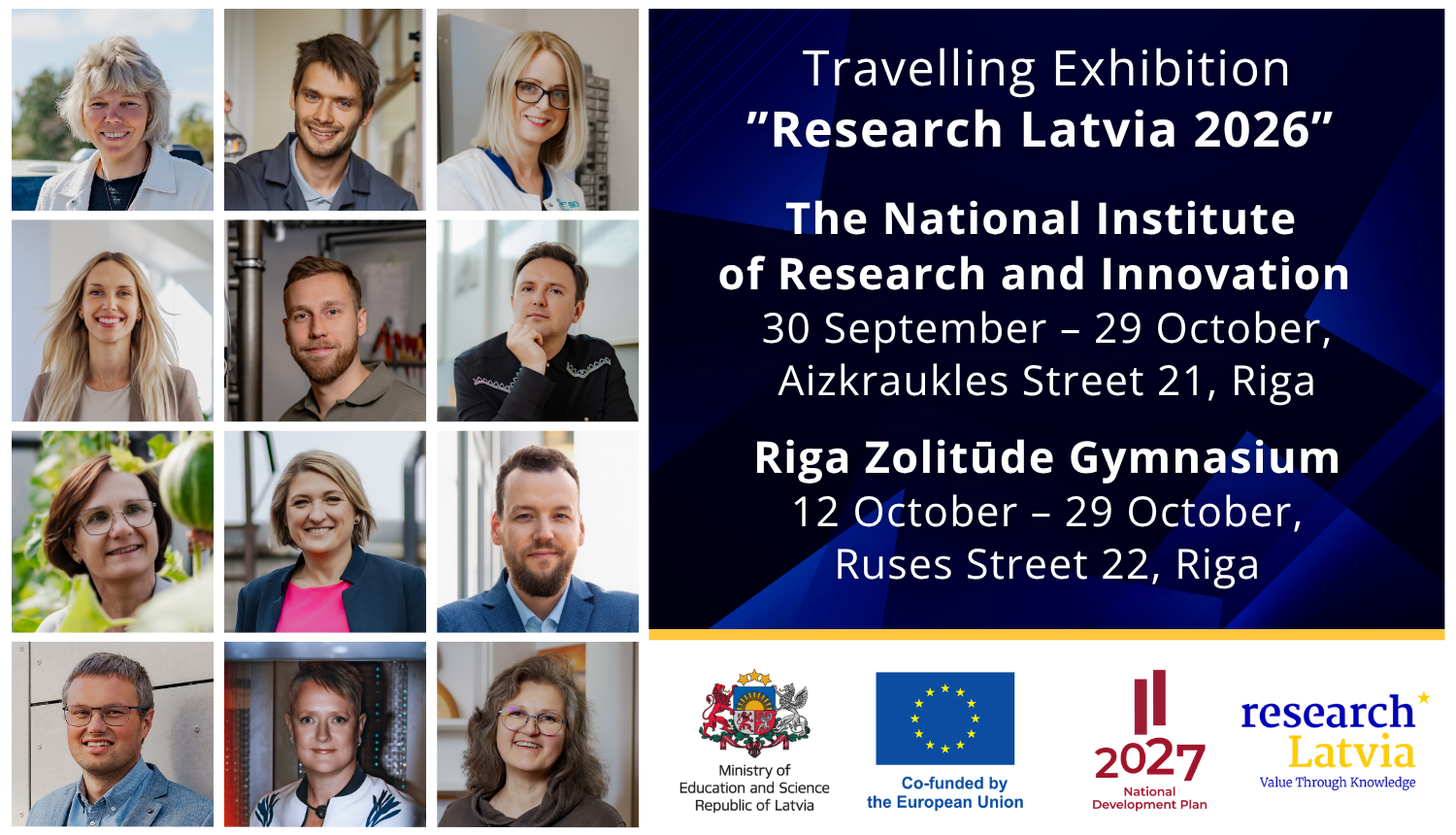
The travelling exhibition “Research Latvia 2026”, created by the Ministry of Education and Science, offers a unique opportunity to discover 12 outstanding Latvian scientists and their contributions to the development of society and research. In May, the travelling exhibition and the science calendar highlight the work and achievements of The National Institute of Research and Innovation (NIRI) emphasising the institute’s significance within Latvia’s research landscape.
The newly established National Research and Innovation Institute (NIRI) is formed by the Latvian Institute of Organic Synthesis and the Latvian Biomedical Research and Study Centre, creating a strong interdisciplinary base for drug development, biomedicine and advanced biotechnology in Latvia. NIRI aims to create a strong interdisciplinary base for drug development, biomedicine and advanced biotechnology in Latvia.
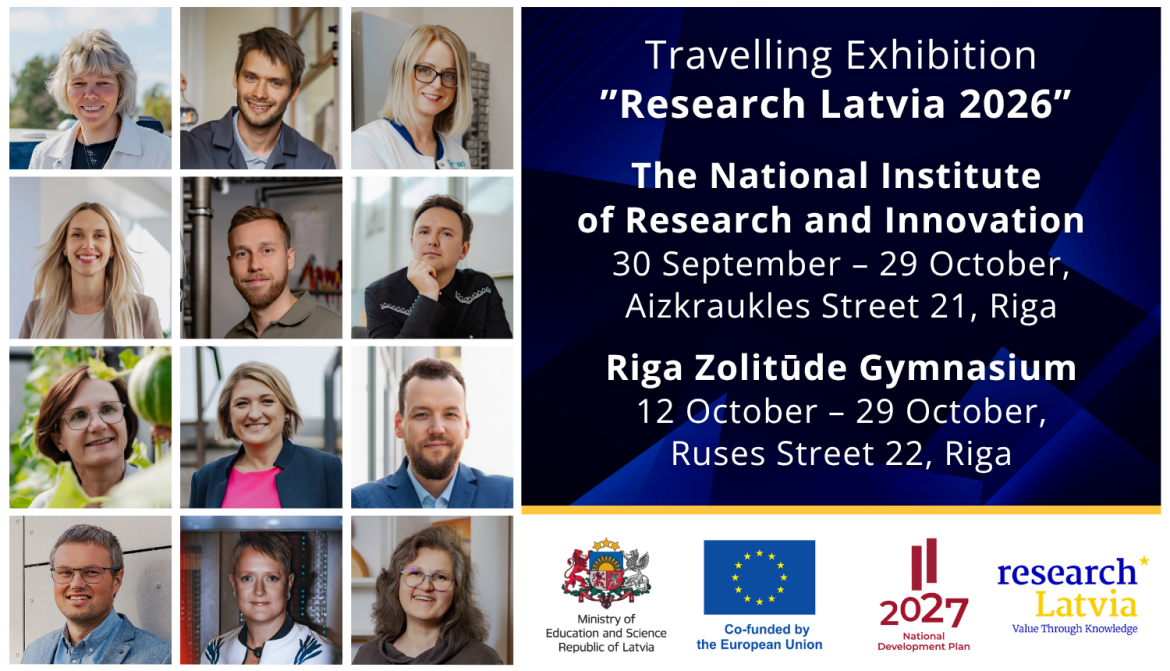
From 30 September to 29 October, the travelling exhibition will be on display at the National Research and Innovation Institute (NIRI), Aizkraukles Street 21, Riga, and from 12 to 29 October at Riga Zolitūde Gymnasium, Ruses Street 22, Riga.
Twelve science excellence figures, representing 12 leading Latvian scientific institutions, demonstrate the strength and diversity of Latvian science in the European Research Area. In collaboration with the science communication platform researchLatvia, the calendar and exhibition "Research Latvia 2026" reflect the questions studied by Latvian scientists that affect our society, environment and culture. Each scientist represents their unique research field.
"Science is not detached from society. It begins with human curiosity and ends with solutions that change day-to-day life,” admits Dr. chem. Gints Šmits, Leading Researcher and Head of the Laboratory of Active Compounds of the Central Nervous System at the National Institute of Research and Innovation.
Throughout the year, the traveling exhibition can be viewed at various higher education institutions, as well as other public and cultural venues across Latvia. By scanning QR codes, anyone interested can watch all 12 video stories. This initiative not only promotes science recognition but also strengthens society's connection with science.
After last year, when higher education institutions were included in the calendar, the Science Ambassadors initiative is being continued this year, with a focus on national research institutes. The 12 researchers featured in the calendar represent a wide range of research fields:
- Dr. biol. Ingrīda Andersone, Latvian Institute of Aquatic Ecology
- Ph. D. Edgars Kuka, Latvian State Institute of Wood Chemistry
- Mg. med. vet. Žanete Šteingolde, the Scientific Institute of Food Safety, Animal Health and Environment “BIOR”
- Dr. biol. Monta Brīvība, Latvian Biomedical Research & Study centre
- Ph. D. Edgars Butanovs, Institute of Solid State Physics, University of Latvia (ISSP UL)
- Ph. D. Jānis Ozoliņš, Institute of Literature, Folklore and Art of University of Latvia
- Dr. agr. Līga Lepse, Institute of Horticulture
- Mg. soc. sci. Ieva Leimane, The Institute of Agricultural Resources and Economics
- Ph. D. Jānis Ārents, EDI - Institute of Electronics and Computer Science
- Dr. chem. Gints Šmits, Latvian Institute of Organic Synthesis
- Mg. sc. comp. Baiba Kaškina, The Institute of Mathematics and Computer Science, University of Latvia
- Dr. silv. Dagnija Lazdiņa, Latvian State Forest Research Institute "Silava"