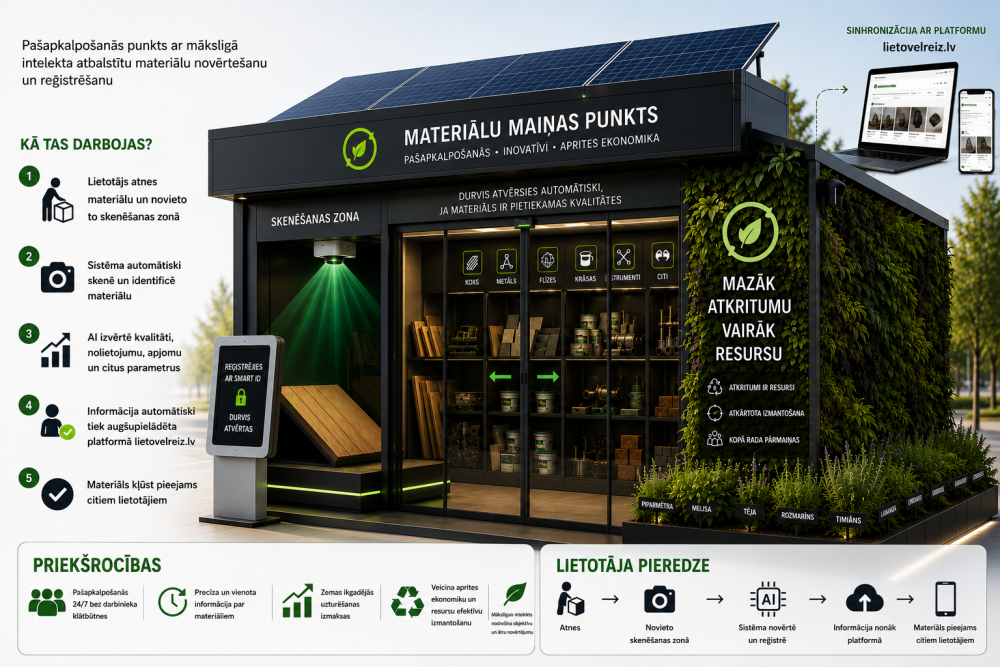
Students of the University of Latvia BA School of Business and Finance have developed an innovative prototype of a self-service point for the exchange of construction materials as part of an international research project, which, with the help of artificial intelligence, would be able to assess the quality of the materials brought in and make them available to other users, the higher education institution informs.
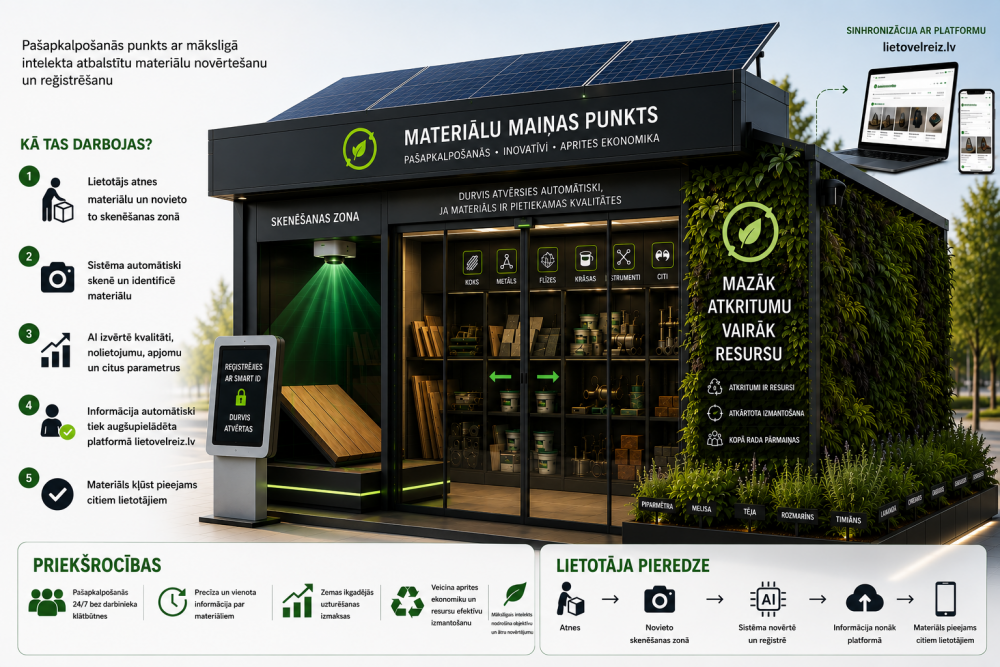
The model could help make this type of exchange point more popular and more conveniently accessible in everyday life, thereby reducing the amount of waste generated by construction and renovation work and promoting the circularity of materials. In the future, self-service points could be located closer to residents’ everyday routes — near shops, schools, workplaces or other easily accessible places.
The prototype was developed as part of the project “TransScale: Urban Resource Sharing and Circulation”, funded by the EraNet DUT Partnerships initiative. The University of Latvia BA School of Business and Finance is the lead partner of the project, which is being implemented in cooperation with partners from Norway, Denmark and Poland. The aim of the project is to study and develop new circular economy business models that could be developed in European cities.
The CleanR exchange point for construction debris, construction materials and renovation items in Stopiņi Parish, as well as the point at 5B Vietalvas Street, where a partial self-service principle is in place, was selected as the Latvian example in the project. The model developed by the students shows how the self-service approach could in the future be linked to a new or already existing digital platform, for example lietovelreiz.lv, using artificial intelligence solutions.
“The solution was based on a practical problem — what to do with leftover renovation materials, such as paint cans, tiles or other construction materials, which often end up as waste even though they could still create value for someone else,” says Inga Uvarova, Member of the Board of SIA “ArtSmart”, Head of the Management Studies Department at the University of Latvia BA School of Business and Finance, and Associate Professor.
The developed solution provides that a resident brings leftover renovation materials and places them in the scanning area. With the help of a camera and artificial intelligence, the system identifies the material, assesses its quality, wear, volume and other parameters, and then automatically transfers the information to the platform. In this case, the risks of fraud and the handover of unsuitable materials could be reduced through user authentication.
Finance students calculated how long it might take for the solution to pay off, while business students assessed how it could be developed more broadly and which companies could be suitable for its implementation.
“This clearly shows that, by combining an understanding of technologies with finance and business, we can create a prototype for a company that can be taken further to the public and developed, not only in Latvia, but also elsewhere,” says Uvarova.
She emphasises that this approach is also becoming increasingly important in the labour market. Knowledge of technology alone is no longer enough — companies need specialists who understand how innovations help businesses earn, grow and become more resilient.
“IT and programming skills have already become basic skills. It is clear that technologies are the very foundation, but there is no point in programming something new if we do not see how it will work, whether it will bring a financial return, whether the market will accept it and in what partnership the solution can be developed,” Uvarova notes.