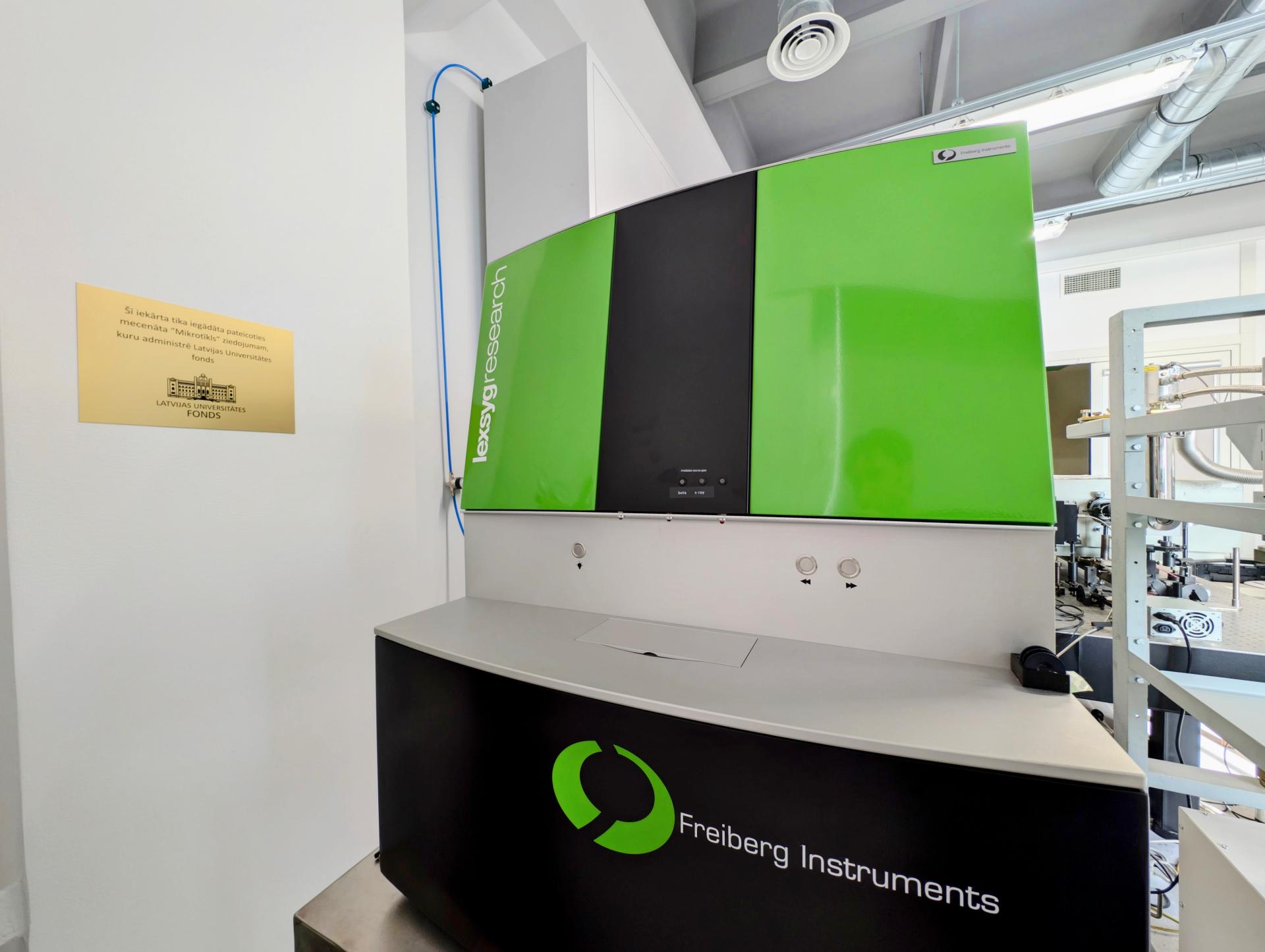
A Peltier cooling element has been installed on the Lexsygresearch TL/OSL reader at the University of Latvia (UL) Institute of Solid State Physics (ISSP) Laboratory of Spectroscopy. This new addition has enabled significant research results in several studies of long-persistent luminescence materials. This equipment has allowed for the rapid development of several research directions – defect analysis in solids, characterization of Long-persistent luminescence luminophores and investigating the properties of dosimetric materials.
![Lexsyg[22675].jpg](/sites/default/files/styles/article_embed_image/public/2025-02/Lexsyg%5B22675%5D.jpg?itok=yZy8LyyT "Lexsyg[22675].jpg")
“High-precision measurements of this type can currently be performed only in a few places in the world, including the University of Latvia. We can compete in the field of the research opportunities offered by other countries. The modification of the equipment allows us to improve the quality of research and significantly expands the range of materials and problems to be studied. Such laboratory improvements expand Latvia’s research capacity, as well as provide the opportunity to attract new scientists and students,” says Dace Ņilova, Research Assistant at the UL ISSP.
Long-persistent luminescence materials are being studied worldwide. Currently, one of the main applications of such materials is in emergency signs that continue to glow in the event of a complete loss of power. In recent years, more and more information has emerged about other uses, such as biomedical imaging, road signs, anti-counterfeiting labels, and others. Implementation of this potential requires a deeper understanding of the properties of long-persistent luminescence materials, and such research is being carried out at the UL ISSP Laboratory of Spectroscopy.
D. Ņilova explains that in many studies related to research and characterization of materials, it is important to perform measurements under the conditions below room temperature. The ability to carry out thermally stimulated luminescence (TSL) measurements at low temperatures allows for a more detailed characterization of the mechanisms characterising performance of long-persistent luminescence materials. However, it was not possible to perform such experiments using the standard configuration of the laboratory’s Lexsygresearch TL/OSL reader.
The support of the UL Foundation’s patron “Mikrotīkls” Ltd., the device has been modified, and it provides the ability to perform TSL measurements in the temperature range from -40 °C to room temperature.
The Lexsygresearch TL/OSL reader provides a wide range of materials’ research capabilities using TSL and optically stimulated luminescence (OSL) phenomena. Applications of the equipment include solid-state structural analysis, establishing the age of materials, research of radiation-induced effects, object authentication, and other studies.
Modifications made to the equipment have ensured obtaining highly appreciable results, thus the research results can be augmented with measurements of cathodoluminescence and X-ray luminescence. It is also possible to use ultraviolet radiation for excitation of the material.
Research employing the enhanced equipment has yielded significant scientific results in several studies, which have been reflected in scientific publications:
- “Luminescent properties of near-infrared-emitting Cr3+-activated beta-Ca3(PO4)2”
- The influence of thermal treatment on X-ray-induced effects in magnesium whitlockite”
- “Role of Paramagnetic Aluminum Hole Centers in UV–C Persistent Luminescence of Ca2Al2SiO7:Pr3+ ”