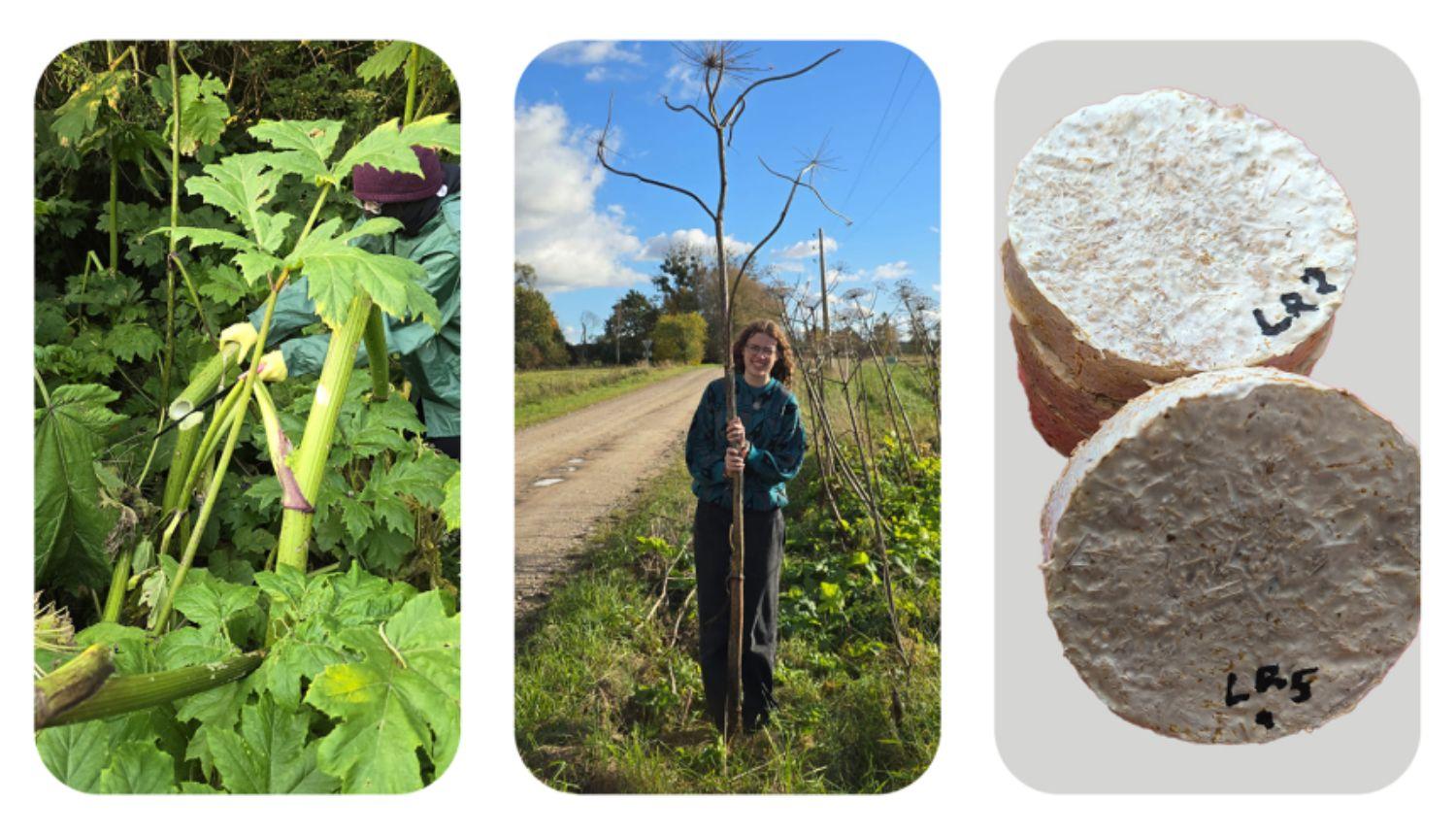
In Latvia, Sosnowsky’s hogweed (Heracleum sosnowskyi) has for decades been regarded as one of the most problematic invasive plant species. It threatens local ecosystems, poses risks to human health, and requires continuous control efforts. This widely recognised issue became the focus of a scientific research project by Katrīna Grīnfīlde, an 11th-grade student at Riga Āgenskalns State Gymnasium, who approached hogweed from a different perspective—that of materials science.
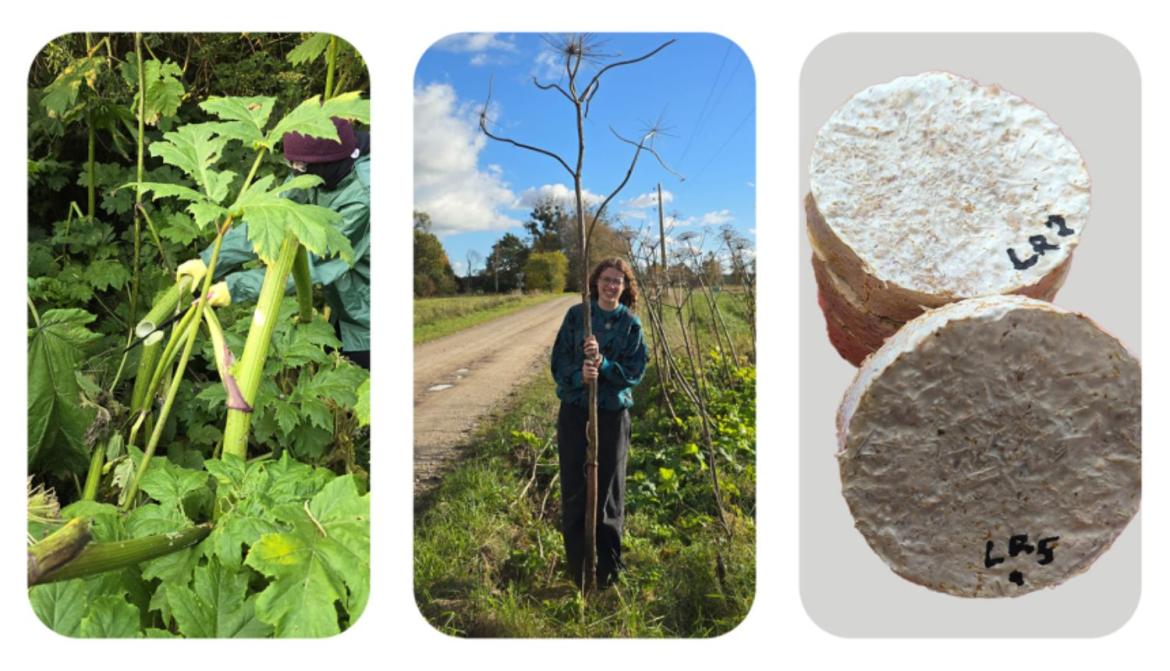
In her study, Katrīna investigated whether Sosnowsky’s hogweed could be used in mycelium composites, which worldwide are being researched as alternatives to synthetic packaging and insulation materials. The experimental work was carried out at the Latvian State Institute of Wood Chemistry under the supervision of Dr. Ilze Irbe and scientific assistant Mikus Kampuss, BSc in Biology. Katrīna’s research project received the highest grade – excellent – at her gymnasium.
Scientifically Grounded Research with Real Experiments
The student’s project combined scientific literature analysis with laboratory work. The physical and chemical properties of hogweed were determined, including pH levels, water absorption capacity, and particle size distribution, while mycelium was cultivated and composite material samples were produced.
Special attention was paid to seasonal differences by comparing hogweed harvested in summer and autumn. The results showed that autumn-collected plants provided particularly favourable conditions for mycelium growth: in these samples, mycelium occupied up to 90 % of the structure, while in summer samples it reached around 76 %. This indicates that hogweed properties change seasonally and that the timing of harvest significantly influences the formation of biomaterials. The study concludes that Sosnowsky’s hogweed has genuine potential as a new raw material for the development of mycelium composites.
The Latvian Context: Why This Research Matters
The challenges posed by hogweed in Latvia are well documented in reports by state institutions. The plant is officially recognised as an invasive species, its spread is regularly monitored, and the public is informed about the health risks associated with contact between its sap and sunlight (State Plant Protection Service, 2022).
In this context, Katrīna’s research gains additional relevance. It not only analyses a scientifically interesting process of biomaterial development, but also demonstrates how a problematic plant can be viewed as a potential resource for research. The study itself stresses that using hogweed in materials science is not a comprehensive solution to the invasion problem, yet it offers a fresh perspective on possible applications and future research directions.
The Contribution of the Young Generation to Science
The project’s supervisor, leading researcher at the Cellulose Laboratory Dr. Ilze Irbe, emphasises:
"This research project demonstrates that secondary-school students are capable of carrying out methodologically sound, laboratory-data-based studies and engaging with topical scientific challenges. Katrīna’s work highlights both her interest in environmental issues and her ability to work with complex materials-science methods, statistical analysis, and well-grounded argumentation."
Katrīna Grīnfīlde’s work exemplifies how cooperation between schools and research institutes enables young people to take part in current scientific processes and to develop research with practical relevance. Such projects not only build and strengthen links between education and research, but also inspire interest in the natural sciences and engineering among young people.