The opportunity to work at the European Space Agency (ESA) seems like a dream come true to many. For Ventspils University of Applied Sciences student Mārtiņš Leimants, this opportunity became a reality when, a year ago, he began a one-year internship at the European Space Agency’s ESTEC technology centre in the Netherlands – one of ESA’s most important research and technology centres. As the internship was drawing to a close, the European Space Agency recognised Mārtiņš’s professional performance and offered to extend the internship for another year. This is a testament to his knowledge, the work he has invested, and his ability to operate successfully in an international environment.
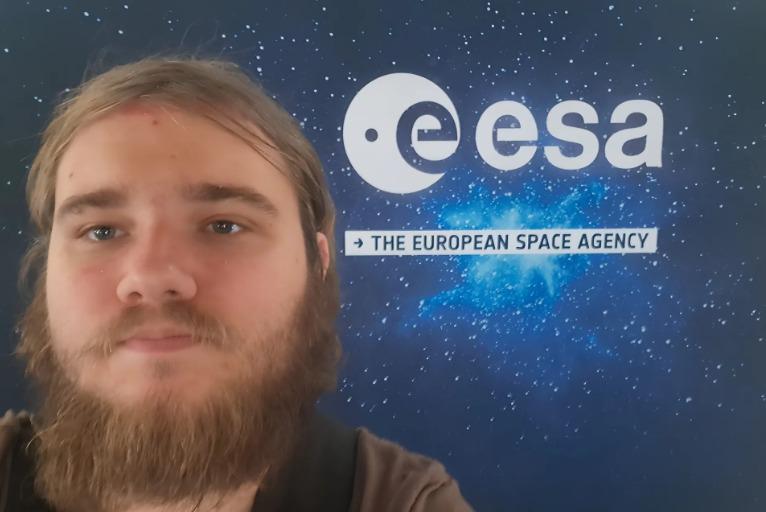
Over the past year, Mārtiņš has not only improved his professional skills but has also worked alongside world-class specialists on a daily basis and participated in the development of new technologies. His experience demonstrates that, with determination, knowledge, and perseverance, students of Ventspils University of Applied Sciences can also reach one of the world’s most prestigious organisations in the space sector.
An environment in which to continuously learn and grow
Although the European Space Agency is often associated only with engineers and technology, it actually employs specialists from various fields, and its organisational units are located in several European countries.
“I can share my impressions mainly from a technical perspective. ESTEC is a place with a very strong technological focus. Meetings are regularly held here in which experts present the latest technologies and innovations. I particularly like the opportunity to learn about previously unfamiliar technical concepts and ideas. ESA is full of highly capable people, and there are almost unlimited opportunities for professional growth here,” says Mārtiņš.
A working day between the laboratory and innovation
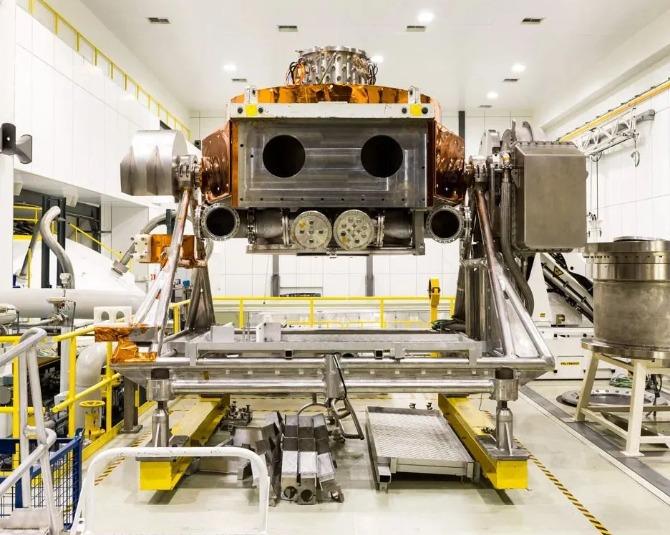
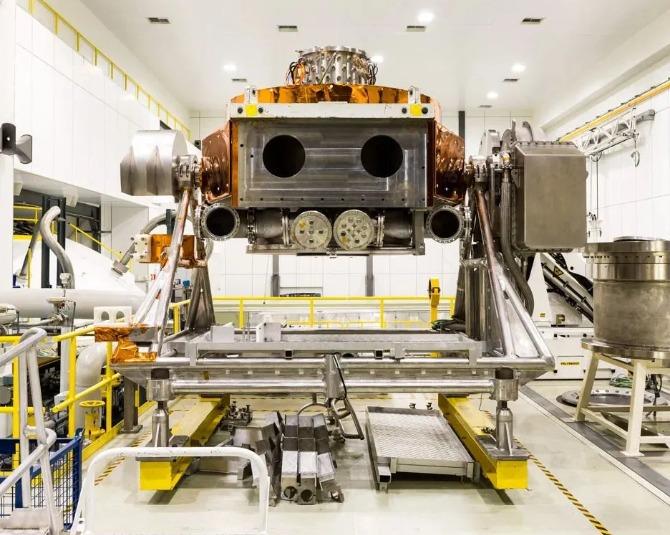
A working day at the European Space Agency begins early – most employees arrive between 8.00 and 9.00 a.m. Mārtiņš spends his working days at ESTEC’s Optics and Optoelectronics Laboratory, where the latest-generation image sensors for Earth observation satellites are tested, and optical communication solutions for future space missions are developed and tested.
The day-to-day work is largely related to testing various sensors and taking measurements in order to accurately assess their performance under different conditions. At the same time, electronics and software solutions are developed to support the testing processes and the validation of new technologies.
“One of the most exciting aspects of this work is the opportunity to work with technologies about which nothing is yet known to the wider public. It is rewarding to realise that, in a few years, they could become part of the European Space Agency’s newest satellites,” says Mārtiņš.
The working culture at ESTEC is also an important part of everyday life. The lunch break usually lasts about an hour, and colleagues often spend it together. It is then frequently followed by a shared coffee break, which provides an opportunity to discuss both current projects and everyday matters in an informal atmosphere.
The knowledge gained at Ventspils University of Applied Sciences became a solid foundation
Mārtiņš acknowledges that the knowledge and practical experience gained during his studies at Ventspils University of Applied Sciences became a solid foundation for his work at the European Space Agency. Although complex research tasks are carried out and world-class technologies are used in ESA’s day-to-day work, the fundamental engineering knowledge, electronics design, programming, and regular laboratory work acquired during his studies enabled him to become fully involved in the implementation of real projects from his very first days.
“Ventspils University of Applied Sciences gave me the opportunity to work with electronics in practice, and that is very important. In a laboratory, theoretical knowledge alone is not enough – you need to understand how real electronic systems behave in practice and what their physical limitations are. Things such as electromagnetic interference, signal quality, or various measurement effects are best learned by working in a laboratory yourself.”
It was precisely this practical experience that enabled Mārtiņš to become involved in the work of one of the world’s leading space research organisations without a lengthy period of preparation. At the same time, he emphasises that working at ESA means continuous professional growth and a readiness to acquire ever new knowledge.
“Over the course of the year, I have gained in-depth knowledge of the structure of image sensors, their testing methodology, and the evaluation of their performance in accordance with the requirements of the space industry. The more you learn, the more you realise how much remains unknown. That is also what makes this work so interesting.”
Curiosity and perseverance are the keys to success
For prospective students who dream of working at the European Space Agency or in another high-technology field, Mārtiņš has one main piece of advice – be curious and persistent. “Professors will not teach you everything, and theoretical knowledge alone will not be enough. Create your own projects, experiment, and ask yourself – why does it work or not work? This is exactly how the most valuable experience is gained.”
He emphasises that, in the technology sector, it is also important to learn to accept failure as an integral part of the work. “You have to expect that a solution will not always succeed on the first, second, or even tenth attempt. Sometimes it takes several days or even weeks to find the right approach. The most important thing is not to give up, to analyse mistakes, and to continue searching for a solution. Sooner or later, the work invested pays off, and that is precisely what makes the final result so valuable.”
Mārtiņš’s story demonstrates that the path to the European Space Agency does not begin in the Netherlands. It begins with a desire to explore, engage in practical work, and persistently seek solutions. Studies at Ventspils University of Applied Sciences also help future engineers build precisely this kind of foundation.