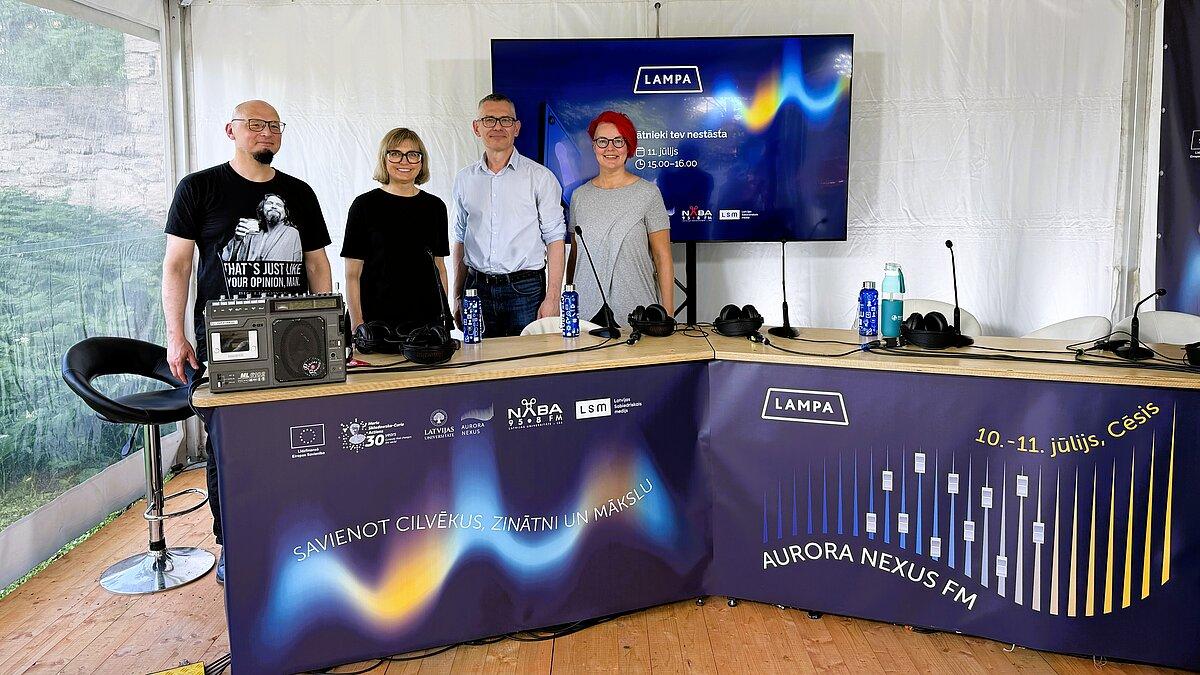
Science shapes modern society – it generates new knowledge, supports well-informed decision-making, helps address complex challenges and determines the directions of future development. These were the very topics explored by researchers at the Conversation Festival LAMPA 2026 in the University of Latvia’s (UL) “Aurora Nexus FM / Radio NABA Studio”, where they offered a behind-the-scenes look at the research process and discussed research ethics, trust in science and its importance in building a democratic and knowledgeable society.
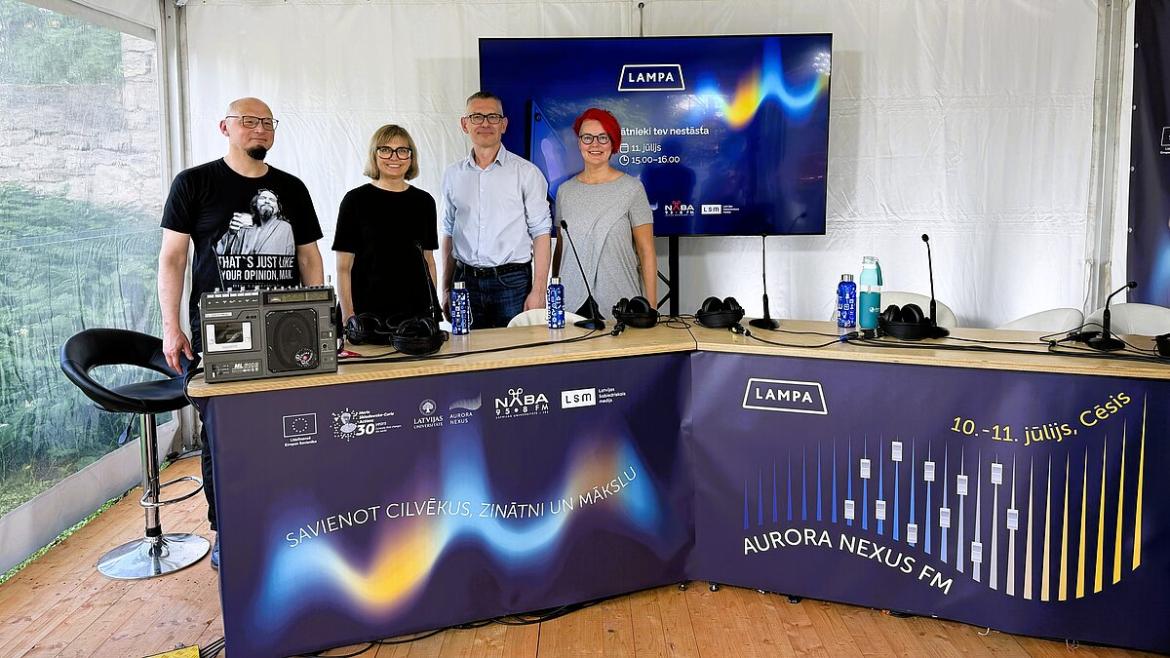
Opening the discussion, its moderator, Ivars Neiders, a leading researcher at the University of Latvia’s Institute of Clinical and Preventive Medicine, referred to 2024 Eurobarometer data indicating low public trust in science: half of European respondents, and 55% in Latvia, believe that scientists can no longer be trusted on controversial scientific and technological issues [1]. He invited the participants to discuss the reasons behind this attitude, the nature of the scientific process and the issues they believe receive too little attention in the public sphere.
Broader discussions about the reliability of science and public perceptions of it became particularly relevant during the COVID-19 pandemic. Public opinion was negatively influenced both by careless and false statements made in the public sphere and by the seemingly conflicting results of different studies at the time. Errors or misconduct in science can have serious negative consequences. Scientific work in Latvia is governed by the Code of Ethics for Scientists currently in force [2], which states that the process of scientific inquiry must be based on research ethics and the principles of discussion, and explains the various roles, duties and responsibilities of scientists.
Inese Čakstiņa-Dzērve, a lecturer at the Department of Biology and Microbiology at Rīga Stradiņš University (RSU) and a leading researcher at the RSU Institute of Oncology and Molecular Genetics, emphasised that the public rarely sees what goes on behind the scenes of scientific work – the planning of experiments, control mechanisms, data description and other processes that ensure the quality of research.
“Society wants fast, high-quality results, but to verify the reliability of the findings obtained in a study, the experiment or research process may need to be repeated several times. Each time, the conditions may be slightly different, and the results may therefore differ as well,” she explained.
“Trust in science can also be undermined by selective data use, or cherry-picking. Often, however, this is not a deliberate violation, but the result of interpreting complex and ambiguous data.” The chain of evidence must be fully traceable and grounded in data. It is precisely these time-consuming stages that make up the majority of research work.
An understanding of the research process is equally important in the humanities, agreed Associate Professor Andris Levāns, a leading researcher at the Department of History and Archaeology of the University of Latvia’s Faculty of Humanities. “Historical research is not merely the gathering of facts, but also an exploration of human self-understanding, culture and political identity, and society is rarely told about the failures, disappointments and long journey towards research results.” The narratives with which the humanities work change relatively little. “They preserve public trust and a certain sense of comfort. The same questions may receive unchanged answers,” he said. “However, there are also topics that require revision and a highly dynamic research process. Historical research generates questions about current events and anticipates future scenarios. There is a fear in society of history being ‘rewritten’, and for this reason we sometimes speak too little about it.”
Similar observations were shared by Professor Linda Daniela, Dean of the University of Latvia’s Faculty of Education Sciences and Psychology. She noted that in the social sciences, too, the entire research process is often not presented publicly – from the analysis of literature and data collection to the interpretation of the findings. She emphasised that these issues are widely discussed among researchers, but one of the main challenges is making this process understandable and engaging for the wider public.
Eurobarometer results show that 37% of respondents in Latvia believe that scientists have poor communication skills, while only 34% agree that scientists are open to dialogue with society [3]. This is the lowest figure in the European Union. “There is often simply not enough time for communication with the public,” Professor Daniela noted. “One possible way of conveying a researcher’s narrative could be through colleagues acting as science ambassadors.” However, it is important to remember that communication is not a one-way process. Society must also be open to listening to what scientists have to say and devote sufficient attention and time to these topics.
[1]European Commission. (2025). Eurobarometer 2024 - European citizens' knowledge and attitudes towards science and technology. ISBN 978-92-68-22156-3. DOI 10.2777/6040908. https://op.europa.eu/lv/publication-detail/-/publication/ed239fc4-e2b4-11ef-be2a-01aa75ed71a1/language-en
[2]Latvian Academy of Sciences. (2017). Code of Ethics for Scientists. https://www.lza.lv/par-mums/pamatdokumenti/64-zinatnieka-etikas-kodekss
[3]European Commission. (2025). Eurobarometer 2024 - European citizens' knowledge and attitudes towards science and technology. ISBN 978-92-68-22156-3. DOI 10.2777/6040908. https://op.europa.eu/lv/publication-detail/-/publication/ed239fc4-e2b4-11ef-be2a-01aa75ed71a1/language-en
The discussion series “Aurora Nexus FM / Radio NABA Studio” was implemented as part of the University of Latvia project “Aurora Nexus: Connecting People, Science and Art” (Project No. 101305570), funded by the European Commission programme “MSCA and Citizens: European Researchers’ Night and Researchers at Schools 2026–2027”.