Last autumn, the National Library of Latvia (NLL) hosted the culminating events of the programme Latviešu grāmatai 500 (500 Years of the Latvian Books). During the Riga Book Festival on 24 October, a document titled "The Right to Read." The Riga Manifesto was signed in NLL Ziedonis Hall, marking the beginning of a new phase of reading promotion and research. The manifesto highlights the importance and potential of reading and critical thinking in the context of the digital world and information threats. The manifesto and a national reading strategy are being developed on NLL initiative, involving an interdisciplinary team of experts and representatives of society. At its core lies the idea that reading is a fundamental right that must be ensured equally - regardless of income, education, health, or place of residence - placing particular emphasis on the right to read in Latvian.
"Today, reading books is becoming part of a particular lifestyle, a way to deepen everyday life and give it new value," concluded Latvian National Library researchers Maija Treile and Pauls Daija while preparing the programme for the 500 Years of the Latvian Book cycle.
Over five years, a broad interdisciplinary team of professionals worked to explore, celebrate, and promote our rights to the Latvian language, to knowledge, and to the pleasure of reading in many different forms, from the community photo campaign My Bookshelf to serious research, discussions, and exhibitions.
At the Latvian National Library, the cycle's most recent exhibition, vividly and provocatively designed Freedom Begins with a Book, is still on view. The jubilee year has ended, but as a new year begins, the themes raised by the exhibition have become even more relevant.
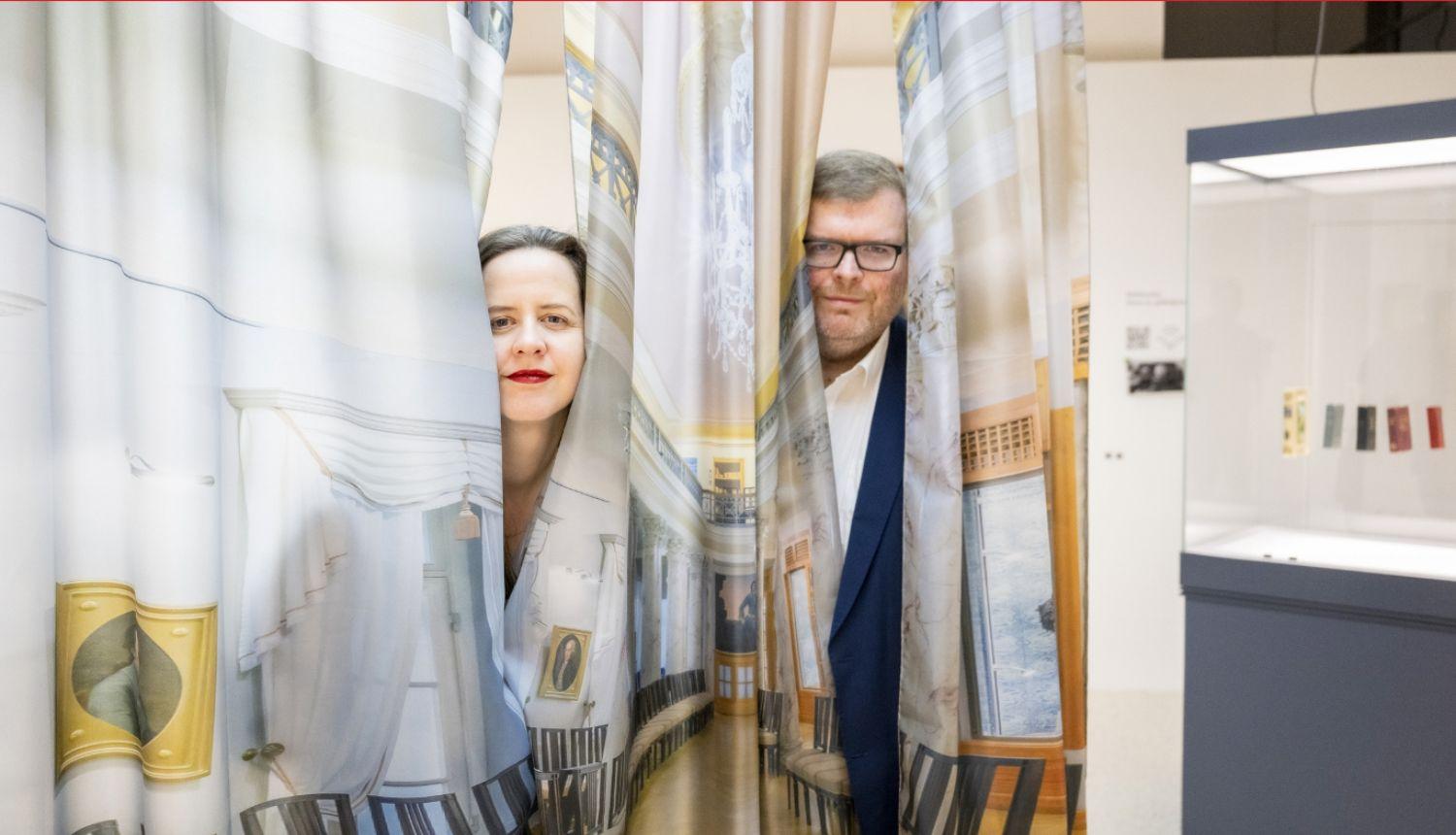
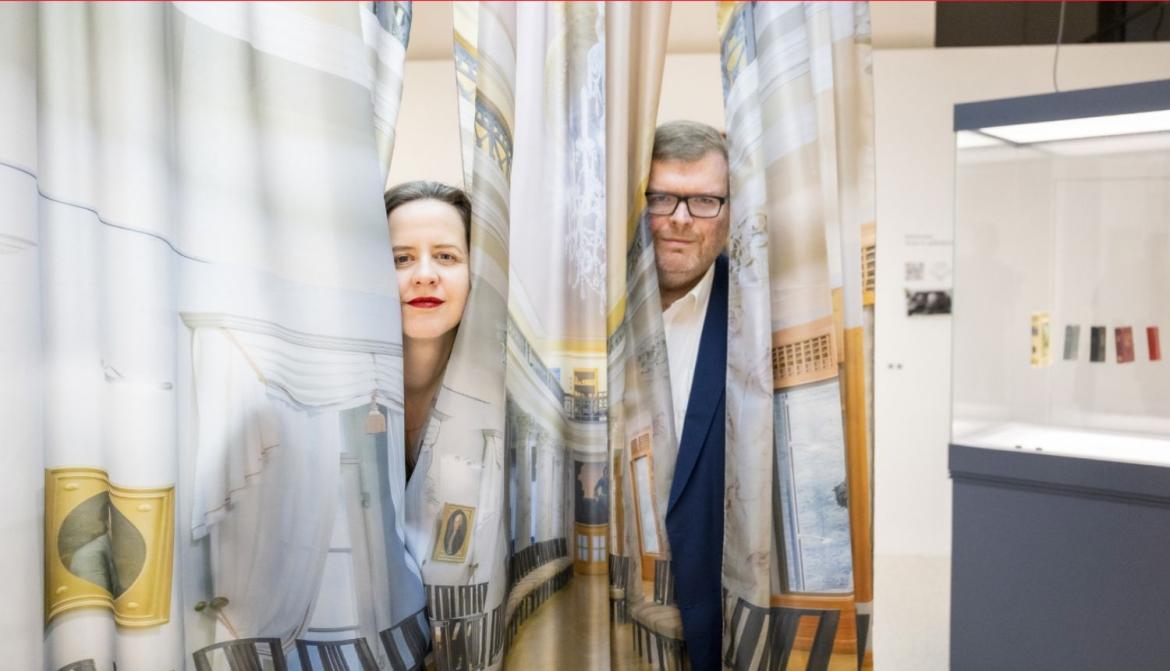
The first books in Latvian, Livonian, and Estonian were burned. Later, from the pages of books, we received the Word of God, lived through Countess Genoveva's suffering, learned how to grow potatoes and how to avoid viruses, and, finally, encouraged by the self-confidence of the written word in our own language, we founded our own state. How does the 21st-century Latvian relate to reading? How are reading habits changing, and is the book as an idea even capable of being eradicated? KDi invited to a conversation the head of the NLL Research and Interpretation Centre, Maija Treile, whose professional daily work involves studying contemporary reading habits, and the NLL's leading researcher, Enlightenment specialist Pauls Daija.
What were your goals and concerns, together with colleagues, when preparing the extensive five-year programme "Latviešu grāmatai 500", which culminated last November? What did you want to emphasise, and what did you want to avoid?
Maija Treile. It was important to me to overcome the "anniversary" mindset. The fact of an anniversary in itself is not so much worth talking about as it is a reason to dig deeper, what lies beneath it, what processes begin with it, how they continue today, what it gives both to society at large and to me very personally, what stereotypes exist or what missing fragments remain. My colleagues thought similarly, and we succeeded not only in avoiding a poster-level approach but also in digging deep and outlining broad interconnections.
Pauls Daija. The programme marking 500 years of the book was an idea of Andris Vilks, which was implemented under the leadership of the current NLL Director, Dagnija Baltiņa. Since we are not only a memory institution but also a research centre, we emphasised new directions in the study of book history, and I take great satisfaction in the monographs, conferences, and exhibitions created during the programme. We very much wanted historical research to resonate with contemporary issues, and it was important to us that the conversation on this topic not be primitive or provincial. That is why support for fundamental research in book history was crucial, as was our close cooperation with colleagues abroad.
It may seem that certain cornerstones of book history, the Herrnhuter manuscript literature, the Hartknoch publishing house that published Immanuel Kant's works, the first newspaper Latviešu Avīzes, Anšs Gulbis's legendary publishing house, and much else, were already well known, but they were illuminated anew. Most importantly, our research team managed to bring these events together into a single story of the Latvian book. The key message of that story, in my view, is that without the book, there would be no Latvian nation and state. It was precisely the written word that preserved the Latvian language and helped people recognise themselves as a single community at a time when they had no political power of their own.
One of the significant events of the 500 Years of the Latvian Book anniversary was the publication of "Tā pirmā grāmata" (That First Book), produced together with Estonian researchers and released almost simultaneously in Latvia and Estonia. Our book histories seem nearly identical. Does it look that way to researchers, too?
P. D. That First Book is a publication created under Toms Ķencis's leadership, with a large team involved. The books whose print run was burned in Lübeck in 1525 were both in Latvian and in Estonian, so it was important to emphasise that the first Latvian book was simultaneously also the first Estonian book. The First Book focuses on parallels in the book histories of Latvia and Estonia. Like the historical processes of our countries in general, these parallels are often surprisingly synchronous. The most significant benefit of this book, I think, is precisely the joint work of Latvian and Estonian researchers, because a substantial part of the material is published for the first time in such a context.
M. T. Speaking of publications, if someone looks back at Latviešu grāmatai 500 a hundred years from now, the contribution will be clearly visible precisely in the books published within the cycle. They are finished, polished examples. The diversity is quite broad: from volumes of LNB's continuing publication Zinātniskie raksti (Scholarly Papers), devoted to anniversary themes and consisting of explicitly academic texts, to the already mentioned That First Book, which is purposefully oriented toward a wider audience. It is a perfect format for students, upper-secondary school pupils, or anyone interested in learning about the parallels between Latvian and Estonian clearly and understandably.
Pauls's study of Baltic German pastors (Pauls Daija's monograph Apgaismības starpnieki. Vācbaltiešu mācītāji latviešu rakstniecībā. 1814–1848 / Mediators of the Enlightenment: Baltic German Pastors in Latvian Literature, 1814–1848), published in these years, is, on the one hand, high-level scholarship, but on the other, written in a language engaging even for a non-specialist. There are stories in it; you can feel life.
We also have exhibition publications, which reflect not only the exhibition topic but also the exhibition itself as a synergy of curatorial work, research, scenography, design, the programme of related events, and visitor experience. Exhibitions are another one of the programme's most visible directions. In a good way, the 500-year cycle does not end with the turn of the year. At the beginning of 2026, we will open several more publications explicitly created within the cycle.
An essential publication will be a timeline of Latvian book history, developed with the involvement of many researchers. The timeline continues right up to 2025 and the Riga Manifesto, The Right to Read, which marks the future path of book culture and reading. We have also just presented Teodors Līventāls's book Krišjānis Valdemārs latviešu bibliotēku nozarē (Krišjānis Valdemārs in the Latvian Library Sector). It was a manuscript kept in the library collection for almost 80 years, prepared and commented on in today's context by our colleague Jana Dreimane. Meanwhile, Viesturs Zanders has done significant work compiling evidence about the notable publisher Anšs Gulbis. It is important to us to highlight the role of libraries, publishers, and printers in the process, and to look not only at history but also at today, including by building cooperation with industry professionals.
P. D. I would risk saying that nowadays it is almost irresponsible for the history of the book to remain in an office or an ivory tower. Of course, for researchers, such an environment is very familiar, and it is also very familiar to me personally, and it plays an important role. But we are at the centre of change, and for many researchers it is no longer possible to focus solely on the past without considering contemporary processes. By this, I mean the changes in reading habits currently underway.
Following the Latviešu grāmatai 500 events, it seems you have successfully combined academic and popular-science levels without slipping into "easy language." Designers also deserve much credit for "packaging" old knowledge in a contemporary visual language. For example, I find Dārta Hofmane's design for That First Book more engaging than the Estonian version, which reverently stylises historical editions.
M. T. Yes, I do too. In both LNB publications and exhibitions, high-quality contemporary design is of utmost importance.
P. D. I was pleased with the design of this book because it visually demonstrates its content: while researching book history, we live in the present and look toward the future.
In the exhibition you created together, The Right to a Library, you chose a young couple as a guiding motif, putting into their mouths not historical paragraphs but an honest exchange of thoughts by contemporary people about changing reading habits, something everyone has heard in their family or among friends.
P. D. In any conversation about the past, it is important to speak not only about concepts and ideas, but first and foremost about people. When history is more centred on people, the conversation gains a different depth. Historians love the saying semper idem ("always the same"), because when looking back, it often feels as if what happens today is not entirely new. An American historian once said that the best crystal ball is the rear-view mirror, and knowledge of history can help you stay on the road.
A good example is changes in reading habits over the past and today, which young people discuss in the exhibition. Media competition and coexistence are not unique to modern times: the same scenarios have played out centuries ago. We also highlight this in Latviešu grāmatai 500: the complex transition from manuscript books to printed ones, and debates about harmful and dangerous reading at a time when reading became widespread. Historical distance allows us to see change more nuancedly and less dramatically than we do today. Without distance, it is easy to fall into black-and-white thinking, either sounding alarm bells or, conversely, declaring everything "progress." Those are traps that threaten us when we talk about digital media replacing books. History shows something else: the media never replace one another in a single moment. They coexist even in periods of change, forming new, unexpected combinations.
Today, too, a simple division into "good" and "bad" offers little. Instead, we should talk about balance, about how, while keeping up with the new, we do not lose what is essential and valuable. Here, a practical look back at the past can serve as a compass to help us avoid getting lost.
Do you agree with the view that we romanticise reading in earlier periods?
M. T. Clearly, we do romanticise it. It is good that reading also brings this emotional involvement. For people for whom reading is essential, it is certainly also a question of their existence in this world. Digital technologies are bringing significant changes, but we cannot say that there was a stable, very long period of 450 years when everything was great, everyone read and appreciated books, and now children only scroll on their phones. Comparing generations is a road we should not take while chanting "when we were growing up…" My generation's reading habits, and mine, are changing, too. I encounter difficulties concentrating; I see new challenges. In the past, living with longer texts and more linear reading felt natural. Now it already requires a more conscious commitment and time planning. At the same time, it is also an opportunity to give greater value to a process that we once took for granted.
It has become increasingly complex for people to be in "slow time" with themselves, the state that reading demands. At the most recent School Song and Dance Festival, a "quiet tent" was available for the first time. That shows that being calm and settling down have become extraordinary things.
P. D. I would say that this is one of the things libraries can provide. When you enter a library, you feel time begin to move more slowly. Not only slow food, but also a slow inner life, are significant values. The moment has come to talk about this, because it is no longer self-evident.
Fragmentary reading is becoming more dominant. In your view, should we strive by all means to preserve the skill of reading long books? In your exhibition, The Right to a Library, the young man answers the young woman's question: "What book are you reading now?" by saying that he is always reading something; is it really that important to read a book specifically?
M. T. It seems important to say, and it also comes through in our exhibition, that we are not against digital technologies. Everyone, both us and young people, must be able to navigate vast information streams today, respond quickly, take the necessary fragments, and critically analyse large volumes of information. It is essential to cultivate both skills. Deep reading and time dedicated to a book also help in the other domain.
Selective reading is increasing. How can deep reading be preserved and strengthened? Students' reading literacy is declining rapidly, and university lecturers find it challenging to teach because students' reading capacity and engagement with texts are weak.
M. T. Balance is important. This time is favourable for the book, as we can offer it as an answer. It is familiar, but we can rebrand it. People want to slow down; they want to think for themselves and live more consciously. It is no accident that meditation is so popular. We cannot live as if we only fly aeroplanes and eat fast food products. The invention of fast transportation does not negate the significant benefits we can obtain only by taking a walk.
P. D. I want to "advertise" the book like this: if you have difficulties with meditation, start with a book. It will not be the same thing, but it will help open the door not only to slowing down life, and it is no coincidence that the National Library has a meditation room where, under the guidance of Ilmārs Latkovskis, meditation events take place.
This process has always moved in cycles. Returning to the previous question about romanticising, I believe that in our attitude to the past, we are caught between two extremes that rather hinder than help understanding. The other extreme is the belief that history does not apply to us; both views are equally naive. I certainly would not want to romanticise past reading habits.
But we must consider something else: the period when the majority of society read and did so a lot has a beginning and an end. Researchers call the period from the mid-19th century to the mid-20th century the "golden age of reading." Clearly, with changes in media, that kind of mass reading will remain in the past, but does that mean reading will disappear? One version could be that we return to a time when reading is elitist. Drawing parallels is risky, of course, but when the electric light bulb was invented, many thought it would mean the end of candles. Yet the candle business is still thriving, not for lighting but for atmosphere.
Something similar appeared in interviews with young people that we conducted when creating The Right to a Library. We did not see book reading decreasing; instead, we saw the function changing. Book reading becomes part of a particular lifestyle, a way to deepen everyday life and give it new value.
In NLL discussions, an insight was voiced: today, an elite person is someone who has time to read. Do you agree? How would you put it who owns knowledge in the 21st century? Who has time to read?
M. T. Honestly, I do see a tendency for reading, deep reading, to become the domain of the elite. Of course, it depends on what we mean by "elite." Reading research has not been carried out systematically enough for us to compare the data.
Looking at colleagues' experiences abroad, specifically Germany, where surveys and studies are conducted regularly, you can see that among the part of society that reads many books, even in the 1990s, when the internet and technology entered everyday life, nothing changed drastically. These habits remain stable. We see that reading is linked to education level.
Some parents think carefully about ensuring their children read; wonderful children's books are published in Latvia and win various competitions. They have a reasonably wide readership; however, these are likely families where the parents already have strong reading habits or consciously cultivate them. Compared to my childhood, children now have a wider range of options connected with digital technologies, various forms of entertainment, and "edutainment." People have broad choices; in this abundance, it is crucial not to lose what is essential—our points of reference.
Everyone should have the right to read. That is the most important thing. We included it in the Riga Manifesto as well. Reading challenges can vary significantly across the Latvian diaspora abroad, people with reading difficulties, and people in less advantageous educational situations. A successful system has been created to reach children, for example, the Children's, Youth and Parents' Jury and read-aloud competitions, which NNL also implements. Itis excellent that these exist, but we need to think even more about instruments that apply to everyone.
For example, 15 minutes of reading at school, yes, the timetable needs rearranging, but it is not impossible. It already happens in schools, mostly in private ones. So there is a certain elitism. There is also a return to summer reading lists. We cannot expect a person who does not come from a family with a reading tradition or who does not have a motivating teacher or librarian at school to start reading on their own. Some teachers can compile wonderful lists, and those who cannot. It is essential to have an inspiring list that teachers, parents, and children themselves can use as a starting point.
These are things that do not require major funds, but the impact can be huge. It is also important to think not only about children's literacy and habits, but also about adults who are already outside the education system.
Recommended reading lists have become an extremely complex and contentious issue. What balance should there be between classics and contemporary original literature? What is more valuable for children to read, Staburaga bērni (Children of Staburags) or Kivirähk's Kaka and Spring, if it is not possible to read both?
M. T. For the 25th year of the Children's and Youth Jury, colleagues created a list of the most acclaimed books of the last decade, books that pupils themselves recognised and wanted to read. But there could also be a list of classics. There are excellent translations; there are great original works. Diversity is possible.
It leads nowhere if we say: you will be a faithful reader only if you have read Zaļā zeme (The Green Land) or Mērnieku laiki (The Surveyors' Times), because I did that when I was in school. Times change. It is important to remember that books are very diverse; they are not only fiction.
It may not be a bad idea to ask pupils in autumn to introduce the class to at least one book that truly captivated them, or even not a book at all, but an article on a topic that interests them.
P. D. Yes. Let's look at ourselves. Many of us began our reading journey with the simplest texts and gradually moved toward more complex ones. We started with entertainment, and at some point, we felt we wanted something more. Reading 19th-century classics today is not easy, and I assume that any self-respecting pupil considers the language and everyday realities of that time a significant obstacle. Not always, but often it turns out that those works should not be the starting point. The path to reading should begin with texts that speak to you, that draw you in, that "work" precisely in the present moment. And who knows, one day the classics may no longer feel like an obstacle. The opposite: unfamiliar words, contexts, and details will become interesting.
In childhood, in Eastern fairy tales about sheikhs and viziers, I didn't understand every third word, but if memory serves, it intrigued me rather than discouraged me…
M. T. To me, what is wonderful is that through a book you can learn that there is a lot you do not understand, but it is essential to move on, to learn to acknowledge and also endure your own not-knowing. In my family, we also read Latvian literary classics at an early age, which I may not have chosen later. I constantly emphasise that, especially when we talk about new readers, it is essential that a mentor accompany the book. It is not enough to create a stylish or less stylish corner at school and place books there; it is necessary to have a teacher or librarian who introduces them and shows that it is cool.
And new readers are not only children; colleagues' examples can also influence adult non-readers. There are workplaces where book clubs form. These are very inspiring examples.
P. D. A book is always part of a larger story. Looking at history, I am especially inspired by the Enlightenment, an age of conversations and letters. The world of books at that time was closely linked to a culture of conversation and the public sphere, including reading rooms, societies, libraries, and cafés, where strangers from different fields met to discuss and argue. This transition fundamentally changed the world: meaningful exchanges of ideas no longer took place only in courts or monasteries. In the Enlightenment, books were part of a broader ecosystem of public debate.
Today, when we speak about reading, new and somewhat different dimensions have emerged in which the book is not really replaceable. One is connected with developing empathy and critical thinking. The other, with the ability to stop, to slow down, which in today's rush often becomes almost a luxury.
In the light (or darkness) of artificial intelligence, how do you see the development of knowledge accumulation and also the need to read? Will the best publisher be the one who can order AI with the most precise prompts? Such books are already being published. How will we use the original, irreplaceable resources of the human being?
M. T. Both the book as an idea and the book as a form will remain. Almost ten years ago, when we created LNB's permanent exhibition The Book in Latvia, we ended with a floppy disk, a symbol of changing technologies that many no longer recognised even then. Museum educators always ask school groups, "What is this?" Most children have no idea, some kind of little notebook? With a book, even the oldest book, there is no problem of recognition.
With artificial intelligence, acceleration is picking up ever greater speed. It took centuries for the book to spread widely in society; radio and television spread much faster; the internet, in a few years; but artificial intelligence reached millions of users in just a few months. The acceleration is enormous. In this race, it seems necessary to emphasise reading, taking a breath, and the importance of the book.
Of course, we are running and want to use it all, but it happens so quickly that we cannot properly comprehend it, let alone study it. Also, in working with AI, the winners are those who can give more precise prompts, and that is directly connected with the ability to read and to formulate thoughts clearly. It is essential to use technology rather than let technology use me. Critical thinking is necessary so that we do not end up in some sludge; we must be able to verify information and find time for that process.
P. D. Thinking about the fact that we still live in a text-based world, one positive benefit that AI offers is the ability to reveal the actual value of bad text, namely, its absence. To produce primitive technical texts that mechanically reproduce language clichés, human presence is actually not needed. And here I would add, paradoxically: at the moment, nothing indicates this, but perhaps in the long term, there will be less harmful text, not more. AI can, rather than lowering the bar, highlight the demand for meaningful and human text.
If there is reason for alarm, I see it in the fact that we are increasingly poorly prepared to function in a complex world. In everyday life and in politics, we see that simplification, clear answers, and quick solutions are becoming more popular. Here, I know the risk that we will look at a complex world with increasingly simple eyes.
In this regard, I recall how Virginia Woolf, in the novel Orlando, described people in 16th-century England, in the time of Elizabeth I. Woolf wrote something like this: their lives were simpler; day was clearly separated from night; sunsets were redder, mornings brighter. Rain either poured or did not fall at all; the sun either shone brightly or total darkness prevailed. People, says Woolf, had not yet imagined our subtle shades, half-tones, and twilight. She is being ironic here, of course, but at the same time, she also describes the effect of deep reading: you discover that the world is not made up only of extremes, and you begin to notice nuances.
I want to refer to art historian Romi Bēms, who, in connection with a Baltic German writer, was asked: what is the benefit of talking about this forgotten person? His answer was: we can become a nuance richer. It seems to me, yes, nuance is wealth.
M. T. Yes, it is essential to realise that nuances are connected with the richness of language. It is indisputable that readers have a much richer vocabulary and the ability to form more complex sentence structures. This is already being studied, but we will yet see what impact artificial intelligence will have on language.