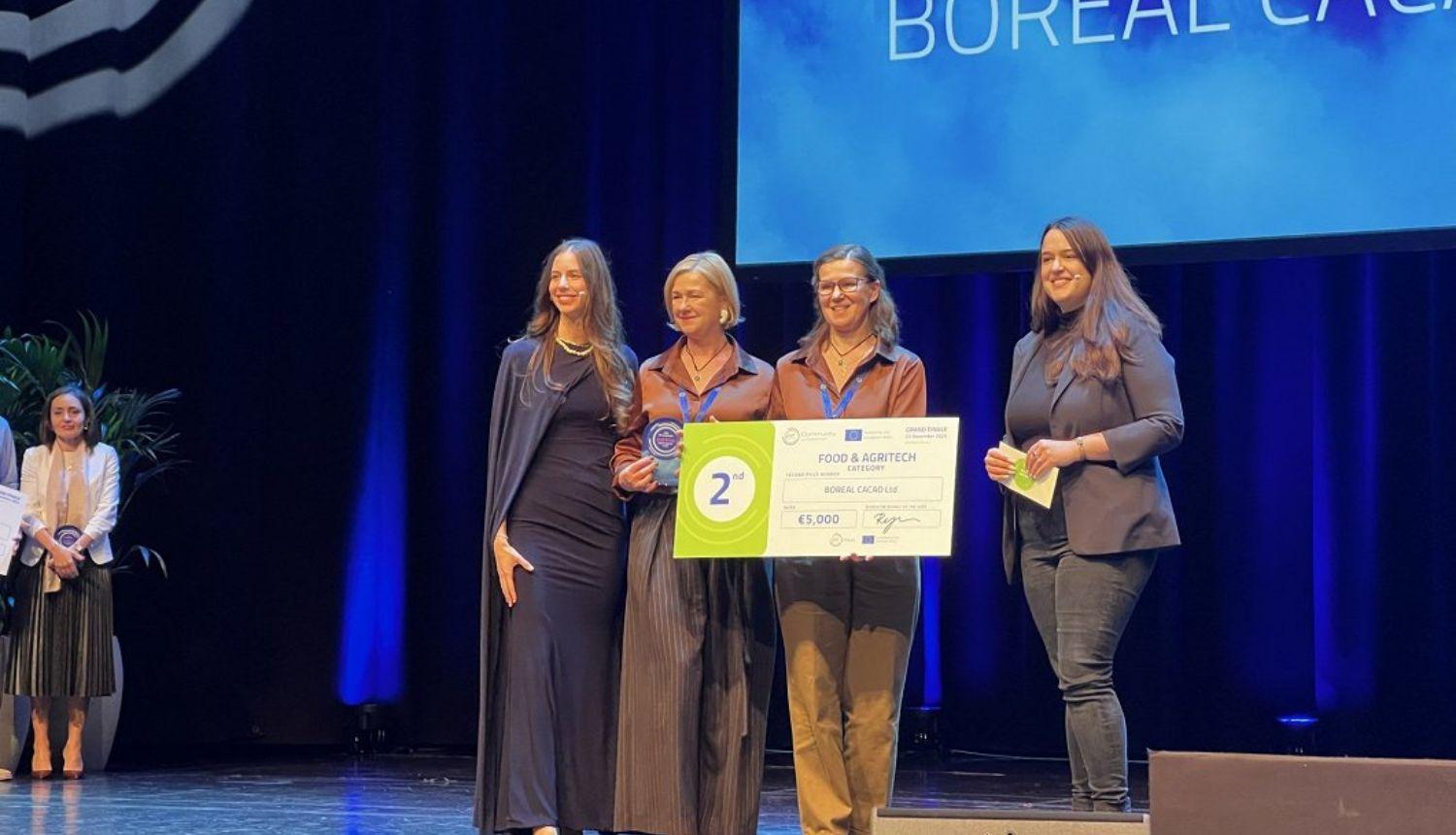
From an idea born during a market crisis to an award‑winning solution at the European level - Boreal Cacao share their experience of how the EIT Jumpstarter pre‑acceleration programme helped transform their idea into a viable business direction.
The journey of Boreal Cacao is a strong example of how a scientific approach combined with innovative thinking can create sustainable alternatives in one of the world’s most dependency‑driven food industries. The idea emerged at a time when the global cocoa market was experiencing sharp price fluctuations, supply‑chain disruptions and increasing climate‑related risks. The team realised that Europe’s heavy reliance on imported cocoa beans creates significant risks for both producers and consumers.
Co‑founder Zanda Ozola recalls that the real turning point came when the team recognised the potential of fermented legumes to create a fully fledged alternative to cocoa products: "At that moment, it became clear that it was no longer enough to simply ‘dream’ about this idea. It had to be developed through real research and experimentation."
The team - Zanda Ozola and Inga Āriņa‑Vilne - have developed an innovative confectionery product that closely resembles chocolate in both taste and texture, but is made from fava beans. The solution is based on a precise, laboratory‑controlled fermentation process that activates natural sugars and microorganisms, giving the product a familiar flavour profile without using cocoa.
Importantly, Boreal Cacao does not aim to replace chocolate itself, but instead to create a functional ingredient for B2B confectionery production - in applications where chocolate‑like texture, flavour and technological properties are required. This opens opportunities for companies to develop more sustainable, locally produced products with reduced supply‑chain risks.
However, the path to this realisation was not easy. One of the team’s greatest challenges was clearly defining what their product actually is and who it is intended for.
"Finding the right product form and market position was the biggest challenge - we knew we didn’t want to compete directly with chocolate, but to create a meaningful alternative for the B2B segment," explains Ozola.
Participation in the EIT Jumpstarter programme proved especially valuable at this stage. Mentors encouraged the team to articulate their idea simply, clearly and concretely before diving into spreadsheets and market projections.
The team acknowledges that the programme’s structure and tasks helped them answer essential questions: who the product is for, what problem it solves, and what the next proof of its viability should be.
"It’s precisely when you start speaking simply that confidence begins to grow," Ozola emphasises.
Currently, Boreal Cacao is at the prototype stage and preparing to launch pilot projects with B2B partners. Over the next year and a half, the team plans to continue technological research and complete the necessary validation steps to begin production in Latvia.
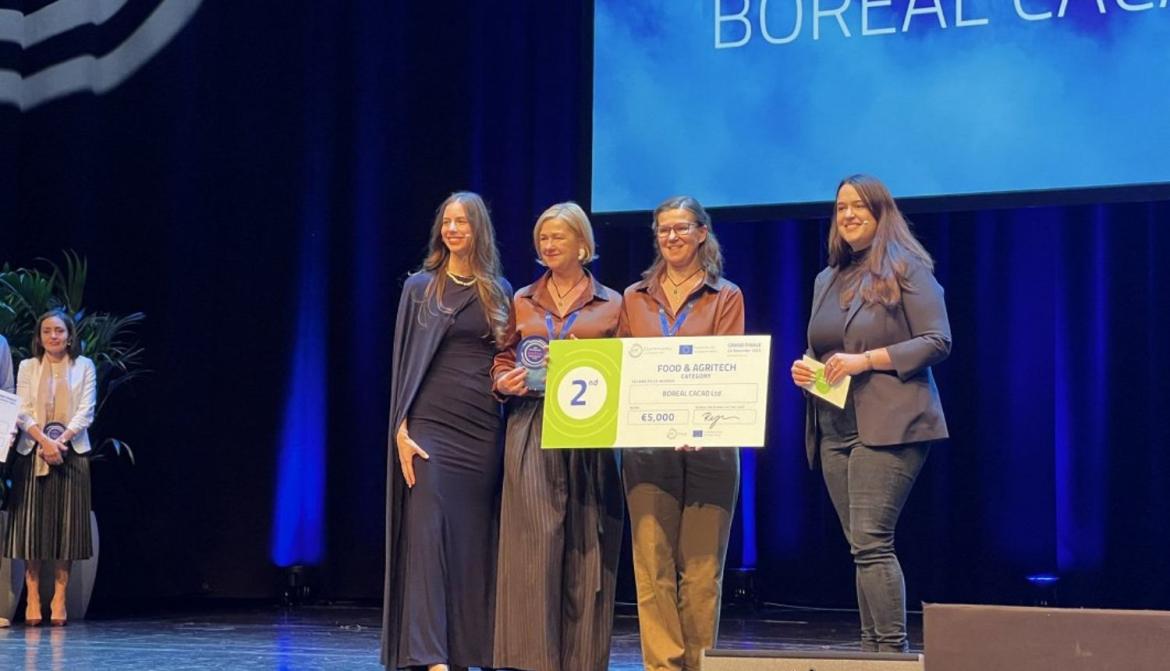
Their second-place finish in the EIT Jumpstarter final confirmed that the idea is understandable and valued beyond Latvia.
"It gave us the feeling that we’re not ‘too crazy’ pursuing this idea. It was a beautiful moment of validation for the entire team," Ozola recalls.
About the EIT Jumpstarter Programme
EIT Jumpstarter is one of Europe’s leading pre‑acceleration programmes, designed for early‑stage innovators, researchers, students and idea holders. The programme provides structured support for validating science‑based ideas, developing viable business models and preparing for start‑up creation. Participants receive mentoring and expert guidance from Europe’s innovation ecosystem and can compete for up to €10,000 in prize funding per thematic category.
This year, applications are open across six thematic areas: healthcare, food technologies, raw materials, energy, advanced manufacturing and mobility.
Only natural persons whose idea is not linked to a company registered before 1 January 2026 are eligible to apply. The programme is particularly well-suited for teams whose solutions are at an early development stage and could evolve into a start‑up during 2026.
Applications open until 8 May: www.eitjumpstarter.eu
Information Session – 17 April
To provide a deeper insight into the programme content and application process, an online information session will take place on 17 April, 15:00–16:30.
Interested participants are invited to register here: https://ej.uz/info_session
About EIT Community Hub Latvia
EIT Community Hub Latvia is the official national representation of the European Institute of Innovation and Technology (EIT) in Latvia. Its activities are coordinated by Riga Technical University (RTU) and supported by the Ministry of Education and Science and the Latvian Council of Science. The Hub’s mission is to promote the engagement of Latvian companies, researchers and students in European innovation networks and funding programmes.
About EIT
The European Institute of Innovation and Technology (EIT) is Europe’s largest innovation network, operating since 2008. It is an EU body and an integral part of the EU’s research and innovation programme Horizon Europe.
The EIT Community offers a wide range of innovation and entrepreneurship activities across Europe, including entrepreneurship education, start‑up support services, business development programmes and collaborative research projects.