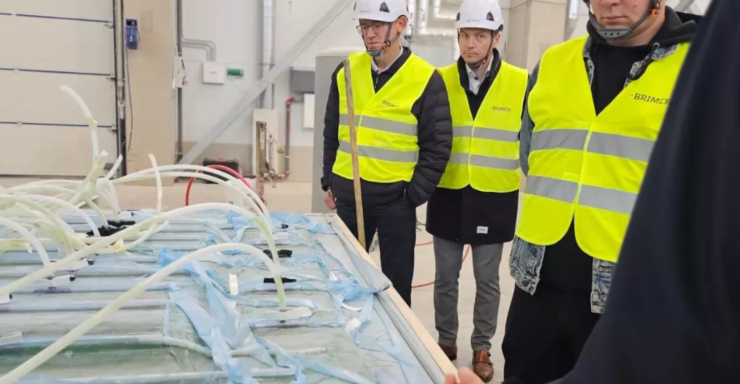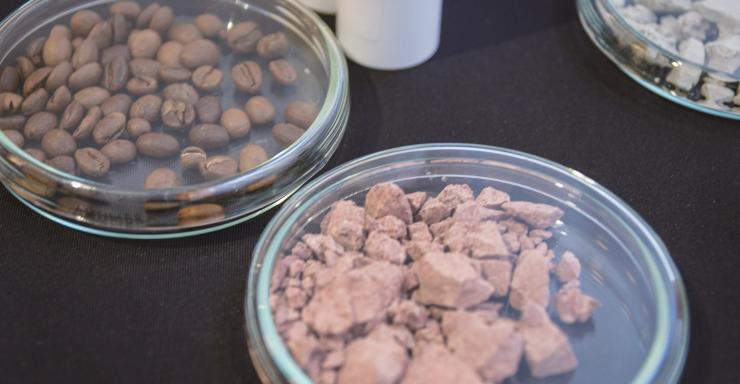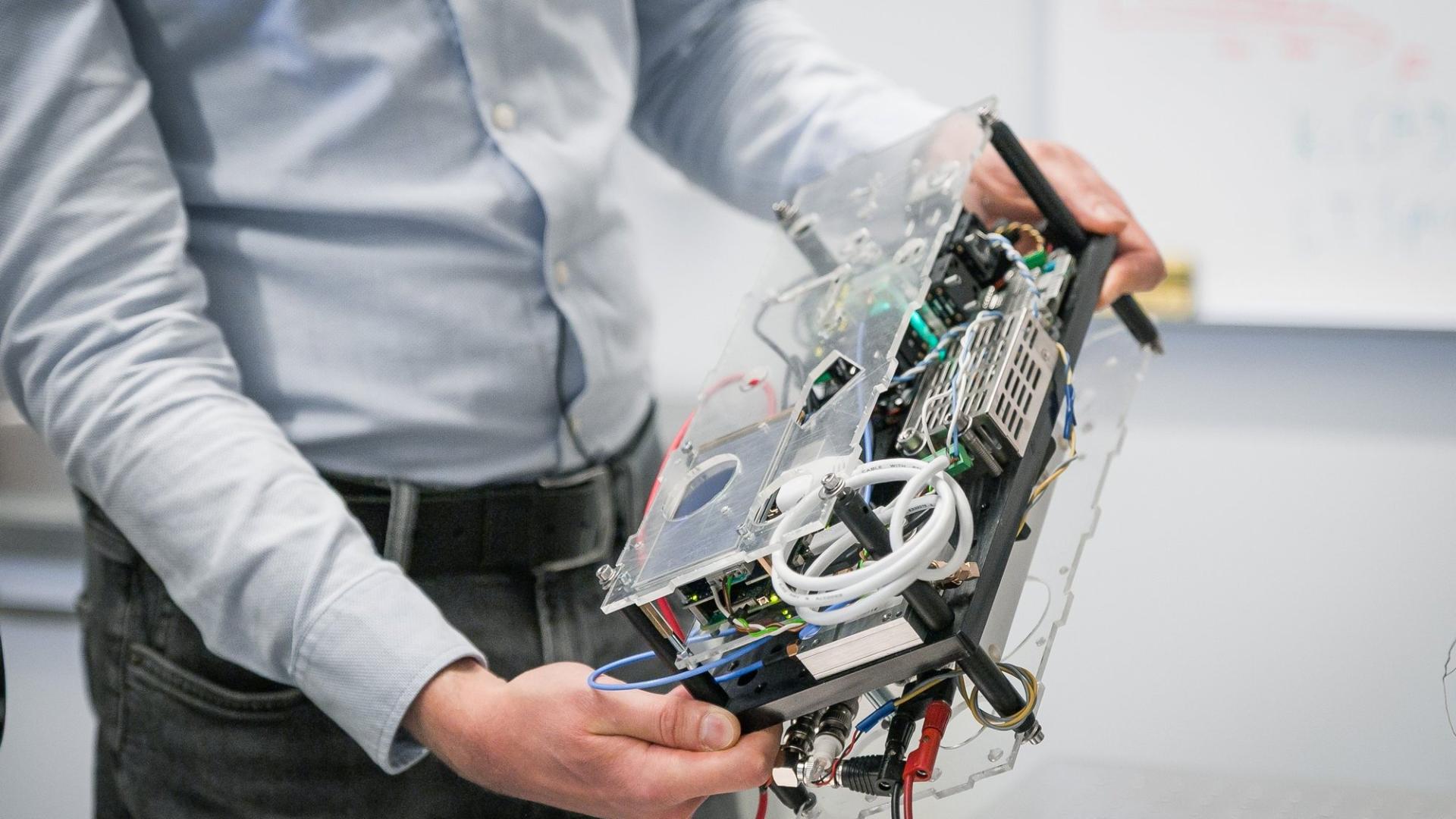
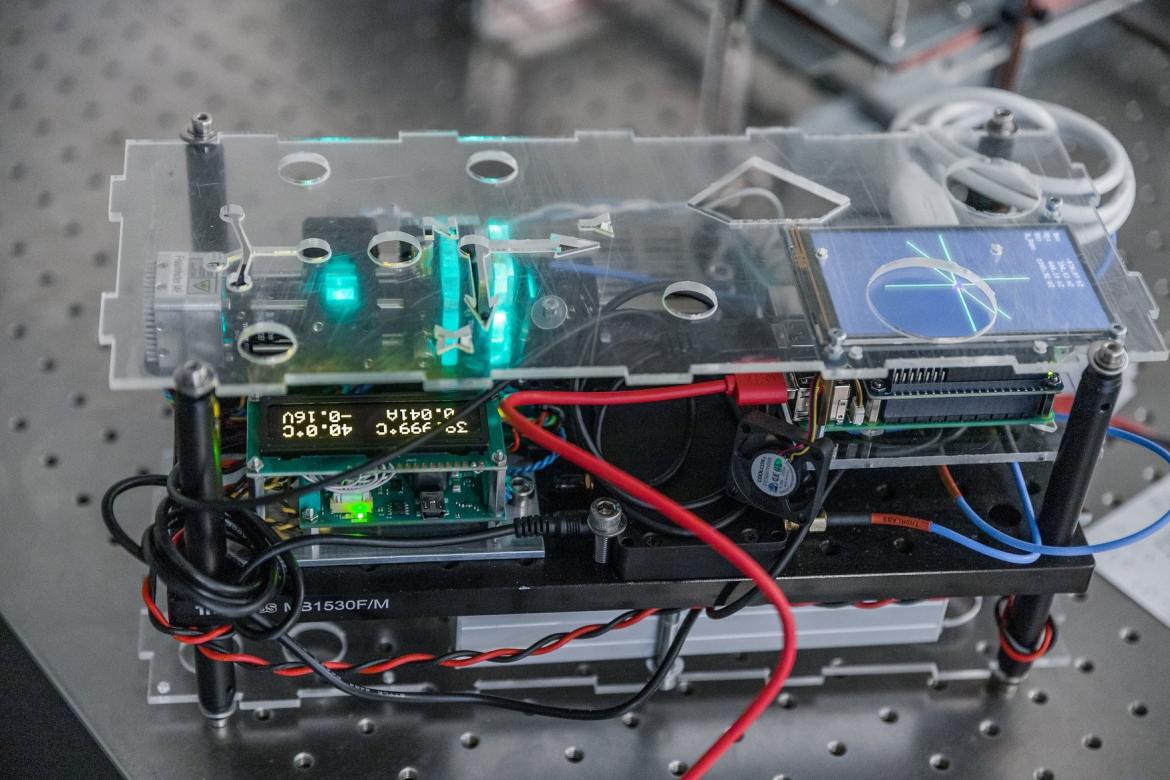
From the outside, it looks like a small, compact box that can be held in one hand, but inside it houses a quantum detector, a microwave generator, a laser, and an onboard computer. Behind its modest exterior lie more than ten years of research, quantum physics, diamond crystals, international cooperation with some of Europe’s largest defence companies, and a question that is becoming increasingly relevant today – how to determine one’s location accurately when the Global Positioning System (GPS) can no longer be relied upon.
The quantum magnetometer developed at the Laser Centre of the Faculty of Science and Technology of the University of Latvia (UL) is one example of how fundamental science can be transformed into a practically usable technology. The prototype device, developed within a European Defence Fund project, is capable of determining the strength and direction of a magnetic field in three dimensions, and in the future it could be used for navigation in situations where GPS is disrupted or unavailable.
However, this story did not begin with the European Defence Fund project. To understand how UL researchers arrived at this prototype, we need to go back more than a decade.
From Fundamental Science to Technology
The story of the UL magnetometer began more than a decade ago in the laboratory, with research into quantum coherent effects – phenomena that help explain how quantum objects can exist in several states simultaneously. This is a field in which the UL Laser Centre has been working for years and has built internationally recognised expertise, consolidated in several monographs, including publications by Oxford and Cambridge University Press.
“Until quite recently, we were convinced that we were engaged in fundamental science. Suddenly, quantum technologies have become a reality,” says Professor Mārcis Auziņš, Leading Researcher at the Laser Centre.
One of the research directions involves defects created in diamond crystals, which become highly sensitive sensors in quantum physics. The UL team has been working in this field for around 12 years, and it was precisely this long-term fundamental research that made it possible to develop the magnetometer prototype, which was taken to Paris in June this year for the final demonstration of the European Defence Fund project. A significant advantage was the experience accumulated beforehand – the Laser Centre had already been studying similar quantum effects in atoms for many years. The knowledge gained from atomic research also proved useful when working with defects in diamond, as their physical properties are similar in many respects.
The story of the magnetometer’s development is closely intertwined with the professional growth of one researcher. UL researcher Reinis Lazda joined the Laser Centre during his bachelor’s studies. His doctoral dissertation, defended in early June this year under the supervision of Professor Mārcis Auziņš, “Hyperfine Interaction of the Energy Levels of Nitrogen-Vacancy Centres in Diamond with Laser and Microwave Radiation in Magnetic Fields”, summarises more than ten years of research into diamond quantum systems, which has also formed the basis for the development of the magnetometer.
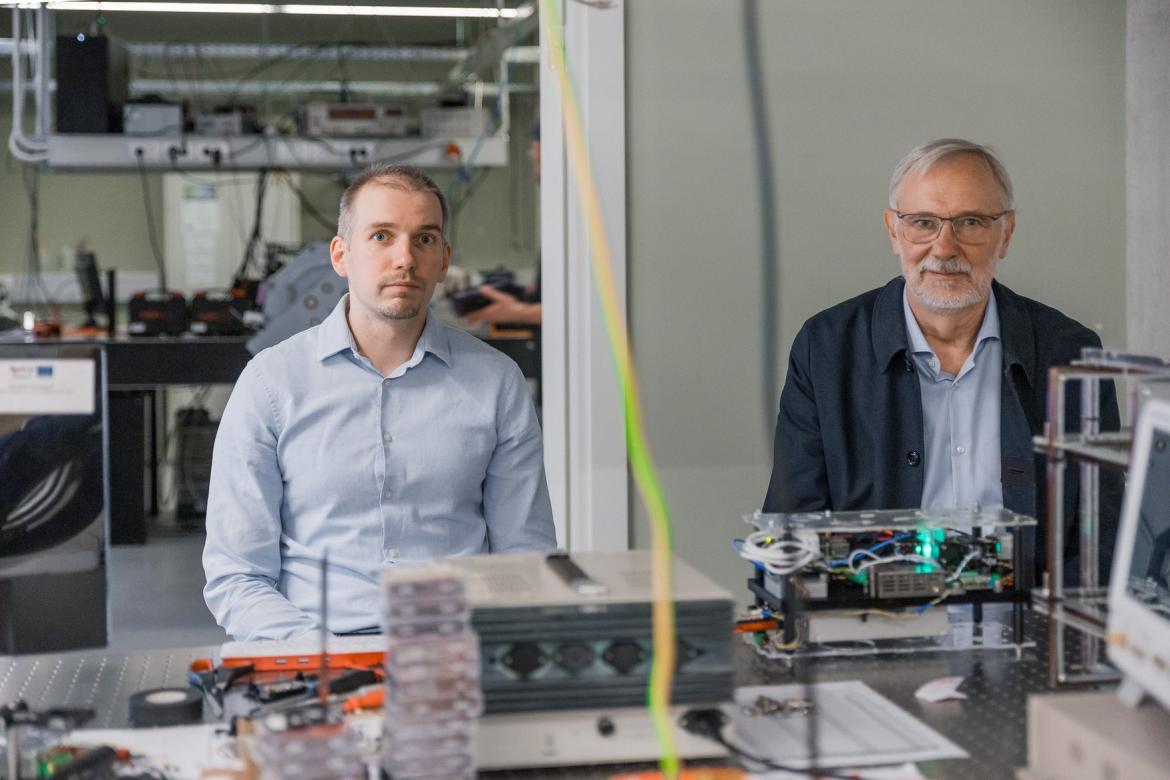
“The doctoral dissertation includes the fundamental research carried out at the beginning: how diamond glows, how finer structures appear within it, how it behaves in a magnetic field, and how the specific defect interacts with other defects in the diamond,” Lazda explains. It was precisely this fundamental research that paved the way for the first applied projects.
The first significant step towards the practical application of the technology was taken in a project with the European Space Agency, in which the UL team had to demonstrate that the knowledge gained through fundamental research could be transformed into a compact vector magnetometer for measuring magnetic fields.
After the project concluded, the Latvian Ministry of Defence also expressed interest, noting that the technology developed could be useful for other purposes as well. This led to UL being invited to participate in a broader European Defence Fund project, with total funding of €27.4 million and partners from several European countries, led by the French defence industry giant “Thales”. Although the project was allocated only three years, with a six-month extension, the UL team succeeded during this period in developing and demonstrating a functioning prototype of the device to the project partners.
“These are very serious partners – major defence companies from France, Germany and Italy, as well as several academic institutions,” Auziņš emphasises. Each participant had their own area of specialisation – from optical systems and lasers to diamond processing, microwave antennas and detection systems. “UL’s task was to build a prototype and demonstrate that it works. That meant combining all the experimental systems into a single functioning device,” Lazda explains.
A Small Diamond Doing a Big Job
To understand what makes this magnetometer so sensitive, it is necessary to look at the principle behind how it works.
At the heart of the device is a diamond crystal only a few millimetres in size. What matters most to the researchers is not the diamond itself, but the nitrogen-vacancy, or NV, centres created within it – quantum systems in which a nitrogen atom occupies the place of a carbon atom in the crystal lattice and is located next to an empty site (a vacancy in the crystal lattice). These defects are extremely sensitive to magnetic fields and make it possible to determine both their strength and direction.
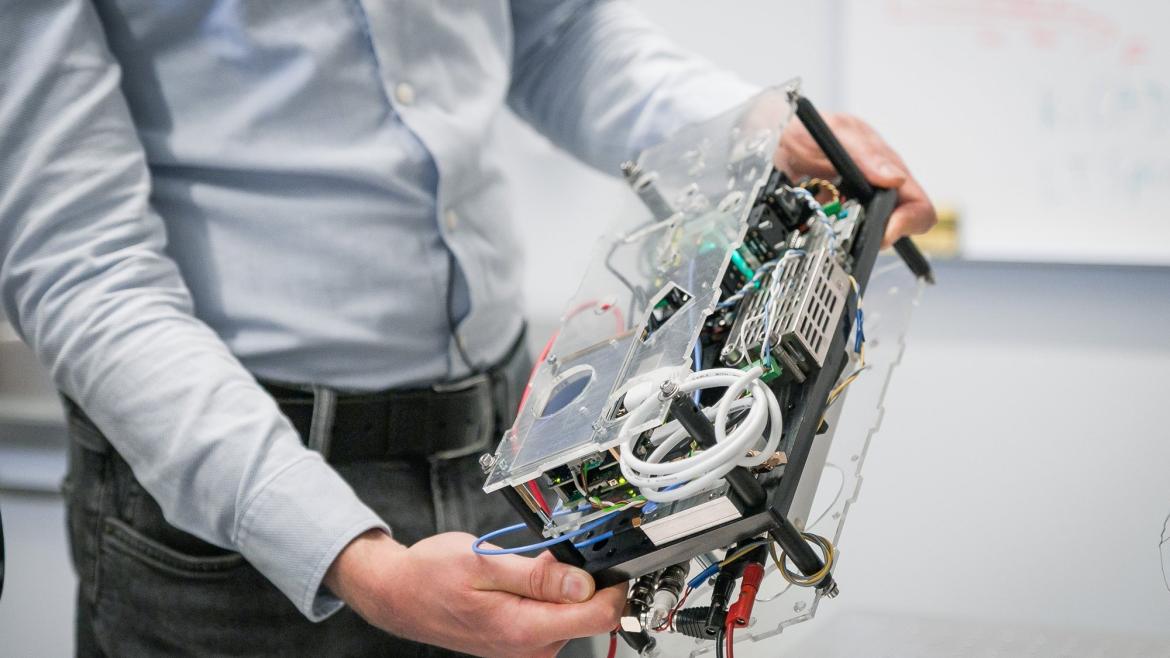
“The most important thing is that defects with interesting properties can form in diamond,” Lazda explains. At the same time, diamond is durable, stable, and non-toxic – it can operate under a wide range of conditions, including extreme environments such as space, as well as at room temperature, whereas many other solutions require complex cooling infrastructure. The small crystal is not inexpensive, but the material itself is only one part of a technology that has required more than ten years of research to develop.
Over the years, the device has become increasingly compact – the first prototype delivered by UL to the European Space Agency was the size of a cabinet drawer, with a separate temperature controller and power supply beside it. The goal was to make the device as small as possible without sacrificing precision, and this balance has improved with each successive version. The prototype demonstrated in Paris was already a small rectangular box with a built-in battery that operated completely independently.
The Road to Paris
In Paris, the UL team had to demonstrate the developed prototype to project partners, representatives of the European Defence Fund, and the European Commission. However, the journey to France was not without an unexpected incident: the airline refused to transport the built-in battery as ordinary cargo because it was classified as hazardous and could only be transported with special certification. Fortunately, the device is also designed to operate from an external power source, and it was successfully demonstrated in Paris in this configuration, without the battery.
The demonstration itself was the moment when it became clear whether what had been developed in the laboratory actually worked as intended. Lazda also recalls an episode when a representative of the defence ministry of a European country approached him and, during the conversation, told him to turn the test magnet around – the arrow visible on the screen indicating the direction of the field should then turn in the opposite direction.
“I had never once thought of testing it exactly that way. I slowly turned the magnet, and the arrow on the screen really did turn with it. I had this moment of surprise – this thing is doing exactly what it is supposed to do,” Lazda recalls.
Why the University of Latvia?
The successful demonstration in Paris raises an important question – why was it the University of Latvia that managed to develop such a device prototype?
In Auziņš’s view, participation in European security technology projects is important not only because of the results of a specific project, but also for the development of Latvian science as a whole. “From my perspective, it is obvious. What we are capable of doing is based on very strong fundamental science. This knowledge cannot simply be bought and replicated within a few months,” Auziņš emphasises. He notes that “Thales” is a billion-euro company with which UL will never be able to compete financially, and that other major companies could, in theory, develop such technologies themselves. However, the decisive factor is often not money, but time.
International competition also demonstrates that developing quantum magnetometers is no simple task. Lazda notes that several years ago the German technology company “Bosch” also publicly presented a phone-sized magnetic field sensor prototype based on diamond crystals. However, the performance of this solution is not publicly known, and a commercially available product has still not appeared on the market. In Lazda’s view, this shows that even for companies with substantial resources, the path from a prototype to a finished quantum technology is not a quick one.
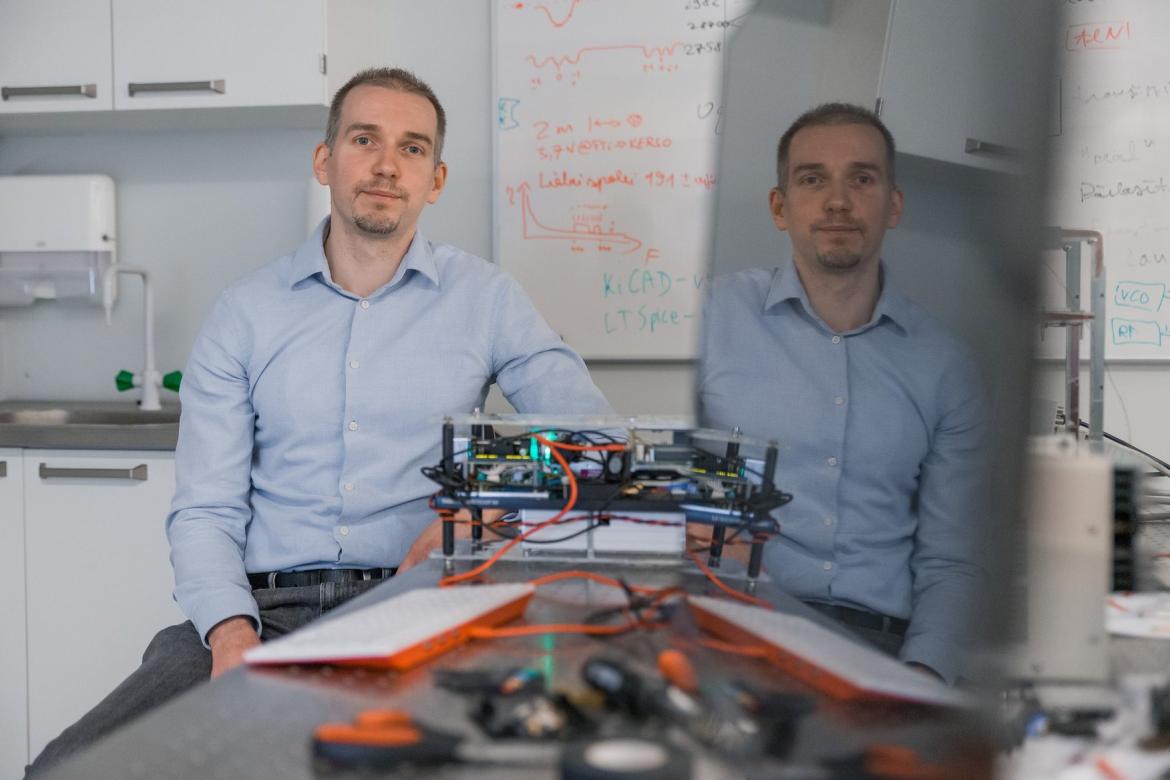
Although magnetometers have been used to measure magnetic fields for more than a hundred years – from geology and aviation to space research and navigation – quantum technologies are opening up new possibilities in this field as well. UL’s contribution is not the creation of a new measurement principle, but the development of a sensor based on quantum technology that makes it possible to measure magnetic fields much more compactly and with high precision.
A Story That Continues
The European Defence Fund project has concluded, but the story does not end in Paris. At the UL Laser Centre, a team of around 20 researchers continues to work in several directions based on the same diamond sensor technology.
One of these directions is the use of precise magnetic field measurements as an alternative to GPS. UL researchers have already tested this in practice – in cooperation with students from Riga State Gymnasium No. 1, they created a magnetic field map that made it possible to determine the position of a small mobile platform – a toy car or robot – in space. The idea has also been demonstrated at a visitors’ day organised by the NATO Multinational Brigade in Ādaži and during UL Researchers’ Night, showing that in the future magnetic fields could become a navigation tool in situations where GPS is unavailable.
Other research directions are also emerging from the same technology – magnetic communications in environments where radio signals do not work, such as underwater or in caves, contactless current measurement using diamond sensors, and quantum random number generators for secure encryption.
In the more distant future, the same fundamental research could also lead to the first quantum computer developed in Latvia, based on individual, precisely controlled defects in a diamond crystal. Although the UL Department of Computing already has a small quantum computer manufactured in China, no such domestically developed device yet exists in Latvia.
However, the magnetometer prototype that travelled to Paris already demonstrates that years of fundamental research at UL can be transformed into technology with practical applications at the European level. “Without fundamental research, we would not have this opportunity,” Auziņš emphasises. Lazda adds: “When you build a prototype and it works – that is the best moment!”
In conclusion, Lazda emphasises that the development of the magnetometer was a team effort by the Laser Centre. He thanks the University of Latvia for the opportunities provided and his colleagues for their cooperation and support in implementing this and other projects. He expresses special gratitude to Valts Krūmiņš, Anna Veronika Priede, Alise Cirse, Oskars Rudzītis, Eva Grauda, Tīna Ance Jansone, Mona Jani, Florian Helmut Gäbauer, Māris Tamanis, Professors Ruvins Ferbers and Mārcis Auziņš, as well as Artūrs Mozers, Head of the Laser Centre.