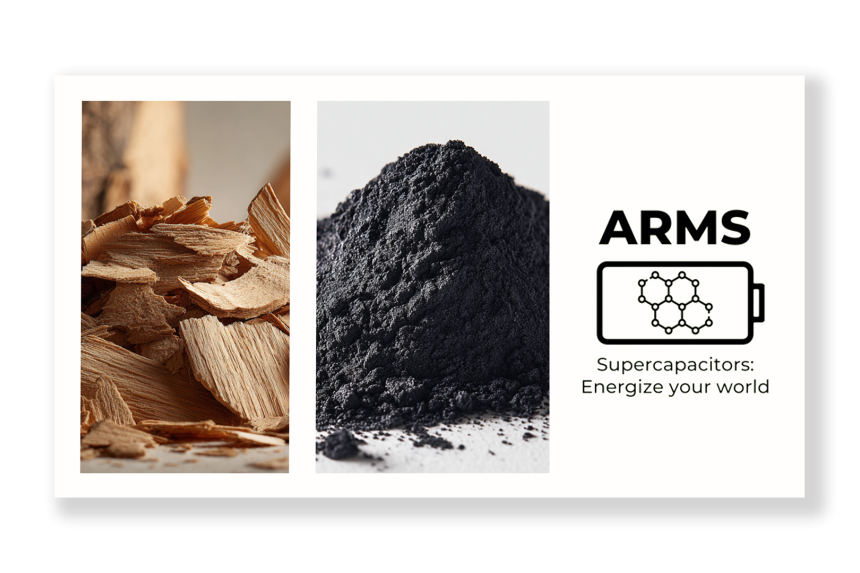
The ARMS consortium is celebrating a new scientific milestone: a collaborative publication that demonstrates how sustainable materials and smart engineering can redefine what printed energy‑storage devices can achieve. In our new Small Science open‑access article, a team of researchers Hamed Pourkheirollah, Remuel Isaac M. Vitto, Jari Keskinen, and Matti M¨antysalo from Tampere University, Dāvis Kalniņš, Līga Grīnberga, Anatolijs Šarakovskis, Gints Kučinskis from the Institute of Solid State Physics, University of Latvia, Aleksandrs Volperts from the Latvian State Institute of Wood Chemistry (LSIWC), and Steffen Thrane Vindt from the InnoCell ApS present a breakthrough in the development of high‑performance printed supercapacitors built from NaOH‑activated carbon derived from alder wood – a biomass precursor that is abundant, renewable, and surprisingly powerful when treated with the right chemistry.
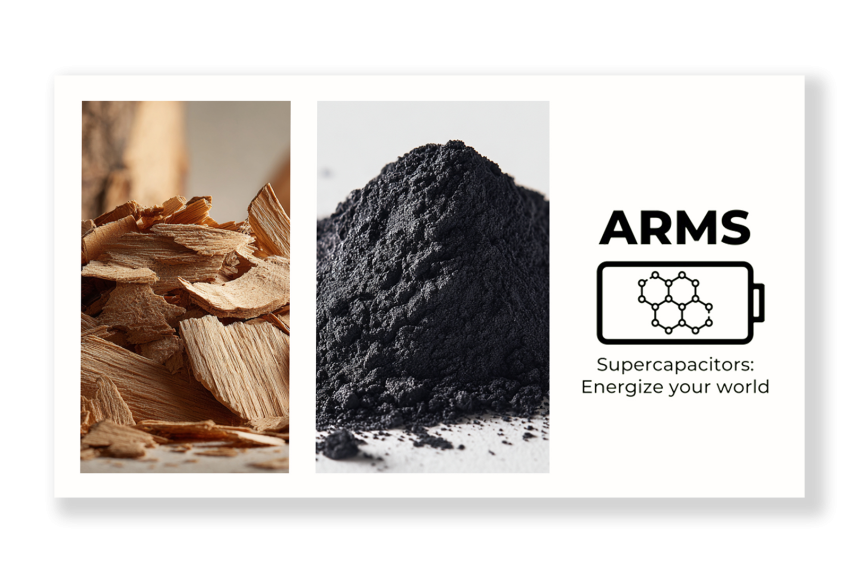
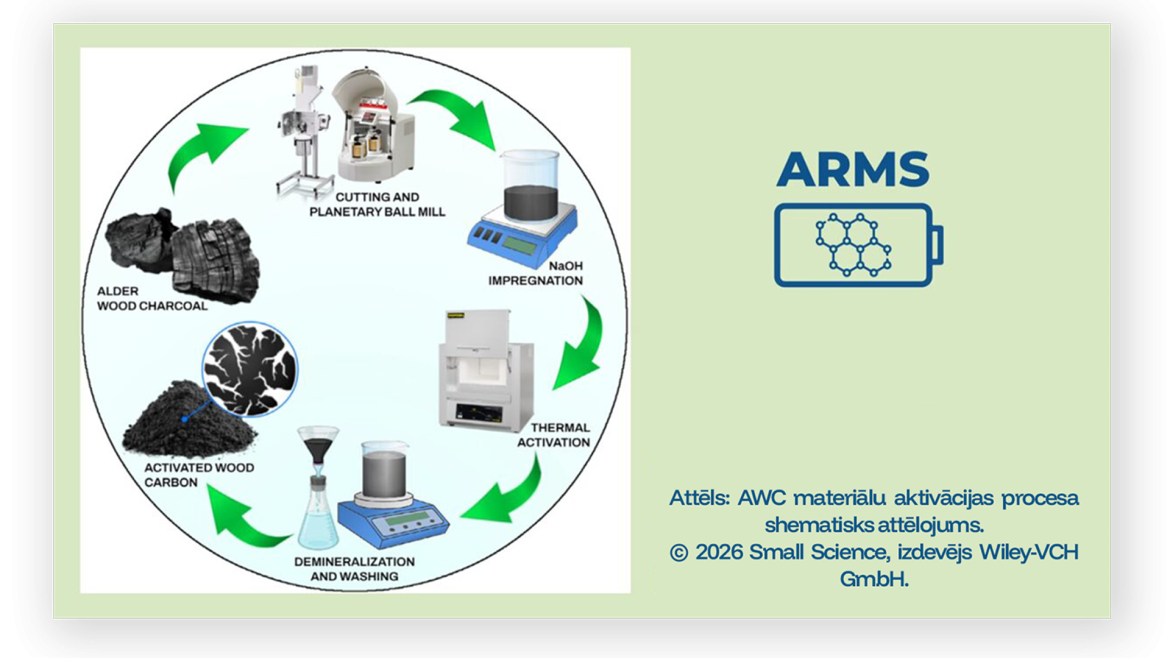
The publication begins with a simple question: Can a material as ordinary as wood be transformed into a high‑value component for next‑generation energy storage? The team’s answer is a resounding yes. By carefully optimizing a low‑temperature activation process using sodium hydroxide, they produced a family of carbon materials—called AWC (activated wood carbon)—with finely tuned porosity and exceptionally high surface areas. Among them, one formulation proved extraordinary: AWC 3‑600, created using a 3:1 NaOH‑to-carbon ratio at 600 °C. This material offered a uniquely well‑balanced pore architecture, combining a very high specific surface area of 2393 m²/g with 85.4% microporosity, allowing ions to move efficiently while providing enormous surface for charge storage.
But the real test came when this carbon was printed into supercapacitor devices. Using water‑based inks and flexible substrates, the team fabricated environmentally friendly, scalable devices—an approach perfectly aligned with ARMS’ mission to support green, future‑proof manufacturing methods. When the devices were tested, the results exceeded all expectations. AWC 3‑600 delivered 307 F/g in NaCl electrolyte and 291 F/g in potassium phosphate buffer, more than doubling the performance of the commercial benchmark material in several cases. Its energy density reached up to 61 Wh/kg, and perhaps most impressively, the printed supercapacitors retained 95% of their capacitance after 10,000 charge–discharge cycles, demonstrating long‑term durability that rivals many commercial systems.
Beyond the headline numbers, the study also uncovers deeper insights. The researchers show how the match between pore structure and electrolyte ion size fundamentally shapes performance. Smaller Na⁺ and Cl⁻ ions thrive in the narrow microporous networks created at lower activation temperatures, which explains why AWC 3‑600 excelled with NaCl. Meanwhile, larger phosphate ions perform better in carbons with a higher proportion of mesopores, such as AWC 4‑700, activated at 700 °C. This connection between activation chemistry, pore architecture, and electrolyte compatibility provides a roadmap for designing tailored, application‑specific energy‑storage materials in the future.
Dr. sc. ing. Aleksandrs Voļperts, researcher at the Latvian State Institute of Wood Chemistry, explains:
"Our goal was to connect materials science with practically applicable printed electronics technologies. Activated carbon derived from alder wood was integrated into a water-based ink and deposited onto substrates, demonstrating that materials of sustainable origin can operate in scalable manufacturing systems. This represents an important step toward environmentally friendly energy-storage devices."
The publication also highlights the strength of the ARMS collaboration. At the Latvian State Institute of Wood Chemistry, activated carbon materials were developed under the leadership of Dr. sc. ing. Aivars Žūriņš; the Institute of Solid State Physics, University of Latvia, carried out detailed structural and chemical characterisation; Tampere University developed and tested the printed devices; and InnoCell ApS contributed materials expertise and device‑level insight. This multi‑partner effort showcases how ARMS brings together complementary skills to accelerate scientific progress.
Ultimately, this work demonstrates that high‑value energy‑storage materials do not need to rely on rare resources or energy‑intensive processes. With thoughtful design and cross‑disciplinary collaboration, biomass waste can be upcycled into advanced carbon materials, enabling printed supercapacitors that are powerful, stable, and environmentally responsible. It’s a story of innovation grounded in sustainability – a story that reflects the core ambitions of ARMS.