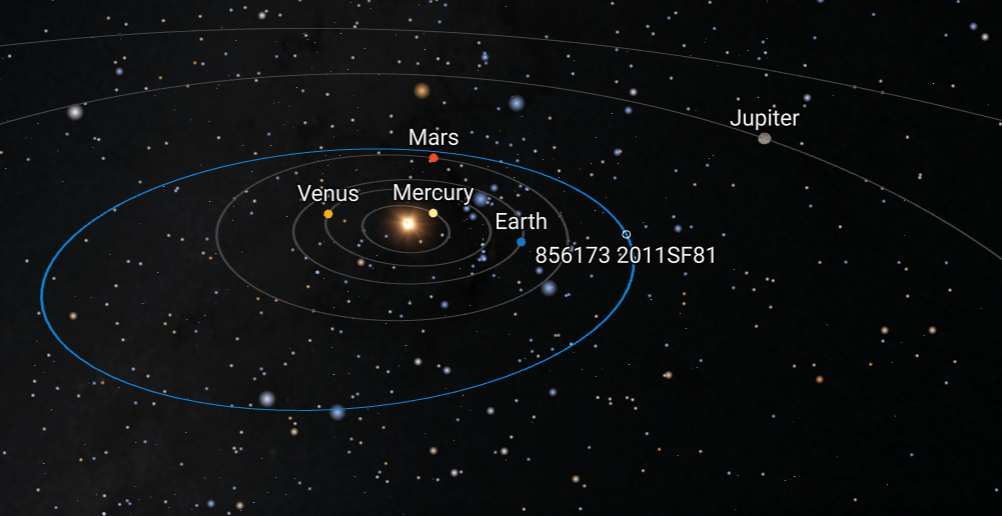
On September 3, 2011, after midnight, a new cosmic object was spotted in the Solar System's main asteroid belt at the University of Latvia (UL) Baldone Astrophysical Observatory. It was discovered using the Baldone Schmidt telescope by Ilgmārs Eglītis, a leading researcher at the UL Institute of Astronomy, while precise coordinate measurements were provided by Kazimieras Černis, a researcher at Vilnius University. This summer, following a proposal by the discoverer, the International Astronomical Union approved the asteroid's permanent number and name – (856173) Rozenštrauhs.
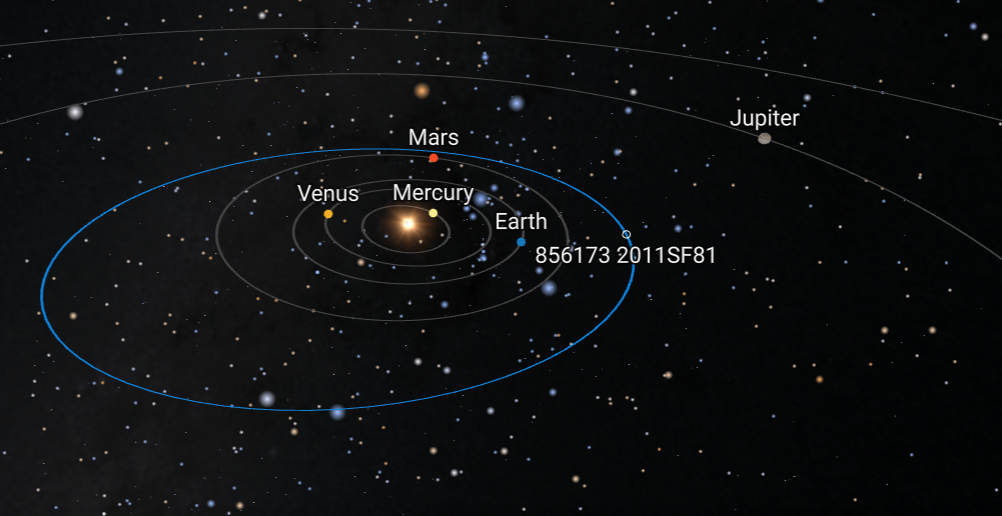
The asteroid, which has a diameter of approximately one kilometer, received the provisional designation 2011 SF81 in 2011 and belongs to the Main Asteroid Belt. The 103 measurements obtained so far during six oppositions (approaches to Earth) allow its position to be determined over a 100-year period with an accuracy of up to 0".73 arcseconds. The asteroid's name, proposed by its discoverer I. Eglītis, was published in the IAU publication WGSBN Bulletin.
The asteroid Rozenštrauhs orbits the Sun at an average distance of approximately 1.81 astronomical units (about 271 million kilometers), following an elongated elliptical trajectory located between Mars and Jupiter. Due to its high eccentricity, the asteroid occasionally comes considerably closer to Earth's orbit, and its minimum distance from it is less than 1 AU (approximately 122 million km). It completes one orbit in 3.65 years. At the time of its discovery, this space traveler was located very low in the sky in the constellation Pisces and was visible only with the very powerful Baldone Schmidt telescope, as its brightness reached only 20.5 magnitudes.
“The name ‘Rozenštrauhs’ brings back childhood memories of family celebrations, when guests would gladly sing, accompanied by my father’s guitar, the songs that Eduards Rozenštrauhs brought to the people through his concerts. ‘Vecpiebalgas ūdensrozes’, ‘Vecās dzirnas’, ‘Jāņu nakts’, ‘Jaunība’ and many others move me, not to mention ‘Zilais lakatiņš’, which became the anthem of the Latvian Riflemen. I fully agree with the assessment of Latvian singer-songwriter Eduards Rozenštrauhs’ creative work published in the encyclopedia: ‘Singer-songwriter E. Rozenštrauhs, combining the talents of a composer and performer, is a unique personality – a phenomenon in the history of Latvian post-war music as an officially unrecognized but popularly beloved musician whose work became widely known without the involvement of recordings, radio, television or sheet music, with his songs spreading by word of mouth. His songs were performed without knowing the name of their author, and some became part of folklore,’” comments Ilgmārs Eglītis.
- ^ Latvian National Encyclopedia
https://enciklopedija.lv/skirklis/162845-Eduards-Rozen%C5%A1trauhs