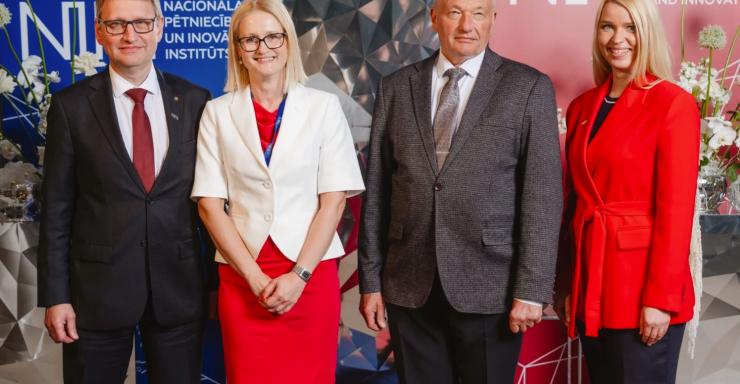
For the second year in a row, the Academies of Sciences of the Baltic States, in cooperation with the UNESCO National Commissions, are announcing a joint scholarship competition for female scientists — the “Baltic Scholarship for Women in Science 2025.” Nine outstanding scientists from the Baltic States will each receive a €7,000 scholarship in recognition of their achievements to date and to support their future research.

The aim of the scholarship is to support women scientists in building careers in scientific research within the Baltic States. The national competitions are intended to evaluate and support the most promising young female scientists in the Baltic region on their path to excellence in science, while also promoting their achievements and encouraging the most talented students to pursue careers as scientists.
Applications can be submitted by young female scientists who are currently pursuing doctoral studies or working on their doctoral thesis at Latvian universities or research institutions, as well as by scientists who have obtained their PhD no more than seven years ago and are employed at a university or research institution in Latvia.
In Latvia, three scholarships will be awarded: two in the fields of natural sciences, engineering and technology, medicine, and health sciences — one for a PhD candidate and one for a PhD holder — and one scholarship for a PhD holder in the field of social sciences and humanities.
The scholarship competition in Latvia is organized by the Latvian Academy of Sciences in cooperation with the Latvian National Commission for UNESCO, with financial support from the Ministry of Education and Science.
Applicants are invited to submit their applications from May 12, 2025, to June 12, 2025, by completing the application form, confirming it with a valid electronic signature, and sending it to the email address: BVstipendija@lza.lv
The scholarship documentation, including the application form, is available on the website of the Latvian Academy of Sciences.
2024. Latvian Laureates of the “Baltic Scholarship for Women in Science”
Dr. philol. Anne Sauka:
“The Baltic States' scholarship for women in science awarded in 2024 is not only a great honor but also an encouragement to continue my research in philosophy. For me as a researcher, the scholarship has provided a sense of security — reassurance that the chosen research path is not only engaging and meaningful for me personally, but also valuable to a broader audience. It has strengthened my confidence in my own abilities. The funding has allowed me to focus on the development of a monograph, which I might otherwise have lacked the motivation or resources to pursue.”
Dr. chem. Daniela Godiņa:
“This recognition means much more to me than just acknowledgment — it is also a responsibility to be visible, to share my experience, and to inspire other women in science. Science has never been just about the laboratory for me — I believe it is important to be active in society as well. I have shared my research and experience through various media channels and have had the opportunity to speak at events such as the LAMPA conversation festival and Deep Tech Atelier. These experiences allow me to present science as accessible, dynamic, and relevant. The scholarship has given me added confidence that I am heading in the right direction — with work that has the potential to create meaningful change.”
Mg. phys. Līga Ignatāne:
“The Baltic States' scholarship for women in science has widened the doors already open to me in science and has also opened new ones, allowing me to engage with the broader public on topics like science in Latvia and career choices. I think it's important to emphasize that science isn't reserved for a specific type of person — we are all different in our daily lives and our perspectives, but we share a common goal: to explore and discover. I see myself in this too — a girl who, in 12th grade, still didn’t know what she wanted to do; a Latvian folk dancer, later a troupe leader passionate about continuing the Song and Dance Festival tradition; a daughter, sister, friend, wife, mother, and by profession — a researcher.”
About UNESCO
UNESCO (United Nations Educational, Scientific and Cultural Organization) is a specialized agency of the United Nations comprising 194 member states worldwide. It fosters international cooperation in the fields of education, science, culture, communication, and information, with the aim of promoting peace, societal well-being, and sustainable development. Latvia joined UNESCO in 1991. Since 1994, the UNESCO Latvian National Commission has overseen the implementation of UNESCO programs in Latvia and represents Latvia's interests and expertise in UNESCO's areas of activity internationally.
More information: www.unesco.lv and Facebook.com/UNESCOLNK
About the Latvian Academy of Sciences
The Academy of Sciences in Latvia was established in 1946. On March 15, 1990, it was restructured into the Latvian Academy of Sciences (LAS) — a classical-style academy of the type common in European countries, comprising elected distinguished scientists and intellectuals. LAS serves as a national and international center for scientific and innovation excellence, expert evaluation, and science communication across disciplines, and represents Latvian science in the global arena.
More information: www.lza.lv and Facebook.com/latvijaszinatnuakademija