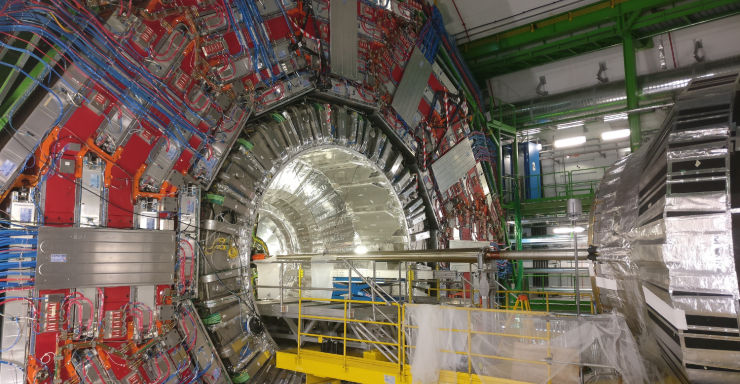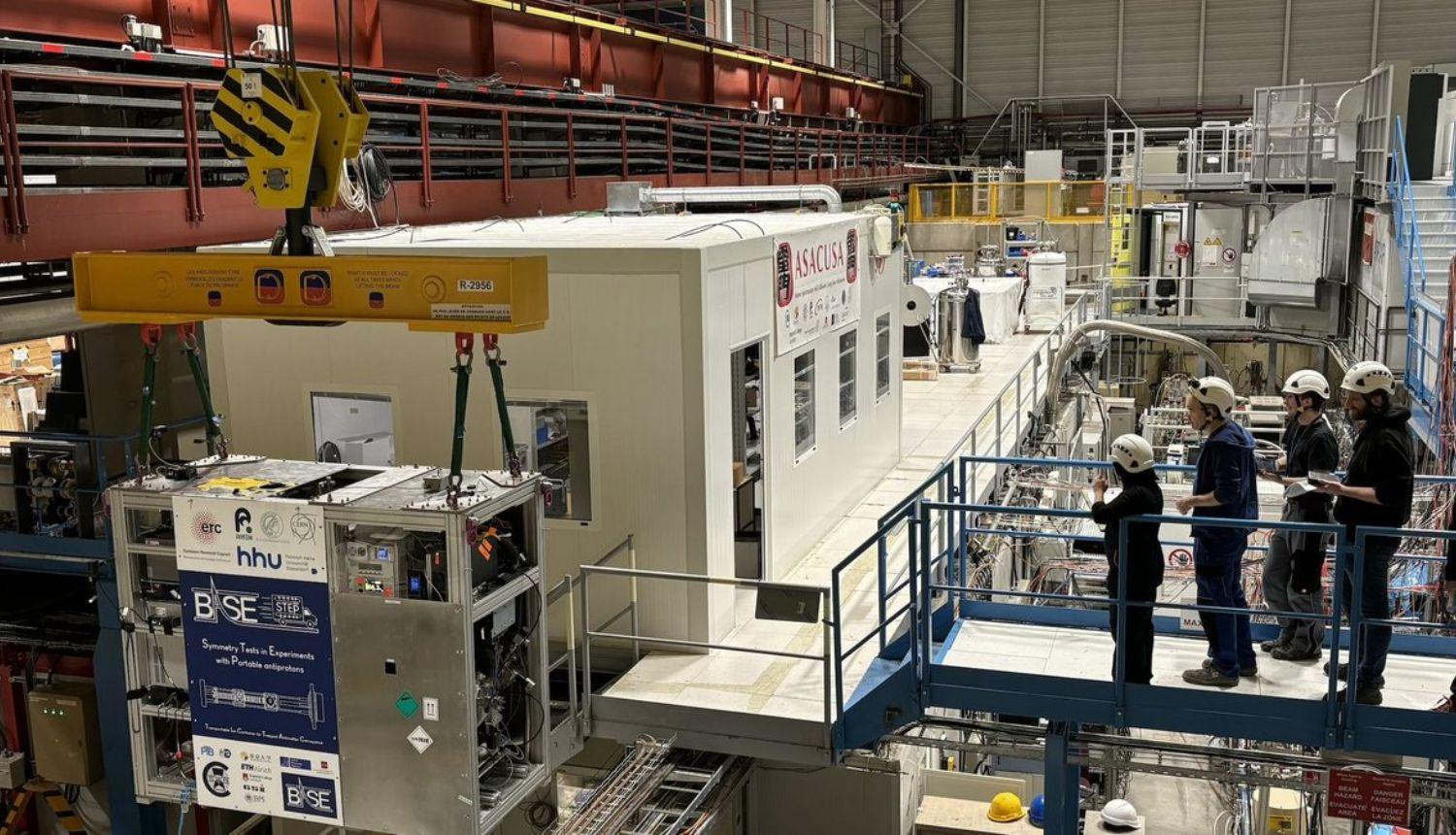
That would be quite an exclusive courier service if this European Organisation for Nuclear Research (CERN) experiment succeeds. Soon, for the first time, antimatter will be transported by car within CERN's territory. This is no simple task, because whenever any antiparticle comes into contact with a particle of ordinary matter, it instantly annihilates, releasing energy.
Matter is everything made up of particles that occupy space. Antimatter particles have all the same properties as their corresponding matter counterparts, with one exception: an opposite electric charge. Antiparticles are just as stable as their matter equivalents, and the only limitation to storing them is ensuring they do not come into contact with ordinary matter. That is not easy.
Antimatter is not only a subject of research for physicists, but also a favourite concept among science fiction writers and fans. It is often portrayed as the raw material for extremely powerful weapons, such as photon torpedoes in the Star Trek franchise, or as a way to blow up the Vatican with just a gram of antimatter in the film Angels & Demons. It is also used for peaceful purposes in fiction, as an almost limitless energy source that enables interstellar and even intergalactic travel.
Unlike its fictional uses, antimatter is very real. You can even buy an "antimatter generator" at a store - bananas. They contain a small amount of the radioactive isotope potassium-40, whose decay causes a banana to emit a positron, the electron's antiparticle, about once every 75 minutes. Antimatter also has practical applications in medicine, for example, in PET (positron emission tomography).
Antiparticles are also produced at CERN in a fittingly named facility, the "Antimatter Factory." Researchers fire high-energy protons at a dense metal target in a particle accelerator, creating a large number of secondary elementary particles, including antiprotons. These are then directed into a device that slows them down and traps them in special chambers, where a strong magnetic field and a vacuum environment ensure that antiparticles do not come into contact with matter and thus do not annihilate.
However, until now, the antimatter produced at CERN has had to remain there. Scientists can store it but not transport it, which would be very useful. Transporting this unique cargo, antiparticles, would allow other laboratories across Europe to use antimatter in their experiments and potentially discover new insights into how our Universe is structured.
A few years ago, a group of CERN researchers successfully demonstrated the transport of protons. This was the first step toward transporting antimatter as well. "Ultimately, we want to be able to deliver antimatter to specialised laboratories at Heinrich Heine University in Düsseldorf, where we could study it with a hundred times greater precision," explained Christian Smorra, leader of the BASE-STEP project, on CERN's website. Eventually, it would not be limited to Düsseldorf, but could include any laboratory in Europe.
Now, The Guardian reports that an antimatter experiment is expected very soon, during which it will travel for about 20 minutes across CERN's territory in a special device mounted on a truck. This will be the world's first attempt to transport antimatter.
Why study it at all? Because it could significantly deepen our fundamental understanding of the Universe. Current models of the Universe's origin suggest that matter and antimatter were created in equal amounts during the Big Bang. But why do we now live in a Universe dominated by matter? As mentioned, when particles and antiparticles meet, they annihilate, releasing energy. So why isn't the Universe just an endless "sea" of energy, instead of containing matter?
"We are in a Universe filled with ordinary matter, but there is almost no antimatter. And that is the great mystery," The Guardian quotes Dr. Jack Devlin, a researcher at Imperial College London.
If antimatter "courier deliveries" become a reality and many laboratories and research groups across Europe begin working with it, there is a good chance that we will make faster progress in solving this mystery.