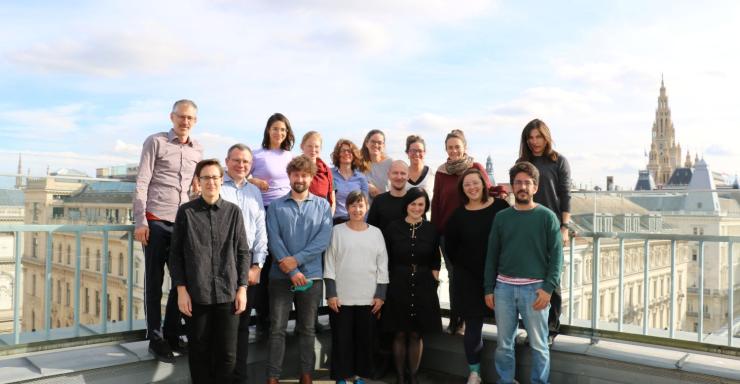
From 21 to 23 April, Athens (Greece) hosted the 27th National Coordinators’ Forum of the European Social Survey (ESS ERIC). During the meeting, researchers from across Europe—including representatives from Latvia, Dr Jurijs Ņikišins, Senior Researcher at the University of Latvia’s Faculty of Economics and Social Sciences, and Research Assistant Ms Anete Elizabete Melgalve—reported on the progress of Round 12 implementation, reviewed the conceptual framework for the upcoming Round 13 questionnaire, and discussed strategies for enhancing the societal impact of the survey results.
Central to the forum’s agenda was the progress of data collection for ESS Round 12 and a comparative assessment of preliminary results. For the Latvian National Coordinator and his colleagues, this provided an opportunity for a detailed evaluation of methodological challenges, including respondent reach and engagement. Data collection for Round 12 has already concluded in 10 countries, while fieldwork is actively ongoing in 13 others. In a further six countries, including Latvia, data collection is scheduled to commence within the coming weeks.
Initial indicators suggest a successful transition to new methodological approaches: the average response rate in countries that have completed the self-completion phase stands at 43%, exceeding initial projections. Furthermore, the vast majority (60–90%) of self-completion questionnaires are being submitted online.
Preparations for Round 13: Focus on Welfare and Loneliness
The forum also saw the presentation of the concept and first version of the Round 13 Source Questionnaire. In the next phase of the survey, the focus of researchers will be directed towards two rotating modules:
- Welfare attitudes in Europe: social security in insecure times – examining how the attitudes of European citizens towards social security are evolving within the context of economic and geopolitical risks.
- Interdisciplinary perspectives on social (dis)connectedness in Europe – a module dedicated to an in-depth analysis of the so-called "loneliness epidemic" and the factors that determine meaningful social ties. The inclusion of this module aims to explain why social alienation remains prevalent even in an era of increasing digital communication.
ESS National Coordinators Share Dissemination Best Practices
A dedicated session of the forum focused on the dissemination of ESS data. Working in five thematic groups, National Coordinators shared experiences on the most effective ways to make complex social research data more accessible to the general public, the media, and policymakers. ESS data are already extensively utilised in social research methodology courses, contributing to the education of new generations of researchers. In several countries, including Latvia, government institutions commission in-depth analyses of ESS data on topics vital for national development planning. Participants also highlighted the challenges of publishing research findings in mass media, as well as the constraints on time, funding, and human resources required for consistent and effective dissemination.
"The exchange of experience and the insights gained from international colleagues allow us to better identify our own strengths and weaknesses, as well as potential opportunities and risks," notes Dr Jurijs Ņikišins, the ESS National Coordinator for Latvia. "Many challenges, both in data collection and dissemination, are shared across ESS member countries; it is therefore essential to learn from others’ experiences while sharing our own success stories."
About the European Social Survey
The European Social Survey (ESS) is an academically driven international survey conducted every two years across more than 30 European countries. The survey is directed by Professor Rory Fitzgerald from City St George's, University of London, and supported by the Core Scientific Team (CST)—a consortium of leading research institutions including GESIS (Germany), Sikt (Norway), and the University of Essex (UK), among others. In Latvia, the ESS is coordinated by a research group at the University of Latvia’s Faculty of Economics and Social Sciences under the leadership of Dr J. Ņikišins, contributing to the study and analysis of social processes in Latvia and Europe.