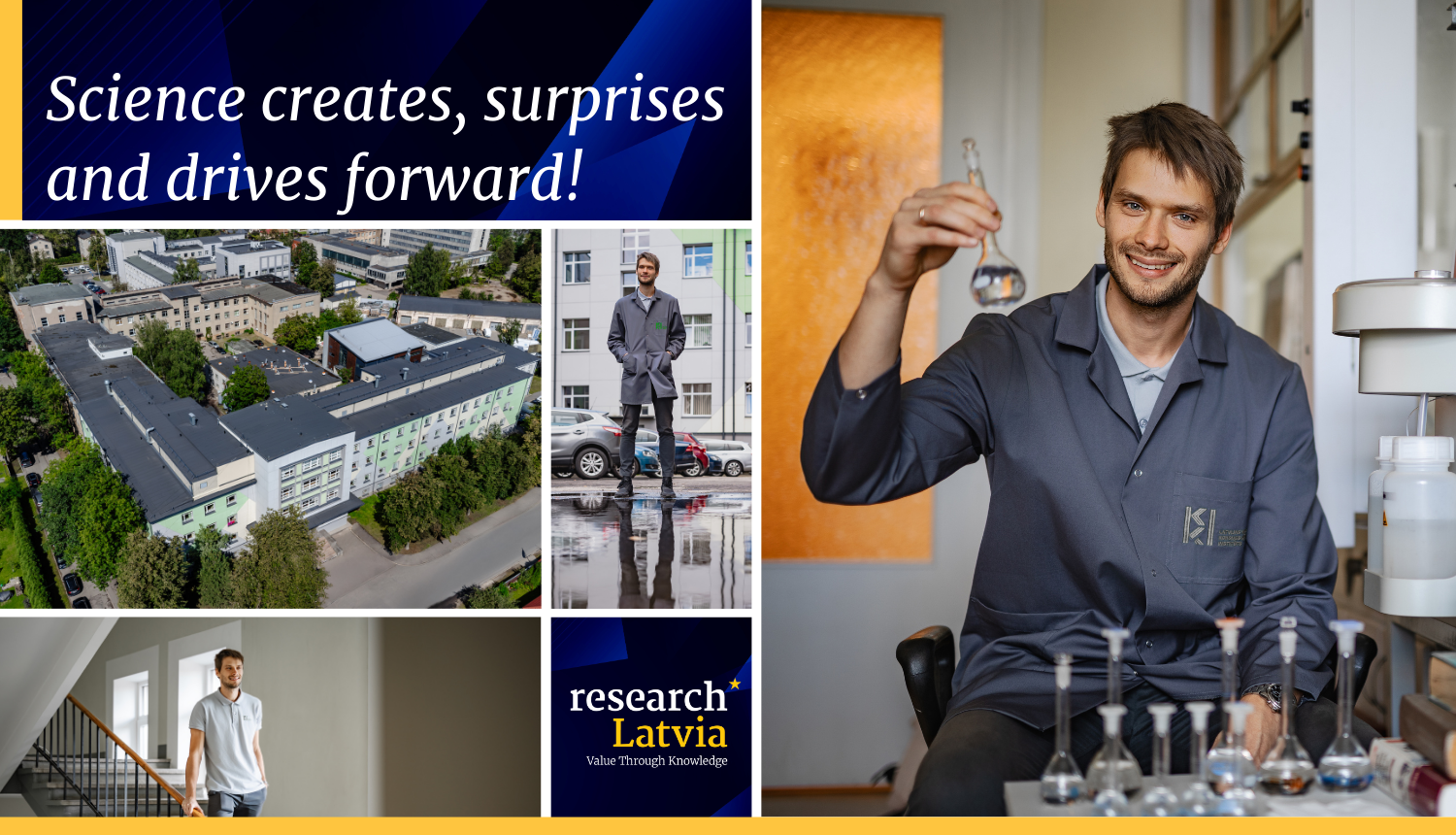
“Researchers must generate new knowledge and objectively evaluate ongoing processes. This forms the grounds for the development of innovative and safe products and technologies, and constitutes an essential prerequisite for ensuring the well-being of society.”
As a Researcher at the Latvian State Institute of Wood Chemistry (LSIWC), PhD Edgars Kuka studies how wood-based materials age and degrade, developing sustainable materials and protective solutions that make their use more durable and environmentally responsible. By analysing how moisture, microorganisms and sunlight influence material performance, as well as researching wood polymer composites and microplastic pollution, he provides essential insights for extending product lifespan and reducing environmental impact.
His work includes studying degradation processes, developing sustainable materials, and creating protective solutions that expand the use of biomaterials and make the construction industry more environmentally responsible. E. Kuka examines how environmental factors – moisture, microorganisms, solar radiation – influence material properties and how innovative solutions can extend product lifespan while minimising environmental impact. His research on wood polymer composites and microplastic pollution offers important insights into quantifying emissions and reducing associated risks.
The key areas of research of the Latvian State Institute of Wood Chemistry include wood preservation, biorefining, green chemistry, and biotechnology. Wood is among the oldest materials used by humankind, yet many challenges remain in ensuring that wood products are durable, long-lasting, and environmentally safe. These are the very issues addressed by PhD Edgars Kuka, a Researcher at the LSIWC Laboratory of Wood Degradation and Protection.
Edgars pursued his academic path at the Riga Technical University, where he studied chemistry and later specialised in materials science – a field that bridges fundamental science and engineering. In 2022, he defended his doctoral thesis in materials science, focusing on wood polymer composite materials. He continued to advance this research within the Fundamental and Applied Research Project (FARP) supported by the Latvian Council of Science.
Edgars has played a significant role in the project “Innovative solutions to improve the durability of wood,” which investigates sustainable approaches for wood used in construction. The project received the Latvian Academy of Sciences Award for one of the most significant scientific achievements of the year. His research results have been published in leading journals such as Polymer Degradation and Stability and Construction and Building Materials, underscoring the high quality and international relevance of his work. He has also presented his findings at the American Wood Protection Association’s annual event, following recognition in an international competition.
PhD Kuka is an active member of the international research community, representing Latvia and LSIWC in organisations such as the Northern European Network for Wood Science and Engineering, Innovawood, and several COST Actions. He has broadened his expertise through training and scientific exchange in Germany, the UK, Italy, Sweden, and other countries. This experience benefits his work with students and collaboration with industry partners, helping companies address current material-related challenges.
Edgars’ career demonstrates how determination, continuous improvement, and teamwork can lead to important scientific achievements and international recognition, while honourably representing Latvian science and the LSIWC worldwide.
The science calendar “Research Latvia 2026” and the researcher descriptions were developed within the ERDF-funded project No. http://1.1.1.1/1/24/I/001 “More Efficient Implementation and Management of Latvia‘s Science Policy”, implemented by the Ministry of Education and Science. Developers: SIA "VFS Films" creative team, including Kristīne Pleša, video director Jānis Šēnbergs, photographer Ieva Romaško and the researchLatvia team.