How Does a Solar Eclipse Occur and Why Is It So Rarely Observed
October 21, 2026
A total solar eclipse is one of the rarest and most spectacular astronomical phenomena observable from Earth. Although a total solar eclipse occurs somewhere on the planet approximately once every 18 months, it may not be seen again at a particular location for several generations. The last total solar eclipse visible in Latvia occurred on 30 June 1954, while the next is not expected until 25 May 2142. Weather conditions in the Baltic region are also often unfavourable for astronomical observations, as cloudy skies frequently prevent even significant celestial events from being observed. For this reason, astronomy enthusiasts and researchers often organise expeditions to locations where the path of totality coincides with a greater likelihood of clear skies.
In recent years, public interest in astronomy has grown in Latvia, as demonstrated by the partial solar eclipse on 29 March 2025, which was observed by many people across the country. In Ventspils, members of the public had the opportunity to observe this celestial phenomenon through professional telescopes at an event jointly organised by Ventspils University of Applied Sciences and Ventspils Youth Creativity Centre. Following this event, the attention of astronomy enthusiasts and researchers increasingly turned to the next major celestial event in Europe – the total solar eclipse that crossed Spain on 12 August 2026. It was one of the most anticipated astronomical events of recent years, attracting scientists, photographers and skywatchers from around the world.
To witness the complete obscuration of the Sun and its spectacular corona, a team of researchers, teachers and students from Ventspils also travelled to Spain, which lay within the path of totality. The expedition included representatives from Ventspils University of Applied Sciences and Ventspils Secondary School of Technologies. The observation site was located in the remarkable Bardenas Reales de Navarra Natural Park, a semi-desert landscape known for its dry climate and clear skies.

How a Solar Eclipse Occurs
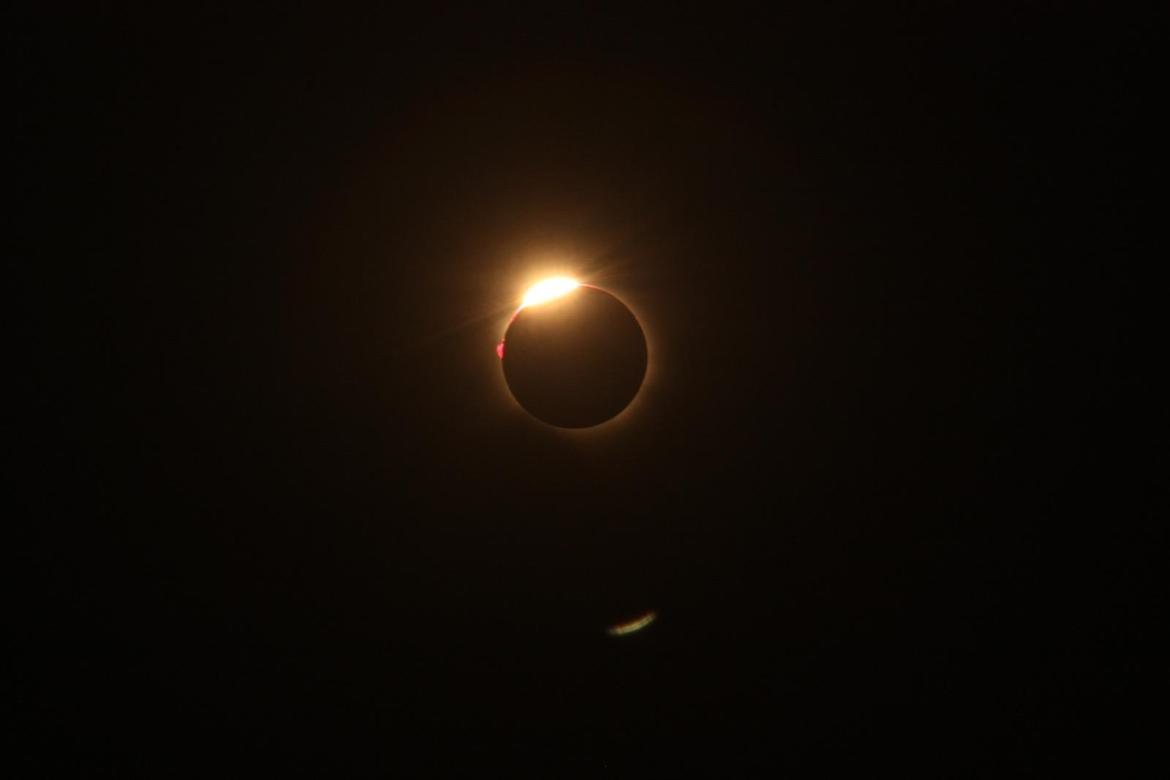
A total solar eclipse unfolds in several stages. Initially, the Moon gradually begins to cover the Sun. This stage is known as the partial phase of a solar eclipse and lasts approximately one hour. As the Moon obscures an increasingly large portion of the solar disc, daylight gradually changes and shadows become sharper. Shortly before totality, one of the most famous eclipse phenomena appears – the diamond ring effect. For a brief moment, only a tiny portion of the Sun remains visible, while the rest of the solar disc is hidden behind the Moon.
When the Moon completely covers the Sun, daylight disappears almost instantly – the sky darkens, stars and planets become visible, and the temperature begins to drop. The most spectacular feature is the solar corona – the Sun's outer atmosphere, which appears as a delicate, silvery-white halo surrounding the dark silhouette of the Moon.
The possibility of a total solar eclipse is the result of an extraordinary cosmic coincidence. Although the Sun is approximately 400 times larger than the Moon, it is also about 400 times farther away from Earth. As a result, both celestial bodies appear almost the same size in the sky. This allows the Moon to cover the solar disc with remarkable precision, revealing structures in the Sun's atmosphere that are normally impossible to observe due to the Sun's intense brightness.
Earth is not the only place where such a remarkable alignment of celestial bodies can occur naturally. Jupiter's four largest moons can cast shadows on the planet's surface, producing eclipse-like phenomena. Moreover, the moons Io, Callisto and Ganymede have simultaneously crossed Jupiter's disc between the Sun and Jupiter, creating a triple transit, or triple eclipse phenomenon.
Observers located on certain moons of Jupiter or Saturn could experience spectacular eclipses caused by other moons. Similar events may also be possible in distant exoplanetary systems if a moon and its star appear approximately the same size in the sky to an observer. Such cosmic coincidences may be rare, but they are not unique to Earth.
Why We Do Not See a Solar Eclipse Every Month
The Moon orbits Earth approximately once a month, so it might seem logical to expect solar eclipses to occur regularly. However, total solar eclipses are rare at any particular location. The reason lies in geometry.
The Moon's orbit is tilted by approximately five degrees relative to the plane of Earth's orbit around the Sun. Most of the time, as seen from Earth, the Moon passes either above or below the Sun. Only when the orbital planes and the positions of the celestial bodies align precisely can the Moon cast its shadow on Earth and cause a solar eclipse.

This complex alignment makes every total solar eclipse a special event, attracting scientists, photographers, educators and astronomy enthusiasts from around the world.
One of the main objectives of STEM education is to encourage young people to pursue studies and careers in science, technology, engineering and mathematics. Astronomy is a particularly powerful tool for achieving this goal, as it naturally combines physics, mathematics, engineering, computer science and curiosity about the Universe.
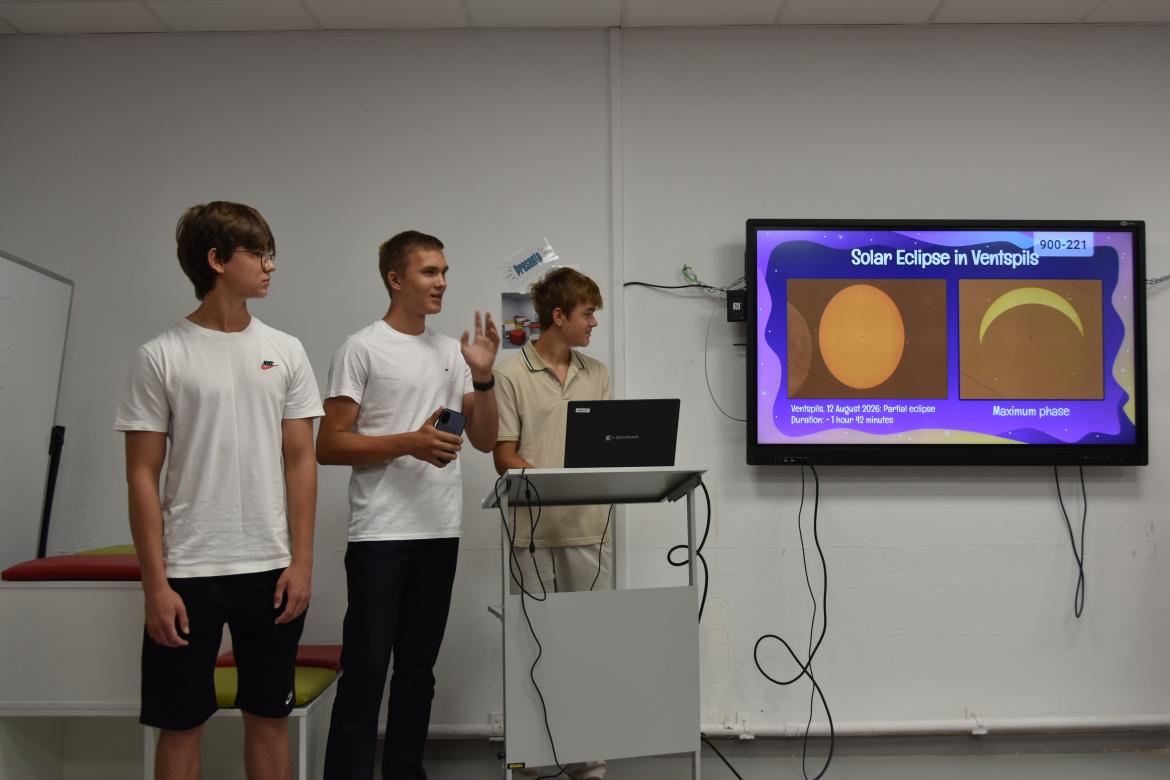
A total solar eclipse provides a unique educational experience, transforming knowledge acquired from textbooks into something tangible and memorable. Concepts such as the motion of celestial bodies, celestial mechanics and solar physics suddenly become visible above our heads.
For the students from Ventspils, this trip was a vivid demonstration that science is not confined to classrooms or laboratories. It is an international field driven by collaboration, observation and discovery.
Photo: V. Bezrukovs, J. A. Cázares Montes, A. Kalniņa.
This information has been prepared within the framework of the project “International Cooperation and Innovation of Ventspils University of Applied Sciences for the Development of Latvia's Smart Specialisation” (No. 1.1.1.5/3/25/I/012).