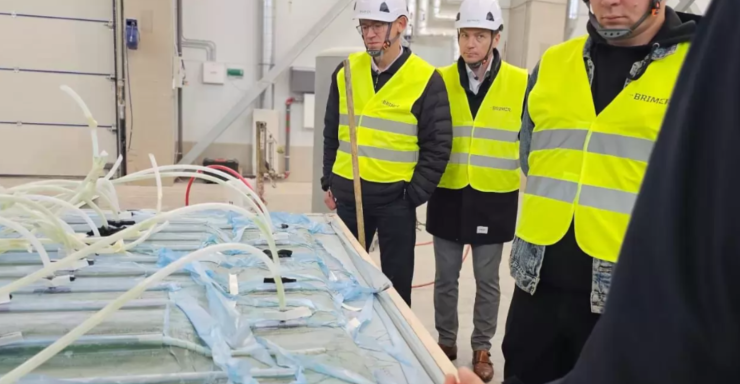
Football is currently undergoing the fastest technological transformation in its history. Sensors in the ball, microchips, semi-automated offside detection, artificial intelligence, high-precision camera systems and video refereeing technologies are significantly changing the fairness and dynamics of the game, as well as the spectator experience. These changes are no longer merely a reality of the FIFA World Cup — they are affecting the entire sports industry, in which billions of euros circulate, and mistakes are no longer tolerated to the same extent as before. The role of technology in football was discussed on the programme “Digital Breakfast” by University of Latvia Professor Leo Seļāvo and Artūrs Uplejs, the technical provider of VAR systems in Latvia.
Modern technologies are being introduced into sport with the aim of reducing the number of human errors, but at the same time they are generating a new wave of discussion. As Jauns.lv notes, throughout the history of sport, the referee’s decision has always been final, even if it later proved to be incorrect. Today, when the pressure to achieve results is enormous, tolerance for mistakes has decreased to a minimum, and the extensive introduction of technology into sport has become inevitable. The VAR system, which was initially introduced to prevent obvious errors, has created a new dynamic in the game — fans often refrain from celebrating goals while waiting for millimetre-precise lines to appear on the screen. However, the human factor has not disappeared: video replays are still interpreted by people, and discussions about the interpretation of the rules continue.
A particularly striking innovation is the microchips embedded in footballs, which record movement and acceleration 500 times per second. They make it possible to determine not only whether the ball has crossed the goal line, but also the precise moment when a player touches the ball, which is crucial for detecting offside situations. The sensors can detect even the slightest touch — a level of precision that the human eye cannot perceive. Similar systems have long been used in tennis and volleyball, where “Hawk-Eye” replaces line judges, and football is following this example with semi-automated offside detection, in which cameras track players’ body points in real time and create 3D skeletons.
However, experts emphasise that referees will not be replaced in the near future. The referee on the pitch is not only a decision-maker, but also a game manager, psychologist and diplomat. Computers cannot sense the emotional temperature of a match, calm agitated players or distinguish a malicious foul from an accidental collision. Technologies are excellent assistants, but the soul of the game and the final say still belong to the person with the whistle.
Latvia’s involvement in the development of global sports innovation
In this global innovation landscape, Latvia plays a surprisingly active role. Latvian scientists and engineers are working precisely in the fields that form the technological foundation of modern football. At the University of Latvia, computer vision algorithms, 3D position reconstruction methods, sensor data analytics and artificial intelligence models for movement prediction are being developed — exactly the kinds of technologies FIFA uses for offside detection and the analysis of player trajectories. University of Latvia researchers work with object tracking in video, data fusion methods that combine camera and sensor information, and movement analysis, which is essential for understanding sports tactics.
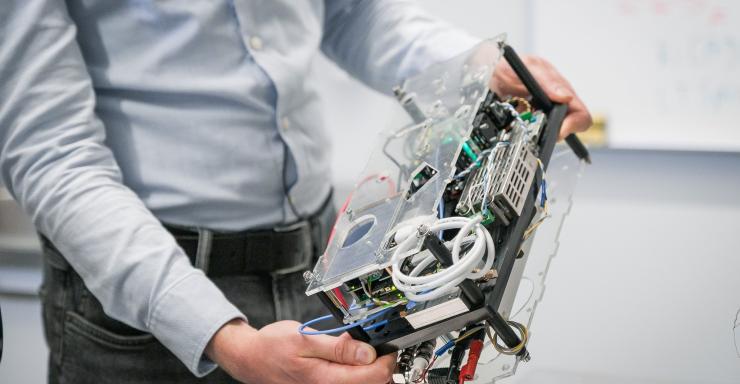
Riga Technical University develops high-precision sensors, signal-processing algorithms and material technologies for sports equipment. The RTU Institute of Electronics and Telecommunications has created prototypes of motion sensors, data transmission solutions and real-time analytics systems that can be used in professional sport and integrated into future football technologies.
At the Latvian Academy of Sport Education, biomechanical analysis of athletes’ movements, training data monitoring and workload assessment are carried out. These studies are essential for modern AI-based sports data systems, which are also used by professional football clubs. The work of LSPA researchers helps to understand movement quality, fatigue dynamics and injury risks — precisely the parameters that global football analytics systems seek to automate.
Latvian companies are developing automated match filming systems, video analytics tools and data platforms for coaches that provide object tracking, event identification and player movement analysis. These solutions are used in both amateur and professional sport, and technologically they are similar to the systems developed by FIFA partners.
Latvian football clubs are also increasingly adopting data analytics, using GPS sensors, video analytics and AI tools to monitor player workload. Some clubs cooperate with researchers from the University of Latvia and Riga Technical University, testing new methods and solutions that could improve player preparation and tactical analysis.
Latvian experts — Professor Leo Seļāvo and VAR systems provider Artūrs Uplejs — serve as an important bridge to the global football technology ecosystem. Their work demonstrates that Latvia not only follows global trends, but also actively participates in the development of sports technologies.
Although the official FIFA systems are developed elsewhere, methods and solutions are being created in Latvia that may become part of the global sports innovation ecosystem in the future. Modern technologies continue to transform football, and Latvia is present in this process — both in research and in practical implementation.