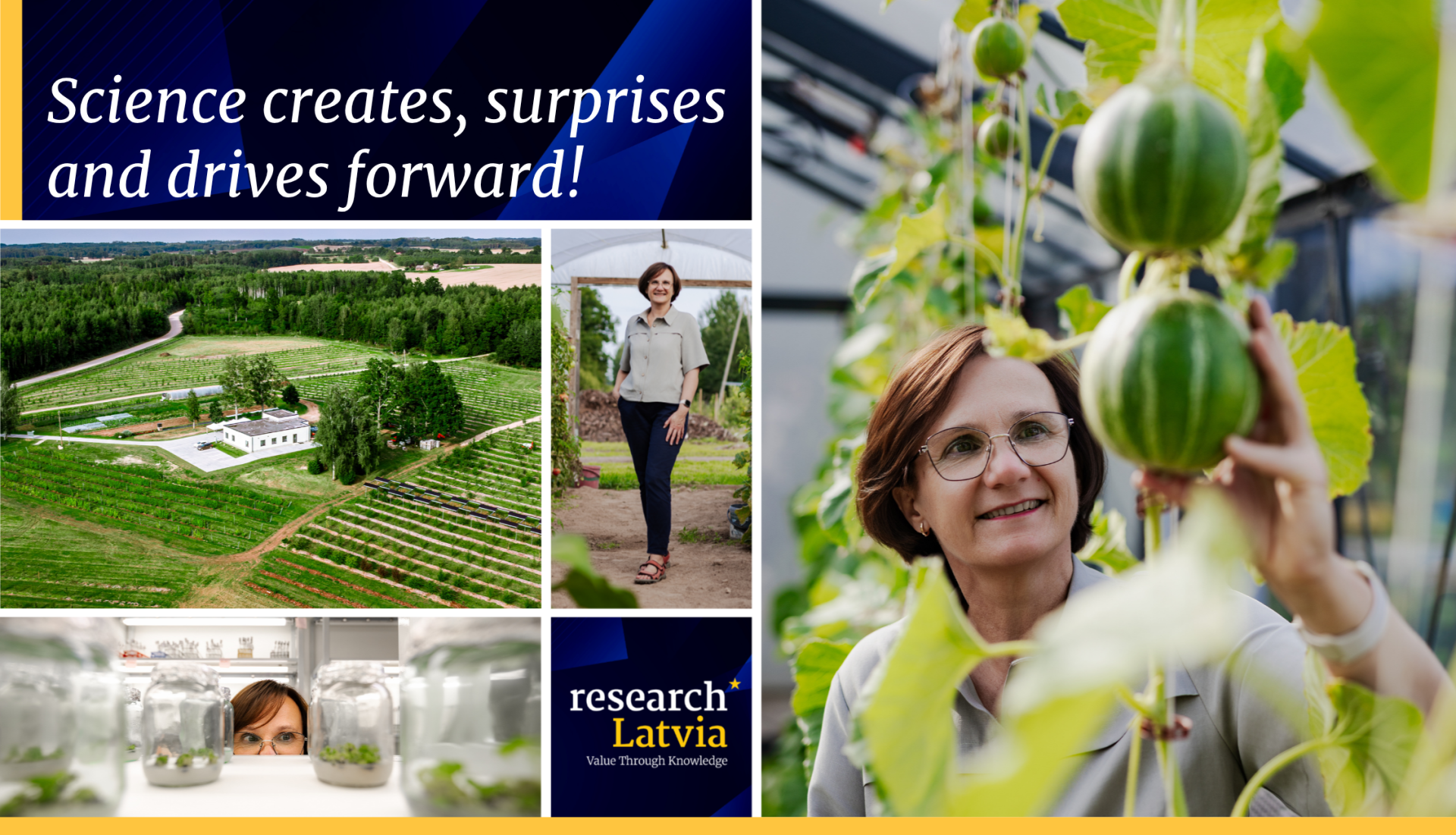
As a Head of Scientific Board, Leading Researcher at the Agrotechnical Research and Variety Evaluation Department at the Institute of Horticulture (IH) Dr. agr. Līga Lepse, where she has dedicated several decades to researching vegetable cultivation technologies and plant breeding. Her work addresses questions of growing global importance – how to produce healthy, high‑quality vegetables while protecting the environment and using resources responsibly.
“I believe that almost anything is possible – as long as we look for solutions with an open mind. The discovery that helps humanity while preserving the world is truly significant.”
As a Head of Scientific Board, Leading Researcher at the Agrotechnical Research and Variety Evaluation Department at the Institute of Horticulture (IH) Dr. agr. Līga Lepse, where she has dedicated several decades to researching vegetable cultivation technologies and plant breeding. Her work addresses questions of growing global importance – how to produce healthy, high‑quality vegetables while protecting the environment and using resources responsibly.
Her current research focuses on the efficient and cost‑effective use of fertilizers, preventing soil fertility loss and ensuring that cultivation practices do not place unnecessary pressure on ecosystems. This helps ensure that consumers receive vegetables grown in Latvia in a manner that is safe for both human health and the environment.
The Institute of Horticulture is Latvia’s leading centre for vegetable and fruit research. It works on selecting plant varieties suited to Baltic geo‑climatic conditions, developing environmentally friendly cultivation systems, advancing innovative food products, and promoting scientific knowledge through public engagement.
Līga began her scientific career at the Pūre Horticultural Research Station, initially working with genetic vegetable resources and later shifting her focus to cultivation technologies. She notes that horticultural research is captivating precisely because of its unpredictability – you can never be entirely sure of the outcome, yet success requires precision, patience and deep knowledge.
For ten years, Līga has been part of the Institute of Horticulture, which she describes as an excellent environment for growth and collaboration. She values the teamwork required in horticulture: good results are rarely achieved alone. She especially appreciates her colleagues at the Pūre Research Centre, where everyone works toward shared goals.
Līga highlights the importance of applied science, which connects researchers with society. “A Latvian always carries the spark of a gardener within them,” she says, explaining why horticultural research resonates so strongly with the wider public. Through lectures, seminars and discussions, she regularly translates complex scientific concepts into accessible, practical knowledge for farmers, students and consumers.
Collaboration with entrepreneurs is equally essential. Līga actively participates in joint projects that identify industry challenges, develop solutions and evaluate their effectiveness in real production environments.
Her ability to link theory with practice, laboratory insights with field realities, and scientific research with society’s needs, defines Līga Lepse’s work. Through this bridge‑building role, she has become one of Latvia’s leading figures in the field of horticultural science.
Watch the video story highlighting the research of Dr. agr. Līga Lepse
The science calendar “Research Latvia 2026” and the researcher descriptions were developed within the ERDF-funded project No. http://1.1.1.1/1/24/I/001 “More Efficient Implementation and Management of Latvia‘s Science Policy”, implemented by the Ministry of Education and Science.