Laima Vēvere entered science while looking for a profession that would not involve routine. For 15 years, she has worked at the Latvian State Institute of Wood Chemistry (LSIWC), researching polyurethane materials derived from renewable raw materials, including their use in cryogenic insulation. The insulation materials developed by her and her colleagues have also been used in Europe’s “Ariane 6” launch vehicle, while the researcher is now working on a material that could in the future be used in aircraft powered by liquid hydrogen.
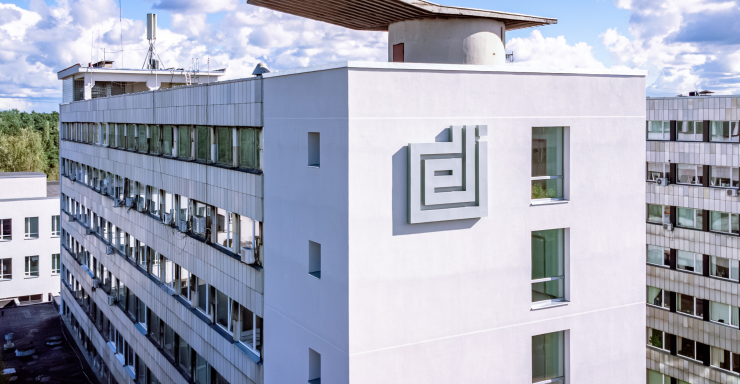
LSIWC is currently implementing the European Regional Development Fund co-financed project “Development of the Bioeconomy Centre of Excellence at the Latvian State Institute of Wood Chemistry ‘WoodChemPlus’”. Its aim is to develop the institute’s scientific infrastructure and research capabilities in three areas of Latvia’s smart specialisation strategy, or RIS3 – knowledge-intensive bioeconomy, photonics and smart materials, technologies and engineering systems, as well as biomedicine, medical technologies and pharmaceuticals.
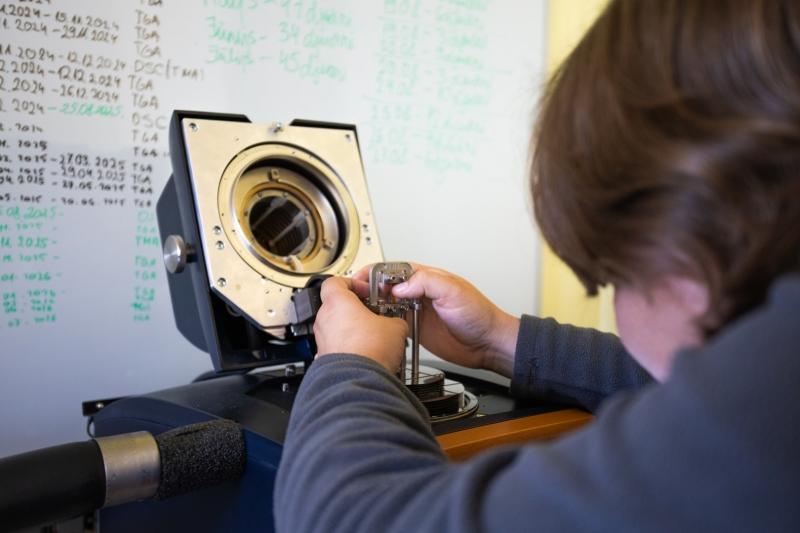
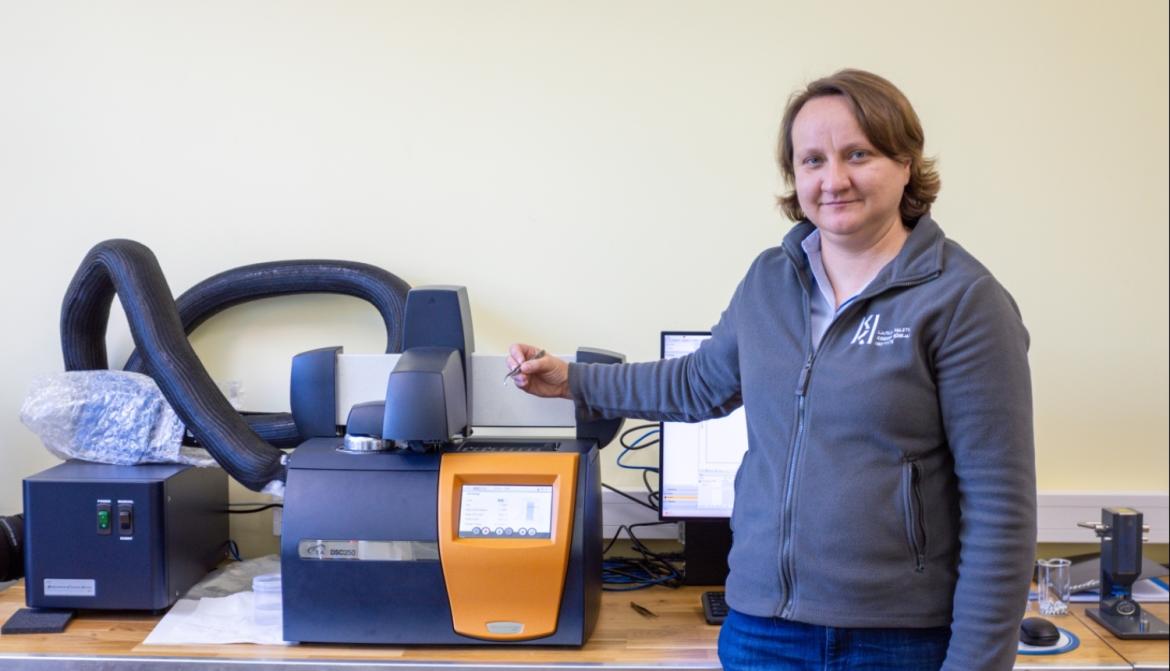
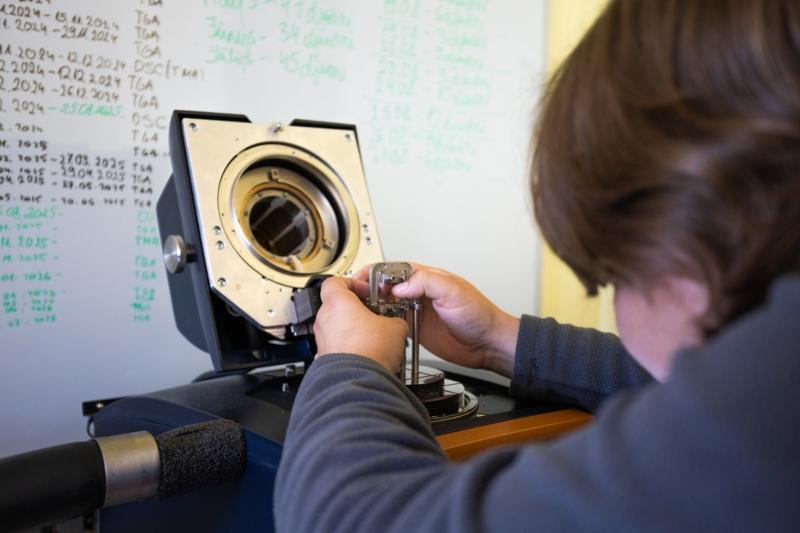
Thanks to European Union funding, the institute has acquired several new pieces of equipment, including a differential scanning calorimeter and a dynamic mechanical analyser. Laima will also work with them on a daily basis when developing and testing new polyurethane materials.
Polyurethane is found in many places – in thermal insulation and construction foams, mattresses, furniture fillings and car interior components. Researchers at the LSIWC Polymer Laboratory are looking for ways to produce it from renewable raw materials, mainly using tall oil – a by-product of cellulose production.
One of Laima’s main research areas is rigid polyurethane foams intended for cryogenic insulation. Unlike thermal insulation materials used in everyday applications, they must retain the required properties at extremely low temperatures. Cryogenic insulation is discussed when a material must withstand temperatures of at least –150 degrees, while in the laboratory samples are also tested in liquid nitrogen, whose temperature reaches approximately –196 degrees.
“In Latvia, we are unlikely to experience temperatures below –40 degrees outside the window, but our materials must withstand much harsher conditions. Moreover, it is not enough simply to provide insulation – we also need to understand whether the material shrinks or collapses in the cold and whether it retains its mechanical strength,” says the researcher.
LSIWC has accumulated considerable experience in this specific research niche, and Laima describes the institute as one of the European leaders in the development of polyurethane materials derived from renewable raw materials for cryogenic insulation. For example, one of the Polymer Laboratory’s significant achievements is its participation in the development of the European “Ariane 6” launch system. LSIWC scientists developed polyurethane foam insulation for the rocket’s cryogenic fuel tanks, and Laima also became involved in the work during the final stage of the project.
“‘Ariane 6’ uses liquid hydrogen and oxygen. To keep hydrogen in a liquid state, it must be maintained at a temperature of approximately –253 degrees, so the fuel tanks require particularly effective insulation. At the same time, the material must be very light, because sending each additional kilogram into space significantly increases the cost of the flight,” she explains. “Moreover, this is by no means the only space project in which Latvian scientists and companies are involved. Although Latvia does not have its own launch vehicles, it can be said without exaggeration that Latvia’s contribution to the European and global space sector is significant.”
Laima is currently working on another innovative material that could in the future be used for the insulation of aircraft powered by liquid hydrogen. The aviation industry is looking for ways to reduce its dependence on fossil fuels, and alongside electric aircraft, one possible solution is the use of hydrogen. Although the widespread use of such passenger aircraft is not yet a matter of the near future, the materials required for such aircraft are already being researched and developed.
“Although in this case we are also talking about hydrogen, the requirements in aviation differ from those in space technologies. A rocket is launched relatively rarely, whereas an aircraft can take off, land and be refuelled several times in a single day. Therefore, the insulation must withstand repeated cooling and warming cycles. At the same time, it must be very light, durable and efficient,” explains Laima.
The differential scanning calorimeter acquired within the “WoodChemPlus” project will allow researchers to determine how the structure and properties of a polymer change under the influence of temperature. It is particularly important to determine the so-called glass transition temperature – the threshold at which a solid polymer becomes more flexible and its other properties also change. Meanwhile, the dynamic mechanical analyser will allow the material to be cooled or heated while simultaneously being subjected to mechanical stress, for example, compression or stretching, in order to test whether it retains the required strength under real conditions of use.
Laima does not hide that her path to science was full of reflection. As a child, she wanted to become a teacher, and later considered journalism and law. At school, she was particularly good at history and chemistry, but in the end practical experience helped her make her choice – while still in secondary school, Laima took part in an event organised by the University of Latvia, now known as “In the Shoes of a Student”, and spent a day following a chemistry student. She says that almost nothing in the third-year lectures was understandable, but the laboratory work fascinated her. Later, at an event organised by Riga Technical University about career opportunities in the chemical industry, Laima learned how diverse the professional opportunities offered by a chemistry education are.
“I knew that I did not want a routine job. At first, however, I thought that only winners of international or at least national Olympiads could work in science. While studying, I realised that this was not the case,” she recalls.
In the third year of her bachelor’s studies, Laima was offered the opportunity to write her final thesis at LSIWC. She began working at the institute even before obtaining her first academic degree, and this summer marked 15 years since she started working at LSIWC. Laima encourages young people who are still considering their future profession not to be afraid of chemistry. The demand for chemists is so high that the institute tries to attract promising young specialists already at the beginning of their bachelor’s studies.
“If we want to have good specialists, we train them ourselves – sometimes starting from the very first year. I do not know a single chemist who wants to work in the field but is unable to find a job. Chemistry opens up very broad opportunities. You could say that chemists are snapped up like hot cakes!” she jokes.
The story was created with the support of EU funds.