They work at the European Organization for Nuclear Research, or CERN, in Switzerland, at research centres across Europe, universities in America and elsewhere around the world. Their knowledge, experience and international contacts represent a potential for Latvian science that is far from being fully utilised. How can the bright minds of the diaspora find one another, how can a sense of belonging to Latvia be transformed into real cooperation, and how can Latvian science make its voice heard ever more convincingly on the global stage?
The First Step Has Been Taken
The world of science knows no borders, ideas travel across continents, and researchers collaborate with colleagues thousands of kilometres away. Some scientists work here in Latvia, while others have been building their professional lives outside Latvia for years, yet their connection to their homeland remains. Many want to help Latvian science grow, so they share their experience, participate in research projects and open doors that would otherwise be more difficult for Latvian scientists to access.
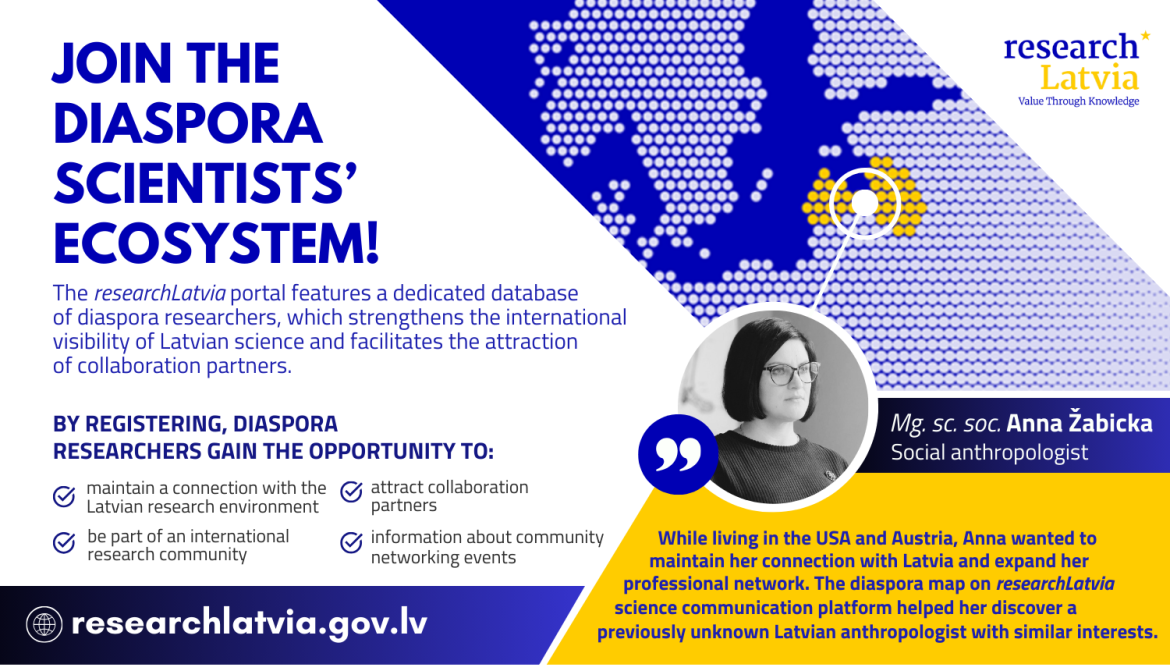
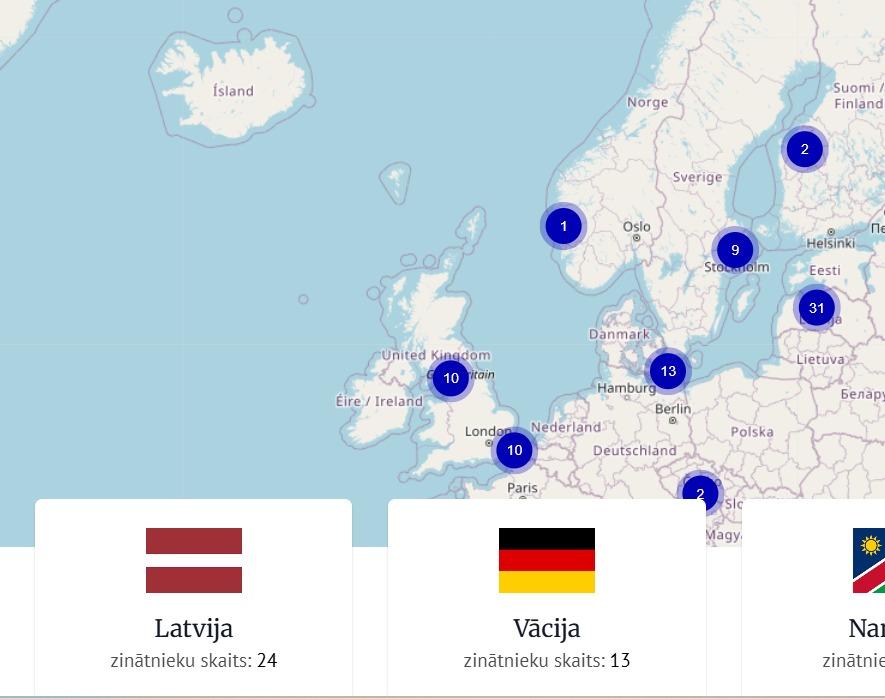
While previously, on the Latvian Radio programme "Global Latvian. 21st Century", we were concerned about how to prevent bright minds from leaving Latvia, today, after two years of building a database of diaspora scientists on the "ResearchLatvija" platform, we can estimate that more than 700 scientists of Latvian origin are working abroad, and more than two-thirds of them are willing to collaborate with scientists in Latvia.
Ilze Dimanta, Doctor of Biology and Senior Expert on International Cooperation and Diaspora Issues at the Department of Higher Education, Science and Innovation of the Ministry of Education and Science, explained what it means to be a diaspora scientist – someone who is currently abroad or spends most of their time living and working outside Latvia.
"Scientific migration is part of the nature of science, so in our profession, it is quite common for researchers to leave, return or remain abroad and continue collaborating. Currently, there are around 120 researchers on the active scientists' map, and our goal is to add at least 50 new participants every year, focusing not just on numbers but on real expertise and tangible results," explained Dimanta. However, numbers on paper are only the beginning – for the system to thrive, scientists need to see its practical value and reach the so-called critical mass.
In her opinion, the database should become a practical tool that helps people find specific cooperation partners – some need a mentor, others need research infrastructure, doctoral students need experienced supervisors, while others need international partners for joint projects.
Ilga Švāne, Chairwoman of the European Latvian Association, agreed that only the first steps have been taken so far in identifying diaspora professionals. She also sees the database as a good starting point, emphasising that much more needs to be done to raise awareness of its existence: "In my opinion, this database is just a kind of runway for further development. It is a tool that should be promoted and explained more widely so that people know what we have and what we can offer one another."
As the researchers acknowledged, one of the biggest obstacles so far has been a lack of information on both sides and busy daily schedules, which often leave opportunities to get to know one another at the bottom of the priority list.
A Special Nickname for Latvians
Inta Mieriņa, Director of the Centre for Diaspora and Migration Research at the University of Latvia and Tenured Professor, pointed out: "In the latest survey, we were somewhat shocked by how busy diaspora scientists are and how few of them even knew about the opportunity to register in the database – it was less than ten percent! Information, information and more information is the very first step, because those living abroad lack information about what their colleagues in Latvia are doing, and university websites are not always organised in a way that allows researchers abroad to easily find suitable partners."
Despite information barriers, Latvian scientists at the world's leading research centres are already breaking stereotypes and earning respect for our country.
Kristaps Paļskis, who completed his doctoral thesis in particle physics in Switzerland and has now returned to work in Latvia, sees enormous added value in international synergy, especially for the younger generation of scientists: "In Latvia, we certainly have many very good ideas, but sometimes we lack the kind of infrastructure available at the world's major research centres. The younger generation is certainly very open to additional expertise from abroad, especially in fields of science that are completely new to Latvia. Now that we also have tools to find and reach out to our compatriots around the world, this is an even better opportunity to develop something new right here at home."
Latvians working at CERN demonstrate on a daily basis what this cooperation looks like in practice in major scientific research. Their work ethic has even earned them a special nickname, Kārlis Dreimanis revealed with a laugh, explaining that in the international environment, Latvians are often referred to as "Energizer" batteries – small bundles of energy who accomplish more than one might expect from a single person.
Kārlis Dreimanis, an employee of Riga Technical University (RTU), Director of the Centre of High Energy Physics and Accelerator Technologies, an experimental particle physicist and one of the Latvians who leads a group of scientists at CERN in Switzerland, urged: "We need to let go of the fear and resentment that someone from outside will come and take away a piece of our funding, because a good person might take a slice on the first day, but the day after tomorrow they will bring a new sandwich, and there will be more for everyone! Just six years ago, when someone at CERN asked me where I was from and I said Latvia, they replied: 'Oh, Lithuania!' I haven't heard such a misunderstanding for more than a year now, because if we want to be regarded as important partners and protected, the world first needs to know that we exist."
Kārlis also emphasises that finding Latvian scientists around the world is not always easy. He himself knows several Latvian colleagues working at different universities, but he is not certain that all potential cooperation partners have been identified.
His words reveal a significant problem – scientists may be willing to cooperate, but if they do not know about one another's existence, interest alone will not change anything. However, even when contacts have been established, the next question arises – is Latvia's scientific environment open enough to welcome experience gained abroad and new colleagues?
Should We Be Afraid of Competition?
It also seems appropriate to ask whether there are concerns that the arrival of diaspora scientists could create competition for already limited funding or employment opportunities. The programme participants encouraged a different perspective on such cooperation – Kārlis Dreimanis believes that someone who comes from abroad with new knowledge and experience is not a competitor, but rather an opportunity for everyone to achieve more together: "If a good person comes to you from outside, they may take something of what you have on the first day, but the day after tomorrow they will bring new tools, and there will be more for everyone. We need to learn to understand that people from outside do not come to take something away – they come to contribute, to become colleagues and friends."
Of course, funding also plays a significant role in science. Inta Mieriņa acknowledges that even highly interested researchers sometimes fail to establish cooperation for one reason – there is no funding available for joint projects: "I have personally experienced situations where diaspora scientists approach me, and I would be very happy to collaborate with them, but if we have no project opportunities, we simply cannot make it happen in practice. We can write joint publications and project applications, but much more would be possible if there were greater funding for science."
But why would a diaspora researcher with a degree from Cambridge, who was not even born in Latvia, want to collaborate and work in the land of their ancestors? The answers often carry an emotional note – Kārlis Dreimanis pointed out that Latvia's scientific environment offers an opportunity to significantly influence the development of a particular field, establish research groups and promote new research directions.
While at a large American university, dozens of specialists may work in a single field, in Latvia's small research community, each person's contribution can be much more noticeable. Moreover, Latvia is Latvia – dear, beautiful, and there is a desire to do something good for it.
Kārlis Dreimanis stated: "In Latvia, there is plenty of room to establish yourself in a relatively leading position, build groups, be a driving force and move forward. If you come to the University of Latvia, where there are three people in your group working in a particular field, and then go to a university in the USA, there are 35 people in the same kind of group. There will always be greater opportunities to make your voice heard a little more loudly in Latvia. At least that is how I see it."
It is not necessary to want to return and move to Latvia – it is enough to have the desire to contribute, help a young researcher, participate in a joint project or open doors for Latvian colleagues to the international scientific community. Latvia is not just a place that scientists leave. It can also be a place to which they return with their knowledge, experience and ideas – even if their daily work still takes place on the other side of the world.
If you would also like to become part of the Latvian diaspora scientific community, you can find more information here