Latvian start-up Catalyco has received €90,000 in investment from EIT RawMaterials to scale a low-emission technology that enables the recovery of high-purity zinc oxide (ZnO) from industrial side streams. Zinc oxide is a critical material widely used across global industries.

The investment was secured through the EIT RawMaterials Accelerator Programme, alongside additional support from the European Institute of Innovation and Technology (EIT) Regional Innovation Scheme (RIS) for Innovation Projects. The funding is being used to advance Catalyco’s technology from laboratory research toward pilot-scale readiness and commercial development.
Catalyco has developed an innovative, cost-efficient and low-emission metal recovery process that enables the extraction of zinc and other valuable metals from industrial residues. Unlike traditional recovery methods, which are often costly and technically complex, Catalyco applies a thermal, multi-step precipitation process, enabling the efficient recovery of high-quality and sustainable zinc oxide.
The recovered ZnO is used in catalysts and absorbents, with a wide range of applications across the chemical, cosmetics, rubber and tyre industries, as well as other industrial sectors.
“The support from EIT RawMaterials allowed us to make a significant step from laboratory research toward pilot-scale development,” said Reinis Spunde, CEO of Catalyco.
“It helped us further optimise our zinc oxide recovery technology, produce high-quality samples for industrial testing, and validate the commercial potential of our solution. At the same time, we strengthened our business model, engaged with potential customers and laid the groundwork for the next phase – the implementation of a pilot plant.”
Catalyco’s solution makes a strong contribution to the circular economy and the sustainability of industrial production, offering significant environmental benefits compared to conventional raw material extraction and processing methods:
- Water savings: potential reduction of more than 600,000 m³ per year
- CO₂ emissions reduction: through circular, low-emission production processes
- Waste reduction: more than 230,000 tonnes of waste per year diverted from landfills
These results demonstrate the technology’s potential to substantially reduce the environmental footprint of zinc oxide production.
Next steps
Catalyco is currently participating in a consortium conducting eight new material recovery tests to establish a robust technical and analytical foundation for scaling the technology toward pilot-level implementation. This phase is supported by the EIT Regional Innovation Scheme (RIS) for Innovation Projects, which focuses on accelerating high-potential start-ups in regions with growing innovation capacity.
About EIT Community Hub Latvia
EIT Community Hub Latvia is the official national representation of the European Institute of Innovation and Technology (EIT) in Latvia. Its activities are coordinated by Riga Technical University (RTU) and supported by the Ministry of Education and Science and the Latvian Council of Science. The Hub’s mission is to promote the engagement of Latvian companies, researchers and students in European innovation networks and funding programmes.
EIT - MAKING INNOVATION HAPPEN!
About the European Institute of Innovation and Technology (EIT):
The EIT strengthens Europe’s ability to innovate by powering solutions to pressing global challenges and by nurturing entrepreneurial talent to create sustainable growth and skilled jobs in Europe. The EIT is an EU body and an integral part of Horizon Europe, the EU Framework Programme for Research and Innovation.
The Institute supports dynamic pan-European partnerships, EIT Knowledge and Innovation Communities (KICs), among leading companies, research labs and universities. These KICs are dedicated to driving systemic change in Europe and beyond, focusing on key areas of climate change, energy, health, food, manufacturing, raw materials, digitalisation, urban mobility, culture and creativity, and water. Together with their leading partners, the EIT Community offers a wide range of innovation and entrepreneurship activities across Europe: entrepreneurial education courses, business creation and acceleration services and innovation driven research projects.
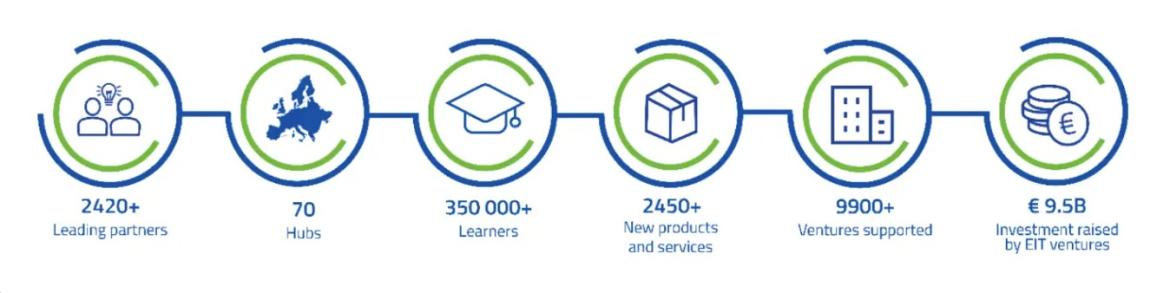
EIT facts and figures
Find out more!
Keep an eye out for news, events, and opportunities on the EIT website and on our LinkedIn page!