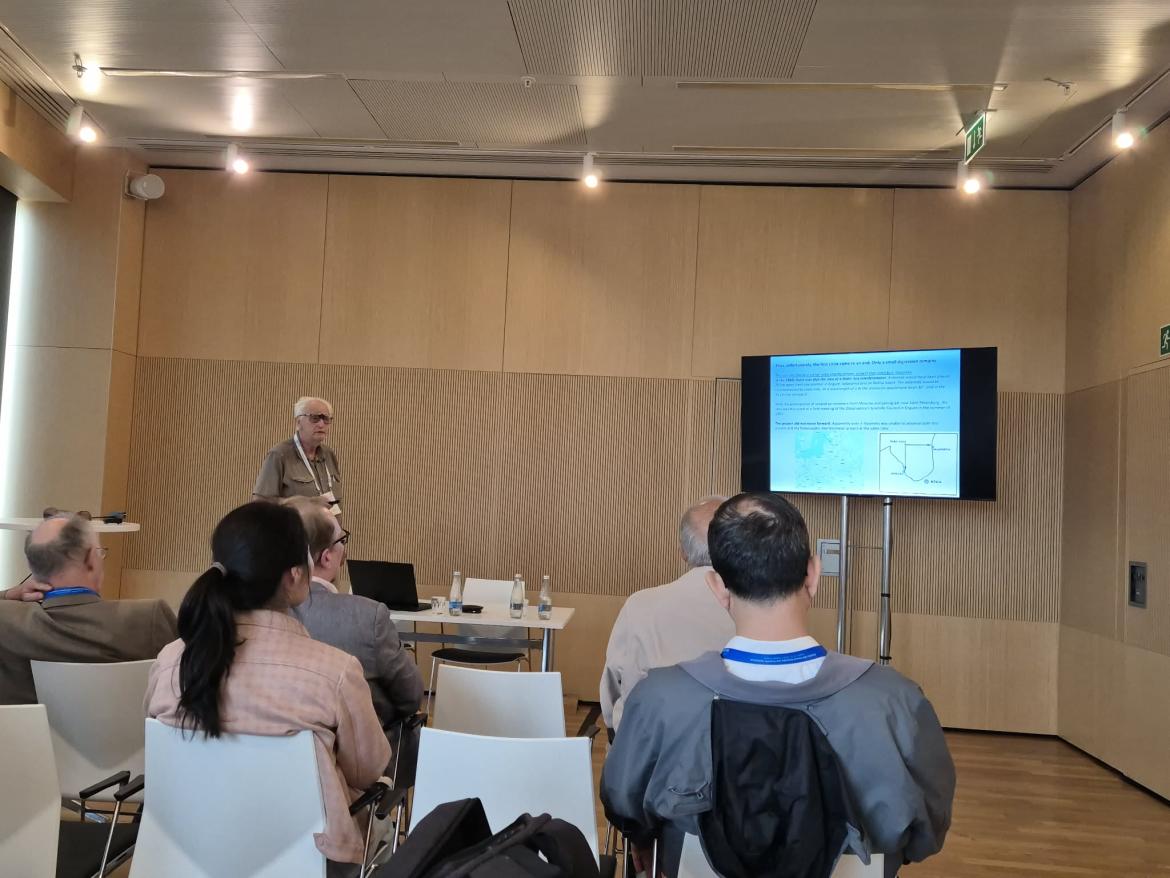
Leading researcher from the Ventspils International Radio Astronomy Centre presents the development of radio astronomy in Latvia at the URSI General Assembly
September 7, 2026
Ivars Šmelds, Leading Researcher at the Ventspils International Radio Astronomy Centre (VIRAC), participated in the URSI General Assembly, which this year took place from 15 to 22 August in Kraków, Poland. At the Assembly, he gave a presentation entitled “Radio Astronomy in Latvia – from the Idea of a National Radio Interferometer to Participation in Radio Interferometry Networks”. Ivars Šmelds participated in the Assembly at the invitation of the event organisers.
One of the Assembly sessions was dedicated to the history of radio astronomy in the Baltic region and Ukraine. During this session, I. Šmelds provided an overview of the development of radio astronomy in Latvia, from its beginnings in the 1950s to the present day. The presentation covered the idea of establishing a national radio interferometer, the development of solar radio astronomy at Riekstukalns in Baldone, as well as the establishment of VIRAC following the takeover of the Irbene radio telescopes in 1994.
Particular attention was paid to the development of VIRAC – from infrastructure that was initially partially damaged and taken over without technical documentation, a modern radio astronomy centre was successfully created. The presentation described VIRAC’s path towards integration into European radio interferometry infrastructure – from the first VLBI experiments and support from international partners to successful observations within the European VLBI Network, full membership in EVN and JIVE ERIC, and the establishment of a LOFAR station in Irbene.
The researcher also presented the modernisation of the RT-32 and RT-16 radio telescopes, the introduction of new receivers, computing systems, and precise time synchronisation systems, as well as VIRAC’s latest capabilities, including in-house developed receiving systems and preparations to support lunar and deep-space missions.
The International Union of Radio Science (URSI) is an international scientific organisation that brings together researchers in radio science and related fields – electromagnetic wave propagation, radio communication technologies, radio astronomy, remote sensing, and other studies of electromagnetic processes. The URSI General Assembly and Scientific Symposium (URSI GASS) is the organisation’s most important international scientific forum and takes place once every three years.
This year, the congress’s scientific programme included approximately 1,300 accepted scientific papers – ranging from electromagnetic metrology, wave propagation, and radio communications to ionospheric research and radio astronomy. The extensive programme featured more than 500 thematic sessions, as well as plenary lectures, specialised seminars, programmes for young scientists, and a student scientific paper competition. The event brought together scientists, engineers, and industry experts from many countries around the world, providing an opportunity to present the latest research results, discuss development trends in radio science, and promote international scientific cooperation, including in interferometry networks such as JIVE and LOFAR technologies.
The information has been prepared within the framework of the European Regional Development Fund project No. 1.1.1.5/3/25/I/012 “International Cooperation and Innovation of Ventspils University of Applied Sciences for the Development of Latvia’s Smart Specialisation”.