Ornithologist Mārtiņš Briedis is a leading researcher at the Institute of Biology of the University of Latvia (UL) and has also been working at the Swiss Ornithological Institute for almost nine years, studying bird migration. M. Briedis says of himself: I still have one foot in Latvia, but my main job is in Switzerland. I interviewed the researcher about working in science in different countries, the use of the latest technologies in ornithology and how birds spend the height of summer in Latvia.

How did you come to pursue research in Switzerland?
When I completed my master’s studies at what was then the Faculty of Biology at the University of Latvia, I began doctoral studies at Palacký University in the Czech Republic (Univerzita Palackého v Olomouci), where cooperation with the Swiss Ornithological Institute had already begun. After that, I spent two years here on a specific postdoctoral project, and then moved into a researcher position.
I know that you equip birds with geolocators. Do you use such cutting-edge technologies only in Switzerland, or is it also possible to study birds in Latvia in this way?
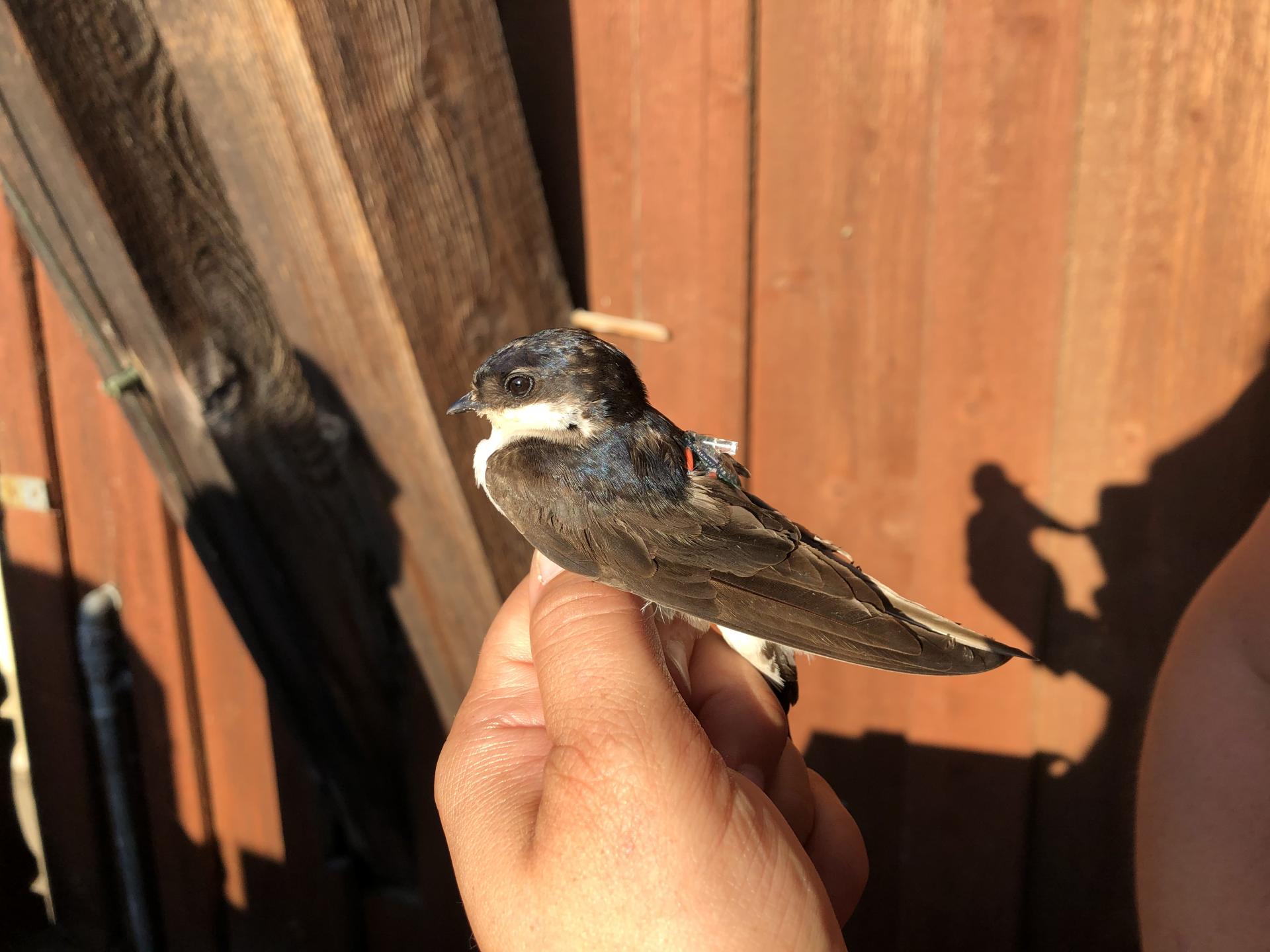
I began using geolocators during my doctoral studies in the Czech Republic. At that time, this was done in cooperation with the Swiss institute where I currently work. There are several such projects here in Switzerland where we do this, but we also work on various projects in other European countries. Latvia is one of these countries. My work at the University of Latvia began in 2020, when we received funding for a project from the Latvian Council of Science on common starlings, in which we used geolocators to study migration. We are still doing this. (1) In cooperation with bird ringer Kaspars Funts, we are also studying the common whitethroat in this way.
To what extent do the latest technologies currently available influence bird research and open up new horizons?
Specifically in the study of migration and, more particularly, small passerine birds, the emergence of geolocators was a truly significant turning point. It was around 2007 or 2008 that the first such technologies appeared. The idea of creating and using such geolocators was borrowed, I think, from studies of large marine mammals. So, already in the 1970s, the idea had emerged that data from light loggers could be used to determine where a bird was located. However, as early as the 17th century, sailors could determine where they were in the ocean based on the length of the day and the timing of noon and midnight. In the study of small birds as well, geolocators initially recorded only light, and its intensity was used to calculate where the bird had been at any given moment. This did not yet provide very precise data, but it was already a small revolution in the study of small birds. GPS transmitters can be used for storks, eagles and other larger birds, but they are far too heavy for small birds. Therefore, geolocators played a revolutionary role in research on the migration of small birds.
If I understand correctly, by using geolocators you can now even determine how much energy birds expend and what weather conditions they have experienced. How is this possible?
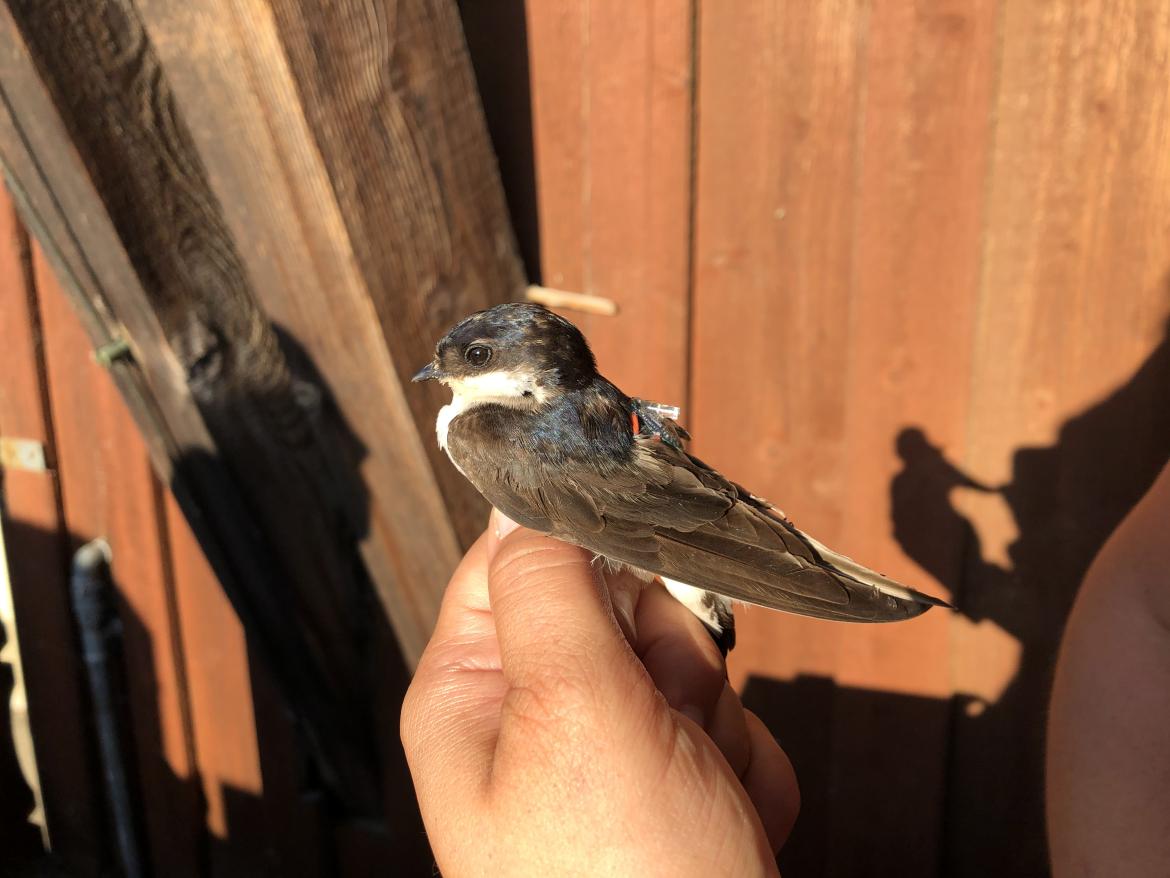
Twenty years ago, we could determine only the place and time of migration, but nothing more. In recent years, geolocators have been equipped with various sensors that also measure atmospheric pressure, temperature and activity. Just as our phones have activity sensors that measure our steps, geolocators also show what a bird was doing at any given moment — whether it was flying, feeding or sitting at rest. These data also make it possible to estimate the energy budget used by the birds. An energy budget has several main components. One is basal metabolism, which humans also have. We expend energy even while sleeping. Then there is thermoregulation, and from temperature data we can determine what kind of climate the bird was in: whether it needed to warm its body or, on the contrary, cool it down, which also consumes energy. The third component of the energy budget is movement: whether the bird is flying, feeding, walking or sitting somewhere in a bush without moving. By combining these three elements, we can estimate the energy budget.
Can these data be used to determine how much the bird would have needed to eat?
Yes! These activity measurements show what the bird was doing during every five-minute period, whether it was flying or sitting. When thinking about migration, we were very interested in the birds’ flights, and we were able to determine the duration of migration flights with five-minute precision. We now know that, when crossing the Sahara Desert, many species fly continuously for 30 hours without landing even once. Meanwhile, atmospheric pressure data allow us to determine how high they fly. Namely, pressure is lower at higher altitudes. Therefore, we can calculate that a bird, for example, flew at an altitude of three or five kilometres. Small birds fly across the Sahara Desert at very high altitudes.
However, to obtain the data, the bird fitted with the geolocator must be caught again. These data are not transmitted online. That is how it is. Neither geolocators nor GPS devices can accommodate large, powerful batteries, because they are heavy. Birds of small species weigh as little as 13 grams. Therefore, the device attached to them must weigh no more than half a gram, including the battery. For this reason, we cannot use transmission technologies that consume a great deal of battery power. At the Swiss Ornithological Institute, we are currently working on making it possible to at least download the data remotely. The data could then be read using an antenna when the bird returns to its breeding site, without us having to catch it, because some species are very difficult to recapture. In principle, we are probably the only ones in the world trying to develop such a technology. However, it is not known whether we will succeed in creating it. When working with new technologies, many years seem to disappear into nothing, spent merely testing things that do not work. To understand whether we have done something correctly or incorrectly, we always have to wait for the bird to return, which means waiting a year. We cannot learn from our mistakes immediately.
So you cannot promise that the new technology will be available soon?
That’s right, yes.
Which species are particularly difficult to recapture? And why? Do they learn from experience?
The easiest species to work with, of course, are those that nest in nest boxes. For example, the common starling is a relatively easy species to study because it lives in a nest box. We can easily find starling nests, and it is also easy to catch the bird in the nest box because we know it will come there. It is more complicated with species that do not nest in nest boxes. First, we have to determine which bush or patch of vegetation the bird lives in. Then nets have to be set up there. We joke that fitting geolocators is easy. The difficult part is catching exactly the same birds the following year in order to retrieve the data.
Yes, and there are species that always learn and become smarter. For example, shrikes are very intelligent and actively avoid traps. They very quickly realise that something is wrong and avoid them. There are also species that live in places where it is very difficult to catch them, for example in open agricultural landscapes where yellow wagtails or pipits nest. There are no bushes there in which to conceal a net. These birds do not go into bushes either. The net therefore has to be placed in the middle of a meadow, but as soon as even a light breeze begins to blow, the net moves. The birds see it and actively avoid the net. These are the species that are difficult to catch.
What percentage of birds fitted with geolocators are successfully recaptured?
It varies greatly between species. It must also be taken into account that survival rates among small species are not particularly high. We have calculated that only about half of common starlings in Latvia survive until the following year. This means that we cannot even attempt to catch half of them again. I think there have been only two cases when we recovered a geolocator from a dead bird. Our recapture rates are generally between 15 and 40 percent.
You mentioned the Sahara Desert and a 30-hour flight without landing. That is truly remarkable. Which birds are the record-holders in this respect?
Most birds migrate at night, so it is specifically at night that they fly across the Sahara. Many of them descend as soon as dawn breaks. However, some continue flying because they need to cross the Sahara without landing, even if that means flying for more than 24 hours. Among small birds, the record is more than 40 hours, recorded in the great reed warbler. However, among birds in general, the record-holders are bar-tailed godwits. They breed in Alaska but fly across the ocean to winter in New Zealand and Australia. They can fly for as long as 10 days without landing.
There are also birds such as swifts, which also live in Latvia, and Alpine swifts, which essentially live in the sky and land only to breed. Information obtained from geolocators has shown that, for example, both common swifts and Alpine swifts can remain airborne for 9 to 10 months at a time. In other words, throughout the entire period they spend at their wintering grounds outside Europe, they remain in flight. They land only the following spring, when they return to Europe to breed.
Do birds that fly across the Sahara for long periods also eat while in the air, or do they go without food the entire time?
They go without food. That is why they build up fat reserves beforehand, which can be seen very clearly when the bird is held in the hand. In birds, the fat is directly beneath the skin, and the skin is very transparent. It is therefore easy to see how much fat has been accumulated. They build up fat amounting to approximately 30 to 40% of their normal body weight. During these long flights, they burn this fat. Physiologically, burning fat also produces water as a by-product. This means that the birds do not need to drink during this time.
There have been experiments in which these wild birds that migrate to Africa were kept in cages over winter without increasing the amount of food. They still gained weight because it is genetically programmed that, for example, they must gain weight in September. From geolocator data, we know that nightingales flying from Africa through the Arabian Peninsula to Latvia in spring also fly at night. They do not fly during the day, but they do not feed during migration either. During the day, nightingales simply sit in a bush, waiting for the next night, when they continue flying. There are, however, times when they stop, for example, for a week. Then they feed again and build up fat reserves.
You said that bird migration is affected by climate change and that some starlings do not fly to Africa but remain in Denmark, where they eat the food intended for cattle on livestock farms. Can these birds really eat so much that farmers regard it as a problem?
In winter, starlings mostly live in flocks that can contain up to several thousand birds. A bird eats around 15 grams of food per day. If we multiply that by, say, 1,000 birds every day, that amounts to kilograms accumulating over the wintering period. Therefore, farmers who operate open farms that birds can enter certainly see this as a problem that affects their finances and how much feed they have to buy. In addition, researchers in Denmark have already studied what diseases common starlings carry and whether they can be transmitted to cattle. Diseases have been detected in some of the birds; however, at least for now, it has not been found that starlings transmit, for example, avian influenza, as waterbirds do.
Can scientists influence these climate change processes that are also altering bird migration in any way?
I do not know whether we as researchers can do much about it, but it is important for everyone to try to reduce the amount of emissions. However, birds will do what is most advantageous for them. In any case, climate change will also affect which birds survive and which birds pass more of their genes on to future generations. Of course, bird migration strategies are also changing. Long-distance migrants that previously wintered in Africa are increasingly choosing to remain in Europe. This is happening with several species. For example, here in Switzerland, white storks have become a very common sight in winter in recent years. That is not yet the case in Latvia, but it may also happen here at some point.
In Latvia, those same starlings are already very commonly seen in winter. But, continuing with the topic of technologies in ornithology, are there any other new technologies besides geolocators that bird researchers use?
I know more specifically about what is used in migration research. Another technology that is beginning to be used very actively is passive acoustic monitoring. This means placing audio recording devices in nature, for example in a forest, which passively record bird sounds. They are used to monitor breeding birds, because they make it possible to determine, for example, which birds are nesting in the forest without researchers having to be there every day. However, these technologies also help in migration research because, as I have already said, most birds migrate at night, and people usually cannot see them. By recording bird calls, we can learn more about nocturnal migration. Different technologies, of course, have their own advantages and disadvantages. One clear advantage is that researchers do not have to go outside at night to listen to birds. However, the disadvantage is that these devices do not hear as well as the human ear can. Of course, if a bird is flying at an altitude of several kilometres, people cannot hear those birds either. Therefore, in addition to acoustic audio recorders, my colleagues in Switzerland also use radar. Incidentally, we also deployed them at Pape for four or five seasons. The radars detect birds flying overhead within a narrow band at altitudes of up to several kilometres and also determine the size of the bird. By combining data from acoustic recorders and radar, we can see which species are flying at any given moment, because radar can also detect the frequency of a bird’s wingbeats. For example, passerine birds fly by flapping their wings and then dropping down. Then they flap their wings again and drop down again. This is a flight pattern typical of passerines. The radar detects this, and we can say that it is some kind of passerine bird. Acoustically, the species can in turn be identified by its call. Thus, these different methods complement one another, and we can obtain more information.
This issue of the newspaper is published at the end of June. What is this time of year like for birds in Latvia?
By the end of June, migration is mostly over. Active nesting is taking place, although for some species it has already ended. Those whose nesting season has ended are moulting. At least small birds replace their entire plumage once a year. Moulting, like feeding chicks, is also a very energy-demanding period. Therefore, birds do not do both at the same time, because energetically it would be too demanding. Perhaps the first autumn migrants already begin to appear at the end of June, although this usually happens more around mid-July. At that point, some birds nesting in Latvia begin to leave, while others arrive here from the north. Geolocator data have shown that some Latvian starlings already fledge their young in June. There are some starlings that are already in Germany by mid-June. This means that they have already flown away from Latvia. They do not have a second brood that summer because they are already 1,000 kilometres away. Since 2020, when we began studying starling breeding in nest boxes, we have never observed them having two broods in one season, although starlings in Germany sometimes breed twice. However, there are species that breed several times during one summer in Latvia. For example, the sparrow is one of the species that has two or even three broods a year. Later in July, the first wading birds that return to us from the tundra, where they have nested, begin to appear in Latvia. Then the migration of warblers also gradually begins.
But why do some starlings fly here to breed if they could apparently do so in even more favourable conditions in Germany?
It is probably competition that has gradually pushed them further north over the course of evolution, where there are also areas suitable for breeding. We have a relatively short summer, but food availability is very high. For example, we have far more insects than Western Europe. Birds take advantage of this. It appears that the energetic costs of migration, and therefore of flying, are not significant enough to deter them. By flying further north and then flying back, the benefits are much greater than those of remaining in the same place all year round.
To what extent do research opportunities, funding and technological resources differ between Switzerland and Latvia, as well as other countries with which you have collaborated?
The situation in Latvia is not as bad now as it was when I was a student. I began my studies in 2008. It is now possible to apply for funding from the Latvian Council of Science at least once a year. If we compare Latvia with other countries, perhaps we are not in as favourable a position as researchers in the Czech Republic, Switzerland or Germany, where more funding is available for research. There, the funding can also be used more flexibly, whereas in Latvia the framework for using funding is quite strictly defined. For example, projects must begin on 1 January and end three years later on 31 December. If I receive funding in Switzerland for a project of a similar nature, I can choose when to start it. For example, I receive funding for four years and can choose when to begin the work within the period from 1 January to 1 June. When we are talking specifically about field research involving birds, it is important not to miss the spring season. At the Swiss Ornithological Institute, most of the funding comes from donations, which account for approximately 70 to 80% of the institute’s total budget.
Are the donors private individuals or companies?
They are mostly private individuals. Switzerland has approximately 9 million inhabitants, and the level of prosperity is, of course, very high, which encourages such donations. The average amounts people donate are not particularly large. One person may donate only around 20 or 30 euros a year. However, because there are so many donors, a large sum is collected. In recent years, people have also begun leaving money to the institute in their wills. Some of the research carried out at the institute is related specifically to bird conservation in Switzerland, and most donations are intended for these projects. Many people may donate because the situation in Switzerland is rather bleak: due to the intensification of agriculture and the large population, bird numbers are declining. Forest birds in Switzerland are still doing very well, but the situation is bleak for those whose habitat is agricultural land. The institute, meanwhile, has an image as an organisation that protects Switzerland’s birds.
Photos from Mārtiņš Briedis’s archive were used in the article