The reforms implemented to date in higher education and science, along with the successful scientific performance of institutions, have enhanced the international competitiveness of Latvian science. This is evidenced by the growing involvement of Latvian scientific institutions in significant European and other international cooperation networks, research consortia, and programmes (such as Horizon Europe), including the attraction of project funding to Latvia.
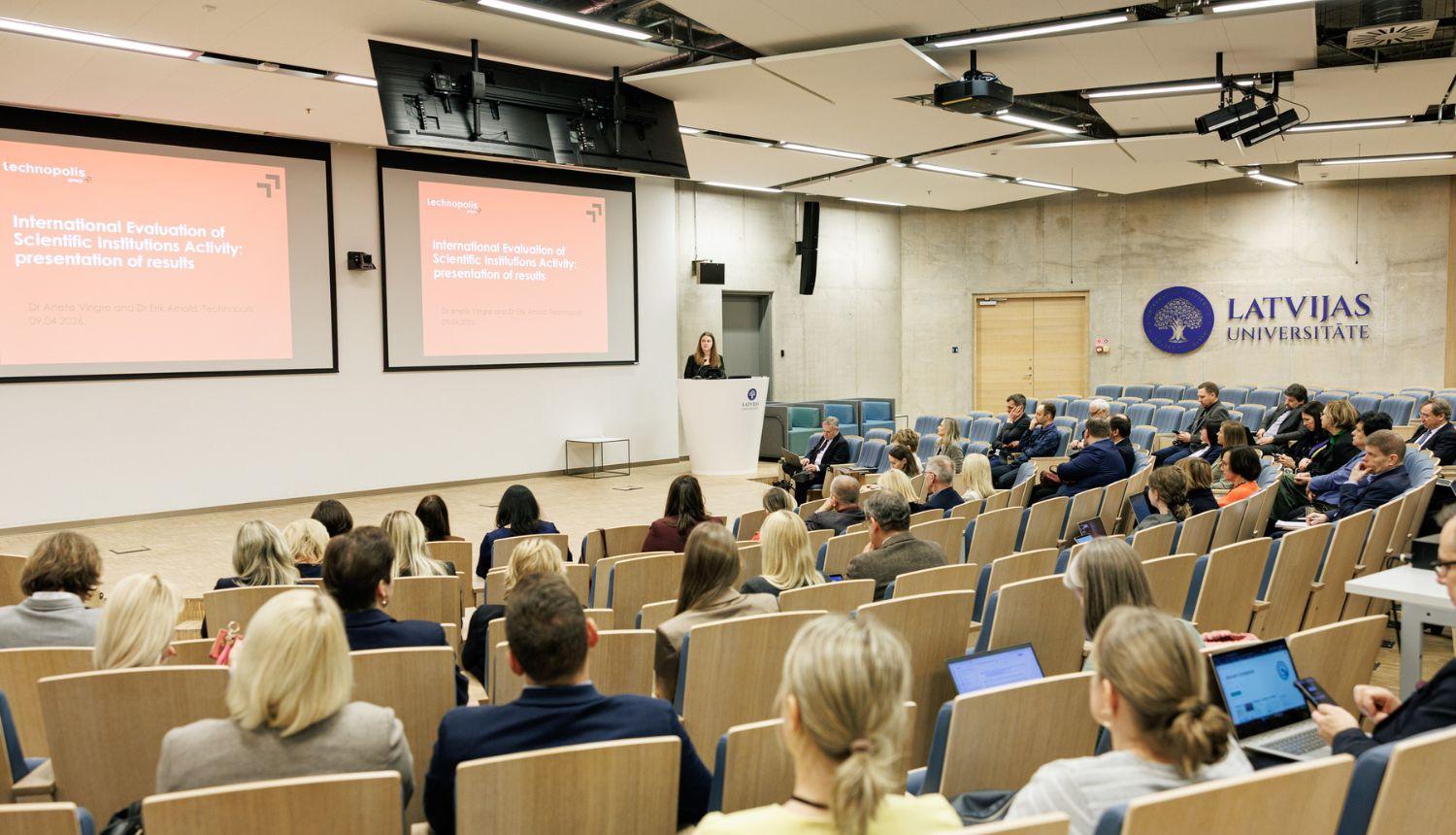
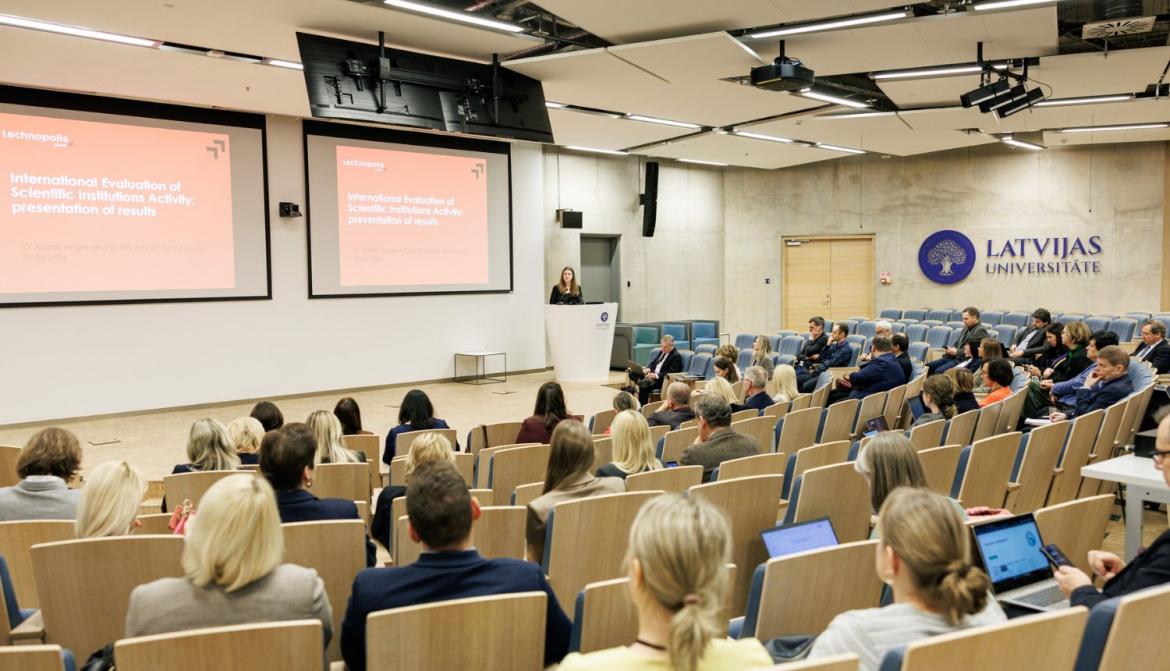
This is confirmed by the results of the 2025 International Evaluation of Scientific Activity, which assessed the research quality, social and economic impact, and development potential of Latvian scientific institutions, including universities. The results were presented in Riga on 9 April.
To promote the growth of Latvian science based on quality, international competitiveness, and development aligned with societal needs, the Ministry of Education and Science initiated an international evaluation of scientific institutions.
Jānis Paiders, State Secretary of the Ministry of Education and Science: "We see that the evaluation shows significant progress compared to the previous two international assessments in 2013 and 2019. This is clearly demonstrated by the fact that 42% of the evaluated units have been rated as very good or excellent in their scientific performance. Within the framework of the international evaluation, recent changes in science have also been positively assessed, including the new doctoral model and the consolidation of scientific institutions by developing and concentrating resources in strong scientific institutions. Improvements can be seen in reducing fragmentation and increasing the concentration of resources in areas where Latvia has high international competitiveness potential."
A total of 44 independent, experienced international experts from science and industry participated in the evaluation. They analysed the scientific performance of Latvian scientific institutions for the period 2019–2024 across five criteria, and assessed the institutions’ strategic development to date and in the future.
As a result of the evaluation, scientific institutions also received expert-based recommendations to improve their scientific performance, while the ministry received evidence-based recommendations for developing science policy in Latvia.
In 2025, 40 scientific institutions participated in the evaluation, including both research institutes and all higher education institutions in Latvia. In total, 62 scientific units were evaluated, as several large universities, representing different scientific fields and subfields, received separate evaluations for each field they represent. It should be noted that, for the first time, all higher education institutions in Latvia, both state-established and privately established, participated in the 2025 evaluation.
The highest rating, “5” or excellent, was awarded to two scientific institutes: the Institute of Literature, Folklore and Art of the University of Latvia, and the consolidated scientific institution, the National Research and Innovation Institute (currently the Latvian Institute of Organic Synthesis and the Latvian Biomedical Research and Study Centre, which received a joint evaluation).
This is the third evaluation of this kind in Latvia, and compared to the previous assessment in 2019, it shows an overall increase in quality within the science system. The conclusions highlight improved research organisation culture, developed research infrastructure, increased volume and quality of scientific publications, and more active and stronger participation of Latvian scientists in international projects.
Experts also view the more clearly defined role of doctoral studies within scientific institutions as a positive development, which supports the work of young talent in Latvia. At the same time, the evaluation shows that the ongoing reforms, including the consolidation of scientific institutions at both institutional and national levels, to be completed in 2026, are strengthening the quality of scientific activity and increasing international competitiveness.
The scientific evaluation is also one of several indicators influencing the allocation of base funding to scientific institutions. This means that funds will be strategically invested where independent evaluation results indicate scientific excellence, greater economic impact on business development in Latvia, and social impact in addressing current societal challenges in a changing geopolitical context.
Additionally, regarding funding allocation, an extra incentive has been introduced by including an “excellence coefficient” in the funding formula, providing additional funding to “strong international players” (rating “4”) and to excellent scientific institutions (rating “5”).
It should be noted that the results of the international evaluation are also linked to the implementation of doctoral studies. Since 2024, doctoral schools in Latvian higher education institutions can only be established if the institution has been rated at least as a “strong national player with some international recognition” in the international evaluation. In this way, a clear link has been established between scientific activity and doctoral studies, as doctoral education is not possible without a strong scientific base and the ability to integrate doctoral students into research successfully.
To ensure transparent comparability of results, the evaluation criteria are based on the methodology of previous years, with the addition this time of principles for assigning consolidated evaluations to scientific institutions. Throughout the evaluation process, the principles of the Agreement on Reforming Research Assessment (CoARA) are followed, resulting in a qualitative rather than purely quantitative evaluation.
Reports are published on the Ministry of Education and Science website.