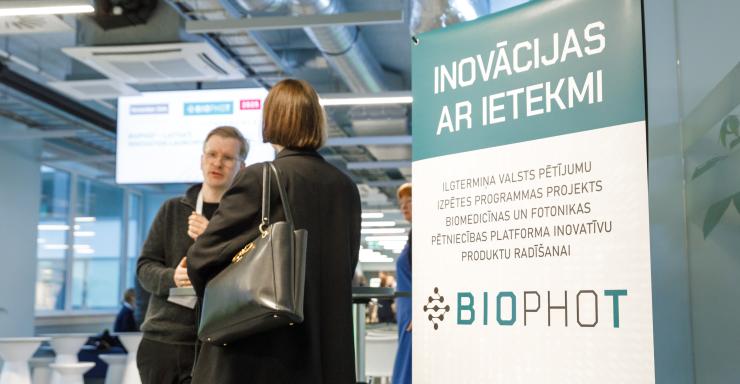
On 18 June at 14.00, the “HyperLab” high-performance laboratory will be opened at the Faculty of Engineering Economics and Management of Riga Technical University (RTU), 6 Kalnciema Street. Its research equipment will enable advanced studies of human behaviour, attention, emotions, cognitive load and physiological responses by combining human judgement, creativity and values, behavioural data, and the analytical capabilities of artificial intelligence.
The high-performance laboratory will create scientifically grounded solutions for the needs of business, education and society.
By tracking various bodily measurements – eye gaze and movement, facial expressions, voice, brain and heart activity, breathing, and skin responses – the laboratory equipment will make it possible to obtain objective information about a person’s reaction to information, a service, a product or an action. For companies, such knowledge will enable a better understanding of customers, their experiences and needs, allowing digital products, services, communication solutions and organisational processes to be improved based not only on opinions, but also on measurements of behavioural and physiological responses. Society, in turn, will benefit from more responsible, human-centred and evidence-based development of artificial intelligence and digital solutions, in which technology is used not only to improve efficiency, but also to strengthen human capabilities, well-being and long-term development.
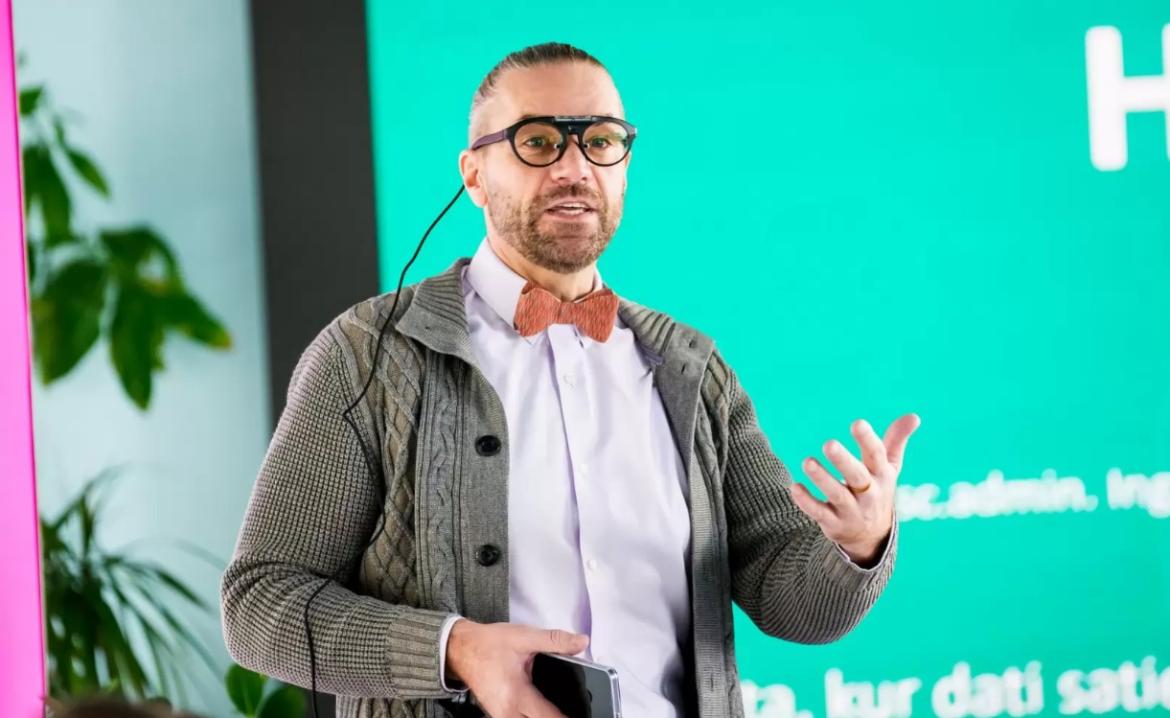
“Researchers and practitioners have always sought to evaluate products or services before offering them on the market. Measurements based on user surveys, to use terminology from the digital environment, have low resolution. The ‘HyperLab’ infrastructure increases that resolution. We do not only listen to what a person says, possibly using learned responses, but also analyse what their body tells us,” explains Agnis Stibe, tenured professor at the Faculty of Engineering Economics and Management of Riga Technical University, founder and co-director of “HyperLab”, by way of example.
He emphasises that “the laboratory’s aim is to create added value not only for business, but for society as a whole, for example, by strengthening resilience against fake news and propaganda, helping employers assess the ability of employees or potential employees to make optimal decisions quickly in stressful situations that may affect technological or human safety, and so on.”
The high-performance laboratory’s research infrastructure consists of five fully equipped “iMotions” workstations. Three of them are located in Riga at the Faculty of Engineering Economics and Management of Riga Technical University, while two are located at RTU Liepāja Academy, forming a national-level research platform.
“This is a significant moment for the development of high-level science in Latvia. With the ‘HyperLab’ and ‘iMotions’ infrastructure, RTU gains new research capacity that makes it possible to understand human behaviour, decision-making and the impact of technology much more precisely. It is an opportunity to strengthen Latvia’s ability to participate in the creation of internationally significant, human-centred innovations,” says Inga Jēkabsone, Vice-Dean for Research at the Faculty of Engineering Economics and Management of Riga Technical University.
The modern equipment will be used not only in studies and research, but also in creating innovations in cooperation with industry. Internationally recognised Latvian scientist A. Stibe plans to transfer the experience of leading universities worldwide, including the Massachusetts Institute of Technology, in attracting and cooperating with industry. Industry has already expressed interest in the opportunities offered by the new high-performance laboratory.
At the opening event, visitors will be able to watch practical demonstrations and see “HyperLab” in action. They will be able to learn how the “NeuroUX” test, behavioural data and artificial intelligence analytics help improve customer experience, how attention, emotional responses and message credibility are analysed, and how organisational decision-making can be improved under conditions of stress or information overload.
The laboratory was established with funding from the EU Recovery Fund project “Implementation of Consolidation and Governance Changes at Riga Technical University, Liepāja University, Rēzekne Academy of Technologies, the Latvian Maritime Academy and Liepāja Maritime College to Advance Excellence in Higher Education, Science and Innovation” (No. 5.2.1.1.i.0/2/24/I/CFLA/003).
RTU video about the unique laboratory: