
Researchers at Riga Technical University (RTU) are taking a significant step forward in the development of ultra-high-speed and energy-efficient communication technologies that could serve artificial intelligence data centres and next-generation communication infrastructure in the future. They demonstrate the possibility of transmitting data in the one-micrometre wavelength band (1-μm band or T-band) using hollow-core optical fibre, setting a new world record. The achievement has already been presented to international industry and scientific leaders at a prestigious photonics conference in the USA.
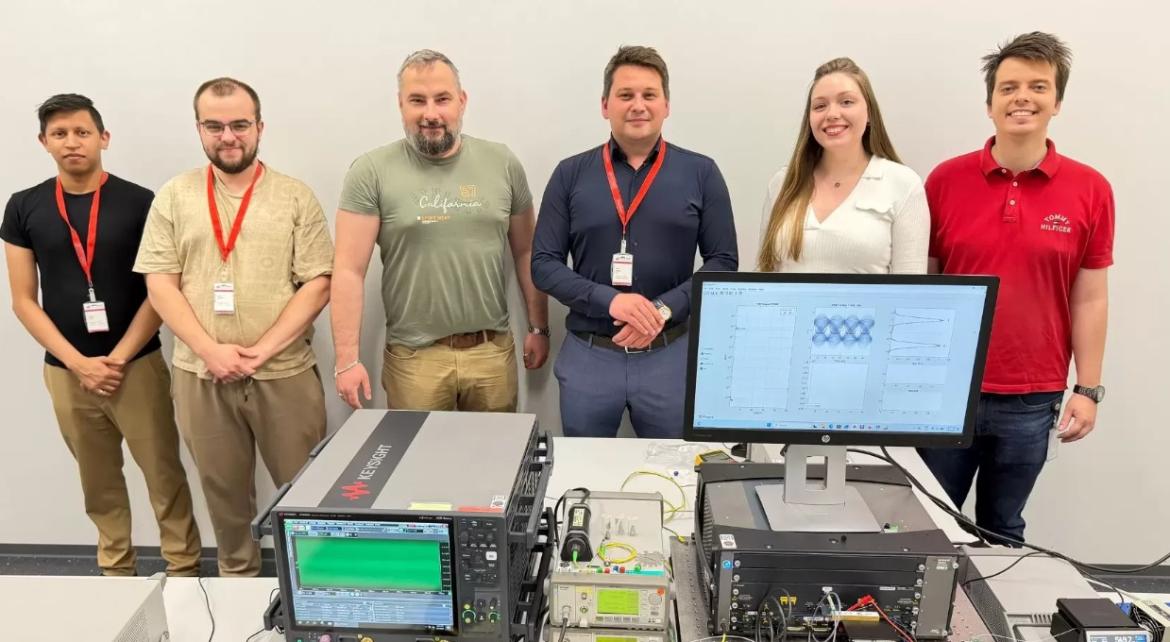
“The future of artificial intelligence infrastructure lies in communication systems operating in the one-micrometre wavelength band,” is convinced Oskars Ozoliņš, Tenure Professor and Academician at the Institute of Photonics, Electronics and Electronic Communications of the Faculty of Computer Science, Information Technology and Energy at RTU.
The research group led by him has combined two promising technologies – hollow-core optical fibre (hollow core fiber) and a one-micrometre (1-μm) wavelength. In hollow-core fibre, light propagates through a central channel filled with air or an inert gas. This makes it possible to achieve significantly lower signal attenuation and dispersion, or spreading, compared to traditional optical fibre. Meanwhile, the one-micrometre wavelength band is a currently underutilised part of the optical spectrum in which new optoelectronic components can be developed, with the potential to become a Latvian unicorn in the chip industry, the Tenure Professor estimates. Currently, the most widely used wavelengths in optical communications are 1.3 and 1.5 micrometres. “At 1.3 micrometres, traditional optical fibre has lower dispersion, while at 1.5 micrometres, it has lower attenuation. By using a new type of optical fibre and wavelength, we can ensure both low attenuation and low dispersion, thereby enabling the rapid and energy-efficient transmission of very large volumes of data. At a time when artificial intelligence infrastructure is expanding rapidly, demanding ever-greater data transmission capacity, this is a revolution,” emphasises O. Ozoliņš.
Together with his colleagues, including young researchers Darja Čirjuļina, Deniss Žurikovs and Abdul Hayee, he has also demonstrated that by combining the innovative fibre and a new wavelength, it is possible to transmit 200 gigabits of data per second over a distance of 500 metres without optical signal amplification. This is a data transmission record. O. Ozoliņš has already set 12 world records.
The Tenure Professor has recently presented the discovery to the scientific and industry elite at the prestigious photonics conference of the Institute of Electrical and Electronics Engineers (IEEE) in the USA. The scientific paper “Net 200 Gb/s/lane Optical-Amplification-Free IM/DD HCF Transmission at 1064 nm Using a LN MZM” was accepted for presentation in the so-called post-deadline paper session, confirming the relevance and high significance of the research.
RTU researchers Darja Čirjuļina, Armands Ostrovskis, Tenure Professors Toms Salgals, Xiaodan Pang (foreign member of the Latvian Academy of Sciences), O. Ozoliņš and Professor Vjačeslavs Bobrovs, together with international partners, have demonstrated that high data transmission speeds can also be achieved in traditional single-mode optical fibre, which is widely used in communication technologies, by using the new wavelength band. They demonstrate this in a study published this autumn in the high-impact scientific journal “Optics Letters”.
RTU researchers are world leaders in photonic microchips and data transmission technologies for the 1-μm transmission band.