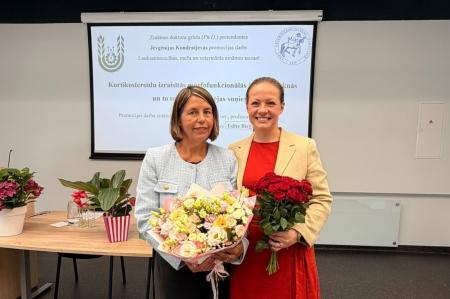
On 24 August, at the Faculty of Veterinary Medicine of the Latvia University of Life Sciences and Technologies (LBTU VMF), Jevgēnija Kondratjeva defended her doctoral thesis “Corticosteroid-induced morphofunctional changes in liver and their reversal potential in dogs” and obtained the doctoral degree (Ph.D.) in the field of agricultural, forestry and veterinary sciences.
The aim of the doctoral thesis is to evaluate the functional, morphological and ultrastructural changes in canine livers induced by the long‑acting corticosteroid methylprednisolone acetate, as well as to determine the impact of hepatoprotective therapy on the severity, dynamics and potential reversibility of these changes.
According to the newly awarded scientist J. Kondratjeva: “In veterinary medicine, corticosteroids are widely used because they provide strong anti‑inflammatory and immunosuppressive effects, which are essential in treating various inflammatory, autoimmune and allergic diseases. Despite their therapeutic effectiveness, the use of corticosteroids is associated with a number of potential complications, including pancreatitis, diabetes mellitus, hypertension, cataract formation and iatrogenic Cushing’s syndrome. Nevertheless, corticosteroids remain among the most commonly used pharmacological agents in veterinary medicine.”
She adds: “Corticosteroids affect several body systems, including the endocrine and hepatobiliary systems. Their long‑term use causes pronounced metabolic changes, such as stimulation of gluconeogenesis, increased glycogen accumulation in hepatocytes and disturbances in lipid metabolism. In dogs, unlike many other mammals, a marked sensitivity to corticosteroid effects at the liver level is observed, which may lead to steroid hepatopathy. This pathology is characterised by hepatocyte vacuolisation, peripheral displacement of nuclei and significant glycogen accumulation, most commonly in centrilobular zones.”
To achieve the research objectives, the study evaluated changes in the functional and morphological condition of the liver in clinically healthy dogs and in dogs with pathological conditions after the administration of methylprednisolone acetate. It also examined whether hepatoprotective therapy can mitigate functional liver changes during corticosteroid use and whether the antioxidant mitoquinol mesylate influences the reversibility of pathological liver tissue changes. The study further assessed the effects of methylprednisolone acetate and mitoquinol mesylate on hepatocyte ultrastructure, including nuclear and mitochondrial morphology.
For the first time in veterinary medicine, a comprehensive study has been conducted on morphofunctional liver changes in experimental dogs following long‑acting methylprednisolone acetate administration. The research produced new, scientifically significant data on corticosteroid‑induced ultrastructural and functional alterations in hepatocytes, expanding existing knowledge on the pathogenetic mechanisms of steroid hepatopathy.
Additionally, for the first time, the effectiveness of various hepatoprotectants in stabilising liver function and their potential role in reducing corticosteroid‑induced changes in dogs has been systematically evaluated. The antioxidant mitoquinol mesylate was also experimentally used in a canine model for the first time, providing new insights into its possible influence on the reversibility of pathological liver tissue changes in cases of steroid hepatopathy.
The doctoral thesis was developed at the Morphofunctional Laboratory of the Preclinical Institute of the LBTU Faculty of Veterinary Medicine, the Comparative Pathology Laboratory of LBTU VMF, the LBTU Veterinary Clinic Laboratory, and the Smart Technologies Division of the LBTU Biotechnology Scientific Laboratory.
The study was carried out with the support of the project “Strengthening the institutional capacity of LBTU for excellence in studies and research”, funded by the Recovery Fund.
Supervisors of the doctoral thesis: Professor, Dr.med.vet. Aija Ilgaža (ORCID: https://orcid.org/0000-0002-7126-878X) and Professor, Dr.habil.biol. Edīte Birģele.