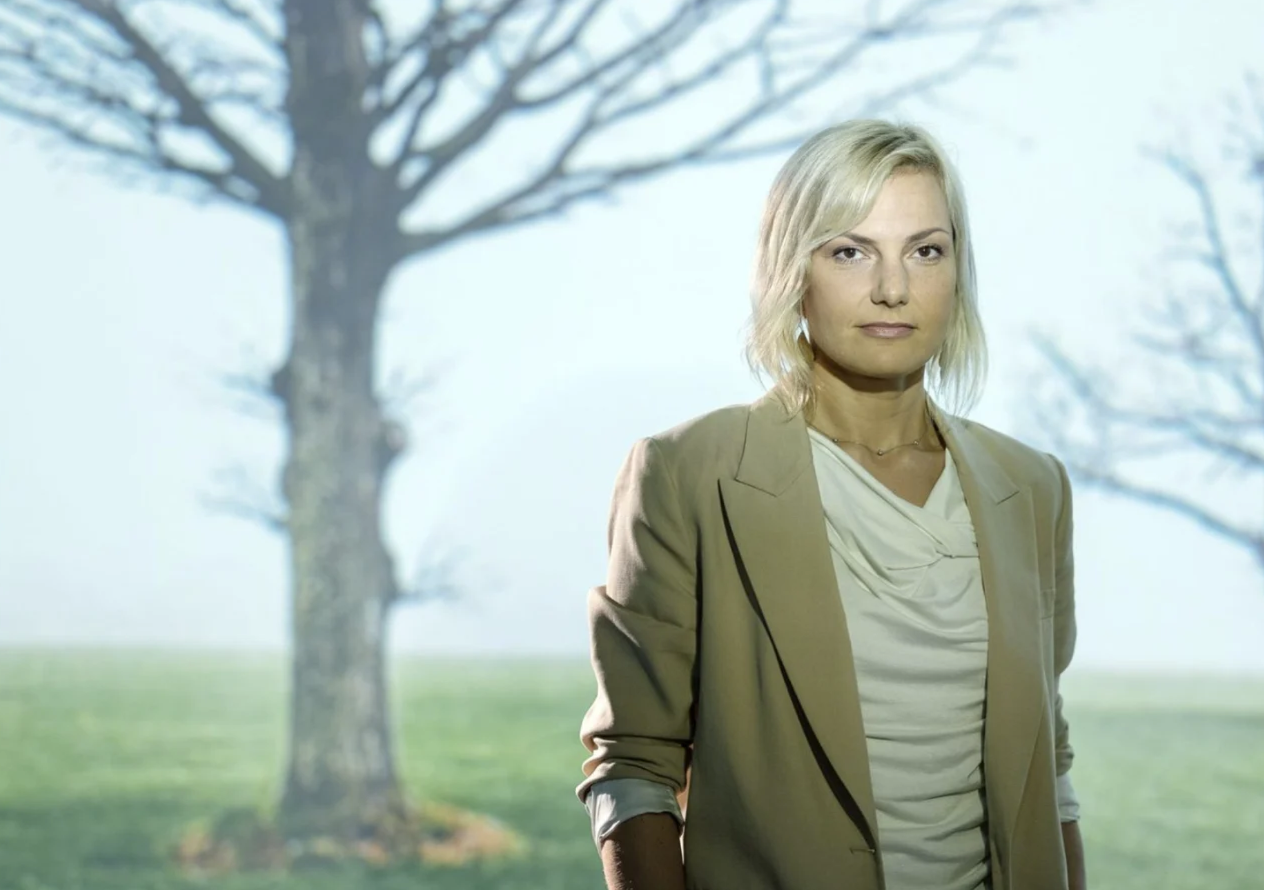
Vidzeme University of Applied Sciences’ Researcher of the Month for July is leading researcher Linda Lancere. From medical engineering and physiotherapy to virtual reality and digital solutions in healthcare, Linda Lancere’s professional journey has consistently led her to the intersection of technology, science and people. The Vidzeme University of Applied Sciences researcher not only builds bridges between different fields, but also convinces international partners that Latvia, too, is a place for world-class discussions on innovation.
What have you been working on recently?
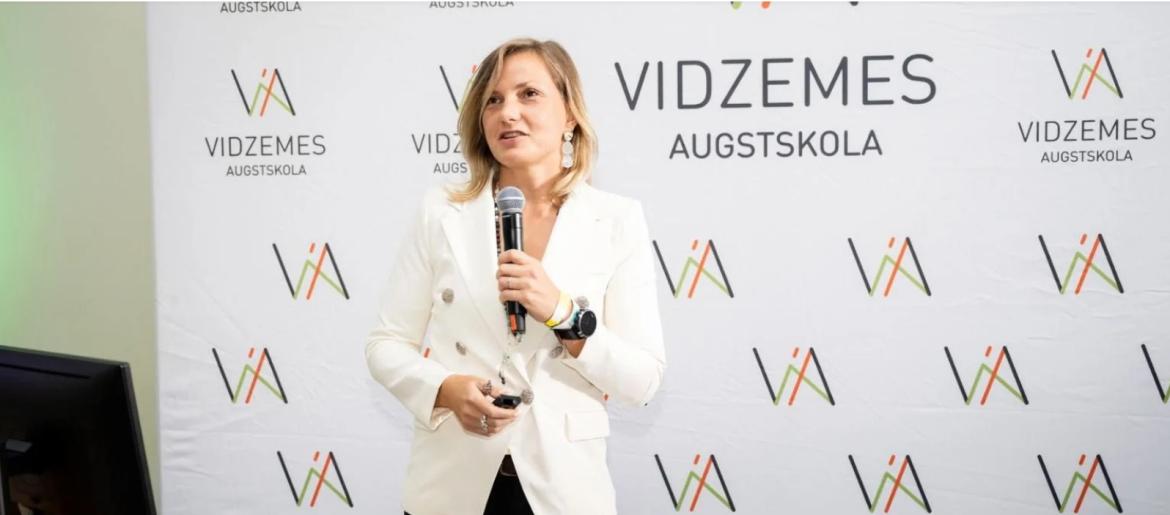
Together with an international virtual reality healthcare association, one of the most highly regarded organisations in the field, we will organise the “8th Annual Virtual Reality and Healthcare Europe Symposium” in Riga in October. Until now, it has been held elsewhere in Europe, but following a conversation with the head of the association at an international conference, I managed to convince them that Riga should host it this time.
The conference will also feature a start-up pitch competition, with world-class experts and participants from both the United States and Europe. The second day will be particularly valuable, as it will take place in conjunction with the Precision Medicine Forum – a well-known industry event in Latvia: https://pmnetforum.com/.
For students and colleagues at Vidzeme University of Applied Sciences, this will be an opportunity to meet world-class professionals, attend inspiring lectures and establish new contacts. The university will also gain visibility in the international professional community, including through a special issue of the journal Frontiers entitled “Immersive, Intelligent, and Interoperable Technologies in Rehabilitation: From Lab to Clinical Integration”.
What led you into your current field of research?
My path has led me through experiments in which I have discovered myself. My first study experience was at the Latvian Maritime Academy, specialising as a ship’s captain – I wanted to travel and earn a good living, but I did not complete the programme. Later, I chose medical engineering, obtaining both a bachelor’s and a master’s degree. Between the two programmes, my first son was born, and my colleagues at the laboratory encouraged me to continue with doctoral studies.
I earned my doctoral degree in medical engineering and, to be honest, the rapidly approaching birth of my second son gave me additional motivation to complete the work. My dissertation supervisor, J. Dehtjars, and the other colleagues were very supportive throughout the process. Medical engineering is a very broad field, encompassing materials science, prosthesis development and electronics. During my studies, we soldered microchips, worked with computed tomography scanners and carried out other practical tasks, which I greatly enjoyed. Laboratory work was very interesting, but I missed a sense of dynamism. Studying processes at the atomic level is fascinating and highly necessary, but results emerge slowly and are implemented in real life even more slowly – I am simply too impatient.
After completing my doctoral studies, I began working at a 3D printing company, which at the time seemed almost like science fiction in Latvia. It was there that I first found myself between two worlds – businesspeople and researchers. My responsibilities included helping both sides understand one another, presenting ideas, developing business plans, managing projects and finding shared solutions from both technological and business perspectives. This was a turning point: although I was only beginning to learn all of this, I realised that it was something I genuinely enjoyed. The company’s management played a major role by guiding me through a process that moved ten times faster than the university environment. It was also at this company that my work became connected with medicine – we printed prostheses for both children and adults and developed software for modelling prostheses.
Over time, I realised that I wanted to help people more directly, so I also obtained a qualification in physiotherapy from the Latvian Academy of Sport Education. I was then offered a position at a company developing virtual reality solutions – simulations for emergency medical care in wartime conditions. The medical theme continued, and here too I acted as a kind of bridge, ensuring that the technology met the relevant requirements from a medical perspective.
It was precisely this diverse experience that brought me to Vidzeme University of Applied Sciences, where I can combine research with collaboration between academia, businesses and healthcare professionals.
How did your journey at Vidzeme University of Applied Sciences begin?
Completely by chance. I really enjoy mountain climbing, and during one expedition – I believe it was on Mount Elbrus or Mount Kazbek – I met Associate Professor Arnis Cīrulis. Some time after the expedition, he approached me about a postdoctoral opportunity at Vidzeme University of Applied Sciences and encouraged me to apply. Atis Kapenieks provided considerable help in preparing the application, but Arnis was the person whose influence ultimately brought me here.
During the postdoctoral project, I had the opportunity to spend a year in the United States through the BAFF programme, which provided highly valuable international experience. I gained knowledge of clinical research and technology validation processes in one of the leading laboratories in the field.
What is your field of research?
Put simply, I create a connection between people and technology. I help medical professionals understand how technology can solve the problems they encounter in their daily work, while helping technology developers understand the needs of the healthcare sector. A large part of my work is related to user experience, or UX. In practice, this involves many conversations with doctors, physiotherapists and other specialists to understand the problem and then “translate” this information for programmers and developers. It can also work the other way around – helping scientists and engineers understand exactly whom their technology could benefit and whether it might also have business potential. It is a process that extends from the initial idea to testing and implementation in real life. I work with mobile, web-based, sensor and virtual reality technologies, as well as everything related to their implementation.
Do research results influence society, the economy or other areas, and if so, how?
I am fortunate to work in a field that has a very direct impact on society. Technology enables us to improve people’s quality of life both at the individual level and across the healthcare system as a whole. We involve people with back pain in studies of virtual reality exercises, develop digitalisation strategies to improve healthcare services, promote dialogue between ministries and hospitals, help health technology start-ups create high-quality products through initiatives such as the LeapXR project, and at the same time encourage healthy lifestyles. It is important to me that research does not remain confined to publications, but is transformed into solutions that genuinely help people.
What excites you most about working as a researcher, and what presents the greatest challenges?
What motivates me most is the knowledge that technology can help people discover their potential and take better care of their health. However, I always say that technology should help people become more aware, rather than become the main solution itself. In my daily work, I meet professionals from a wide range of fields, constantly learn and discover something new. It is impossible to stand still in this field, as technology develops extremely rapidly. Ironically, a large proportion of mobile and web-based solutions are still not designed in a way that is convenient for people to use, let alone virtual reality solutions. I enjoy being the person who brings different parties together and helps them arrive at a shared solution. This gives me a great sense of satisfaction and also inspires me to develop new ideas. I have probably exhausted my colleagues a little with them at times (laughs).
Of course, there are also difficulties. Securing funding is becoming increasingly challenging, and competition in project calls is growing. Another challenge is encouraging people to try new technologies, especially when they involve various sensors. At the same time, this is also rewarding – explaining, challenging stereotypes and helping the creators of ideas understand how best to develop their solutions. In the field of virtual reality, regulation and certification requirements create additional complications, which means that even a very good product often does not reach the market as quickly as one would hope. Moreover, there is still a widespread stereotype that virtual and augmented reality are intended only for games and entertainment, even though their potential in healthcare is far broader.
How does the environment at Vidzeme University of Applied Sciences support your work?
The greatest advantage of Vidzeme University of Applied Sciences is its flexibility. It provides the freedom to choose projects, collaborate with partners in Latvia and abroad, and work on topics that are genuinely important. There is no sense here that everything becomes bogged down in processes – ideas can be advanced quickly, developments in the field can be followed closely, and tangible impact can be created. Another major asset is the people. Our university has many enthusiastic and highly professional colleagues with whom it is truly possible to move mountains.
What characterises you outside research?
I enjoy movement and challenges. I dance Latin American dances, play beach volleyball, ride a quad bike and have gone skydiving. I also greatly enjoy mountain climbing. Of course, I spend most of my free time with my two sons and my dog. When I feel like taking a break, that often means helping my parents – mowing the lawn or working in the garden (laughs).
Do you try to guide your children towards your own field?
Not deliberately. It is more important to me that they find their own calling and learn independence, responsibility and self-confidence, while acquiring skills that will be useful regardless of the profession they choose. For example, I involved my older son in video editing for the Riga TechGirls project “Technology with a Human Touch – for Healthcare Professionals” and encouraged him to enrol in the StartSchool programme. I do not know whether this will become his future profession, but the experience and environment will certainly be valuable.
Where do you see yourself in a few years?
It is important to me to understand the essence of things and how processes work. Therefore, I do not think it is crucial whether I work at a university, a company, a non-governmental organisation or elsewhere. What matters most to me is being part of a team that develops practical solutions that society genuinely needs.
I have always enjoyed working at the intersection of different fields, helping people understand one another and achieve results together. I believe that, in a few years’ time, this is still exactly what I will want to be doing.