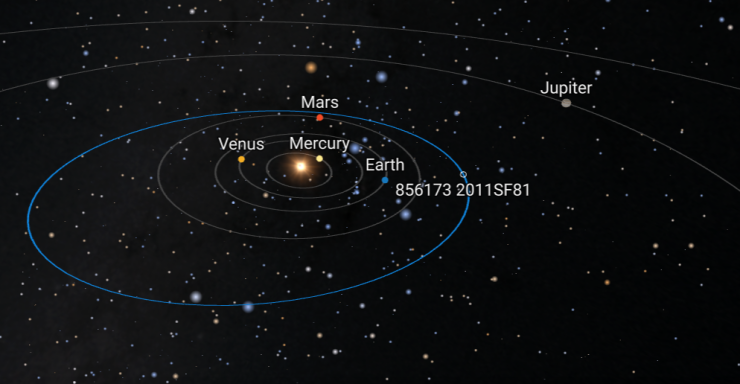
Latvian scientists track asteroids and monitor space debris that threatens Earth and satellites. Why is this research also important for our safety? Ilgmārs Eglītis, Head of the Baldone Observatory, and Diāna Haritonova, Leading Researcher at the Institute of Geodesy and Geoinformatics of the University of Latvia (UL), discuss this in the "Radio SWH TV" programme "Latvia in Science", produced with the support of "Rietumu Banka".

More Than 140 Asteroids Discovered in Baldone – Named After Outstanding Latvian Figures
Scientist Ilgmārs Eglītis has spent more than 40 years of his professional life at the Baldone Observatory, where he continues to discover asteroids and study black holes, stars and other celestial bodies. Since 2008, when scientists at the Baldone Observatory began observing asteroids as part of the research programme "Studies of Small Bodies of the Solar System", more than 140 asteroids have been discovered. They are named in honour of those who have supported science, including one named in gratitude to all patrons of the University of Latvia Foundation for their contributions to education and science in Latvia, including the modernisation of the Baldone telescope's observation equipment.
This year, two asteroids have been named after Latvian female scientists. One was named in honour of astronomer Mārīte Eglīte, the other – astrophysicist Zenta Alksne. Two others have been given names associated with culture – Jānis Streičs and Eduards Rozenštrauhs. All four are located in the main asteroid belt between Mars and Jupiter and pose no threat to Earth.
Asteroid research has a much broader significance. Although increased attention is being paid to this research worldwide, only 71% of all potentially hazardous asteroids have currently been discovered in the Solar System. Astronomers on Earth cannot see objects located in the direction of the Sun, so observations from spacecraft help detect them.
Asteroid research helps us understand the formation of the Solar System, while observing near-Earth objects allows potential threats to be detected in time. The researcher explains that discovering new asteroids, particularly those closer to Earth, is essential for our safety. Even an object just one kilometre in diameter can cause devastating consequences, potentially even fatal to civilisation, if it strikes Earth. Eglītis recalls the meteorite explosion over Chelyabinsk, Russia, in 2013, emphasising that such risks must not be ignored, as events of a similar magnitude, according to radar maps, occur on average once every five years.
Studying asteroids is very important, and it is also essential to determine their taxonomic class or type. Objects can be of icy, rocky or metallic origin. In the future, such objects could serve as sources of rare metals or water. Eglītis explains that there is very little water on Mars or the Moon, and very little water in space in general, but survival beyond our planet is closely linked to the availability of water. Asteroids could also become a valuable source of mineral extraction in the future. Studying their composition provides information about the materials from which the Solar System, including the planets, was formed. Some of these materials are located deep within the Earth and are not directly accessible for research and use.
"We only know theoretically what is there," Eglītis says about the centre of the Earth, explaining why the composition of asteroids can help us better understand planetary formation processes and provide valuable rare minerals.
Space Debris – A Threat to Satellites and Everyday Technologies
While distant celestial bodies are studied in Baldone, Haritonova's work is related to space geodesy technologies. Satellite observations can also be used to study movements and deformations of the Earth's surface. One of the researcher's areas of work involves positional astrometric observations of objects in Earth's orbit using an optical observation system installed on the roof of the University of Latvia's House of Science, which was developed by the institute's researchers together with its control and data processing software.
"Space is heavily polluted, especially low Earth orbit," says Diāna Haritonova. Space debris poses a threat to satellites that provide communications, navigation and other services essential to everyday life. Even a single collision can destroy an expensive spacecraft and generate new debris.
Eglītis illustrates this risk with an example – if a communications satellite collides with a piece of space debris, losses could amount to billions, and the collision would generate new debris that would, in turn, threaten other satellites.
Observations carried out by Latvian researchers help determine the orbits of inactive satellites and space debris more accurately. Such data can be useful for assessing collision risks and, in the future, for space debris removal missions. Haritonova emphasises that the main monitoring of orbits is carried out by major international centres, while Latvian scientists can conduct additional measurements and help refine the information.
Previously Two Hours, Now Eight Minutes – How Technology Is Changing Astronomers' Work
Alongside the observation of space debris, asteroid research capabilities are also being improved in Latvia. At the Baldone Observatory, in cooperation with the Institute of Geodesy and Geoinformatics, synthetic tracking methods are being developed, based on the digital shifting and stacking of a large number of short-exposure images according to the assumed speed and direction of an object's movement. Eglītis points out that Latvian researchers are among the first in this field to seek new solutions.
Technological development has already significantly changed the work of astronomers. Thanks to donations from patrons of the University of Latvia Foundation, the UL Institute of Astronomy has implemented three projects, one of which – the installation of a CCD camera – was carried out within the framework of the "MikroTik" project competition in the fields of natural sciences, technology and medical sciences. Eglītis explains that previously it took two hours to obtain a single image, whereas now a similar result can be achieved in eight minutes. Importantly, the images obtained are immediately available in digital format and can be used by researchers from anywhere in the world. Thanks to the support of "MikroTik", two projects were also implemented at the UL Institute of Geodesy and Geoinformatics, resulting in improvements to the technical parameters of the optical observation system and the functionality of the astrometric analysis software. Latvian researchers also develop and adapt software themselves to determine the positions of observed objects more accurately.
The Largest in the Baltics – What Makes the Baldone Telescope Unique?
The Baldone Schmidt-type telescope is unique due to its large field of view and the excellent quality of images of celestial objects. It allows the observation of large areas of the sky and is particularly suitable for discovering new objects. It is the largest in the Baltics and the twelfth-largest instrument of this type in the world. For example, the entire Andromeda Galaxy or 10 Moon discs placed side by side can fit within the field of view of the Baldone Schmidt telescope.
There are more than 700 observatories worldwide (optical, infrared, radio, X-ray and gamma-ray observatories), including space observatories. Each country has one or two, the astronomer reveals. The famous exoplanet-discovering Kepler space telescope was based on the Schmidt optical system.