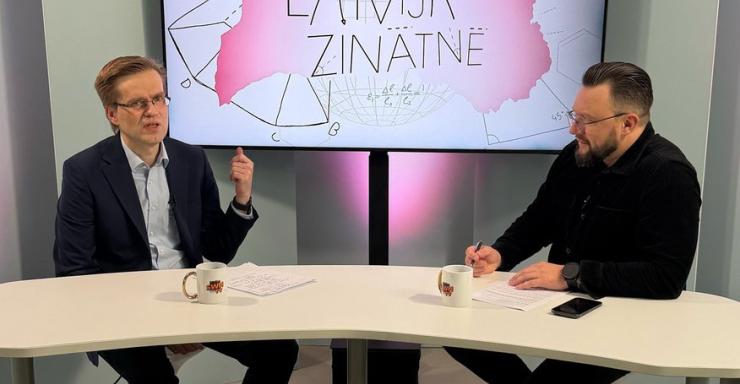
In recent years, knowledge transfer competence has become increasingly important – scientists must be able to popularise and explain what they do. Nowadays, this is expected of all academic staff, said Zanda Rubene, Professor at the Faculty of Education Sciences and Psychology of the University of Latvia and Director of the Doctoral School, on the Latvian Radio programme “Zināmais nezināmajā”.
Must know how to transfer knowledge
Through cooperation between Latvian higher education institutions, a research group has been developing a competency model for academic staff for the third year within the national research programme “Education”. It is planned to be completed by the end of the year, said Nora Jansone, Associate Professor at Rīga Stradiņš University and Director of the Centre for Educational Growth.
In other words, the research examines what academic staff – scientists, lecturers and professors – should be able to do, and what competencies people in these positions should possess. “As well as what areas they need to learn about. That is the biggest challenge. We want to say that, just as Riga is never finished, a professor must also continuously engage in professional development in various areas – both in their own field and in organisational, administrative and pedagogical areas,” Rubene emphasised.
No member of academic staff – even if we are talking about a scientist working in a laboratory – ever works completely alone. In the academic environment, there is always someone nearby who wants to learn from that person. Therefore, it is extremely important to know how to pass on one’s knowledge. Whether it is to a colleague, a student, or perhaps society as a whole.
“At present, the newest and most relevant competence is knowledge transfer competence, especially in Latvia in recent years. It is a competence that helps us popularise what we do and explain to society how things work,” Rubene noted.
What constitutes wisdom
Evija Kļave, Associate Professor and Vice-Rector for Studies at Turība University, emphasised that a very important contribution of this study is an understanding of what it means “to be that wise person”, or what it is that constitutes this wisdom. It is important not only to be able to name the necessary competencies, but also to be able to assess which of them I possess and how to develop them.
“It is possible that there will be an area in which I have progressed further, but another in which I am lagging slightly behind. Then it is important to be able to look at oneself self-reflectively through self-assessment – what should I do so that I could expand myself to an even greater extent,” Kļave said.
Therefore, it is planned to create a tool that would help academic staff assess themselves – by answering various questions, evaluate their abilities, skills and competencies and draw conclusions about what they still need to learn in order to improve their work in the academic environment and pass on their knowledge. This is important because, in today’s world of science, pedagogical and knowledge transfer competence in particular is becoming increasingly important in order to be able to continue one’s work, Rubene emphasised.
“Everyone must be a specialist in their own field. There is nothing new about that. To a certain extent, there is also nothing new about the fact that everyone must, in a sense, also be a Teacher. With a capital ‘T’. But it is still a matter of discussion, and very often academics themselves also try to distance themselves from this aspect and say that it is not the most important thing, that expertise in one’s field is the most important,” she explained.
Scientists must engage with society
Thanks to the development of technology, modern society has become accustomed to having access to information. Full access to information is the norm. Therefore, it is only natural that society also wants access to the information traditionally managed by scientists and researchers.
“Perhaps over the centuries we have become accustomed to the idea that society does not always understand everything, so a person who drives a car does not necessarily need to know what the car engine is made of. But this is what is current and new, what is changing, and scientists need to address society,” Rubene emphasised.
Although this is by no means easy and sometimes requires an enormous amount of time and resources, nowadays professors, scientists and researchers are expected not only to have expertise in their field, but also to be active members of society and to engage in defending scientific thought.
“The modern scientist is, in a sense, a one-person orchestra, but I think every profession is like that. Of course, every academic institution has a communications department that helps and provides support, and yet a scientist must be able both to conduct scientific research and to speak about science in a popular way,” she concluded.
At the same time, Jansone reminded that learning, or the exchange of information, is a two-way process, so society and politicians should assume just as much responsibility for it as scientists and academic staff.
“It is an absolute process of mutual engagement and interaction. Therefore, I wish everyone ever greater openness of mind and heart,” she concluded.
Listen to the full programme here