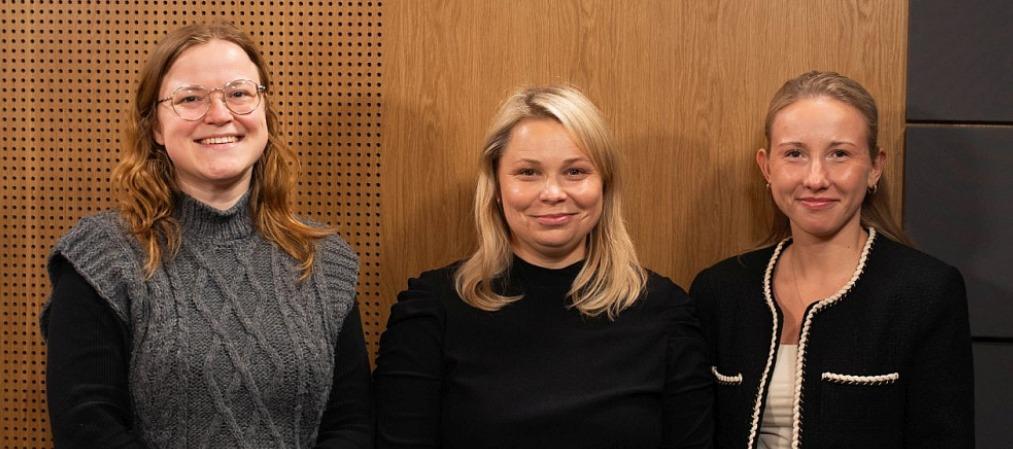
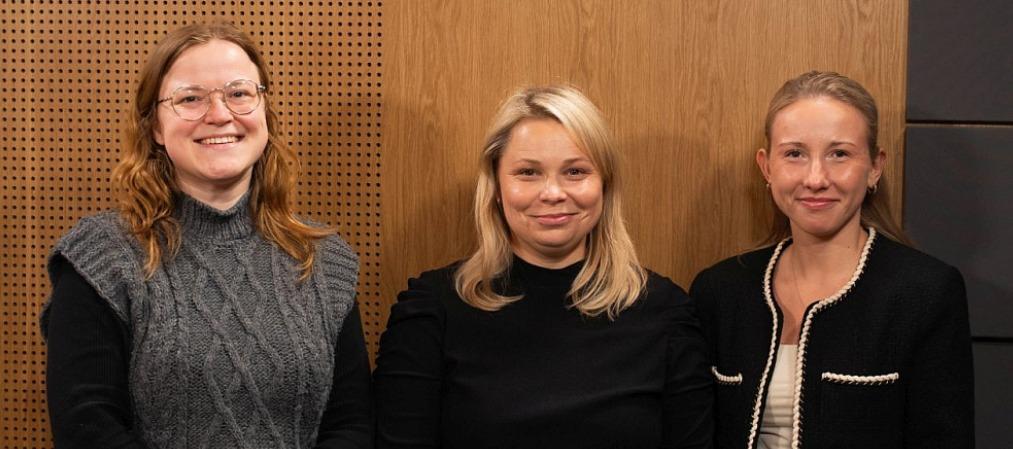
Research on ceramics in archaeology, agricultural soil research in the context of climate change, and research on composite materials and biopolymers in chemistry – these are the fields represented by young Latvian female scientists that have received recognition in the annual “Baltic Fellowship for Women in Science” competition, reported the Latvian Radio programme “Zināmais nezināmajā”.
Researching soil and greenhouse gases
Arta Bārdule began her path in science at the University of Latvia (UL), where she focused particularly on analytical chemistry. However, while still studying, she joined the Latvian State Forest Research Institute “Silava”, where she is currently a senior researcher.
“I work in the Forest Environment Laboratory, carrying out chemical analyses of soil, water and plant material. Gradually, I really came to enjoy research. Now, after years of analysing why that happened, I realised that, in fact, ever since my school days I have always been drawn to and fascinated by solving ‘tough nuts’, and research, in a way, is constantly about solving ‘tough nuts’,” said Bārdule. It is precisely solving complex questions that gives Bārdule a sense of excitement in her daily work and motivates her to continue exploring ever new topics.
This includes research on agricultural soils in the context of climate change, for which Bārdule received the Baltic Fellowship for Women in Science this year.
“In Latvia, we have quite a lot of soils with a relatively high organic matter content. We call them organic soils. If these organic soils have been drained, then it is quite clear that they are a source of greenhouse gas emissions,” the researcher explained.
This means that microbiological processes take place in these soils, resulting in the release of greenhouse gases such as carbon dioxide, methane and nitrous oxide, and that, of course, is not a good thing.
“Therefore, we are looking for solutions for managing areas with drained organic soils in a way that reduces greenhouse gas emissions from the soil. We know that the European Union has quite ambitious goals – to achieve climate neutrality by 2050 – and this climate neutrality also concerns land use and the forestry sector,” Bārdule explained.
Researching skills from seven thousand years ago
Vanda Haferberga, a researcher at the Department of History and Archaeology of the Faculty of Humanities at the University of Latvia, became interested in archaeology already in secondary school. She has always found the following questions very intriguing – how did ancient people live? What did they do? How did they develop?
“I did not know that I would become a scientist. I also did not know that I would pursue doctoral studies and write a dissertation. But already during my bachelor’s studies, back then at the Faculty of History and Philosophy, I took part in my first fieldwork placement – archaeological excavations,” Haferberga said.
Under the guidance of Professor Andrejs Vasks, the students managed to find an exceptionally large amount of pottery at the Skrundas Krievu kalns hillfort, and Haferberga immediately felt a strong desire to work with it – to clean it, examine it and sort it. Encouraged by her lecturers, the researcher began working with the material, taking a deeper interest in it and, over time, also writing about archaeological pottery. This topic has accompanied her from her course paper and first conferences all the way through her master’s studies, doctoral studies and the Baltic Fellowship for Women in Science.
“All of this intrigued me greatly, and the more you research and understand, the more questions arise about what else was there. You want to investigate more deeply. A sense of excitement emerges – to discover and unravel what it was really like,” Haferberga explained.
At present, her field of research reaches back about seven thousand years from today. This is the Early Neolithic – the period when the knowledge and technology of making ceramic vessels arrived in our region.
“With the funding I will receive from this fellowship, for which I am very grateful, I will carry out a broader study, including archaeological excavations at one of the settlements near Lake Lubāns,” the researcher revealed.
Haferberga primarily studies ancient technologies – the ways in which pottery was made. This makes it possible to discover a great deal of new information about ancient communities, for example, what knowledge people of that time possessed and what materials were available to them.
Researching biopolymers and bioplastics
The path into science of Aļisa Ponkratenkova, a researcher at the Institute of Chemistry and Chemical Technology of Riga Technical University, also began during her school years.
“My interest specifically in the field of chemistry was sparked by my chemistry teacher. Together with her, we carried out a research project, and that was my first opportunity to look inside a laboratory and see what happens at a university. To see the latest equipment, about which I knew absolutely nothing at the time,” she said.
Alongside her bachelor’s studies at the University of Latvia, Ponkratenkova began working at the Institute of Polymer Mechanics, where she gained a much more detailed understanding of polymers and materials science.
Polymers and their research fascinated her so much that she continues to work in this field to this day, and this year Ponkratenkova also received the Baltic Fellowship for Women in Science specifically for research on composite materials and biopolymers in chemistry.
“We continue to study biopolymers and bioplastics in particular, because we use plastic products every day, but they are usually synthetic products made from petroleum. They are cheaper, they have very good properties, but they have a negative impact on the environment,” the researcher explained.
In her research, for which she has received recognition, she is developing new biopolymer blends, or bioplastics, for use in 3D printing to manufacture products with properties similar to plastic, but made from renewable resources.
In Latvia, 48 applicants had applied for the fellowship. A total of 31 applications were received for the competition for holders of a doctoral degree, while 17 applications were submitted for the competition for doctoral degree candidates. Thirty-eight applications were evaluated in the fields of natural sciences, engineering and technology, medical and health sciences, as well as agricultural and veterinary sciences, while 10 applications were evaluated in the humanities and social sciences. The applications were assessed by expert committees of the scientific divisions of the Latvian Academy of Sciences (LAS), with the final decision taken by the joint expert committee of the LAS and the Latvian National Commission for UNESCO.