From 15 to 17 October, EUDIS Defence Hackathon 2026 Latvia took place at the University of Latvia, bringing together technology developers, engineers, entrepreneurs and other participants interested in the development of defence technologies. Over three days, 22 teams worked on solutions in the fields of autonomous systems, unmanned aerial vehicle navigation, threat detection and coordination.
EUDIS Defence Hackathon is a European Commission initiative held simultaneously in eight European countries, promoting the development of new technological solutions for Europe’s security and defence needs.
This year’s hackathon focused on autonomy on the battlefield. Participants worked on three challenges – autonomous navigation without a GNSS signal, coordination of autonomous systems, and the detection, classification and prioritisation of low-flying threats.
During the hackathon, the teams worked with mentors, defence sector experts and industry representatives to refine the technical requirements of their solutions, assess their practical applications and identify directions for further development.
At the conclusion of the hackathon, the jury evaluated the solutions developed by the teams, their technological potential and their relevance to the challenges set.
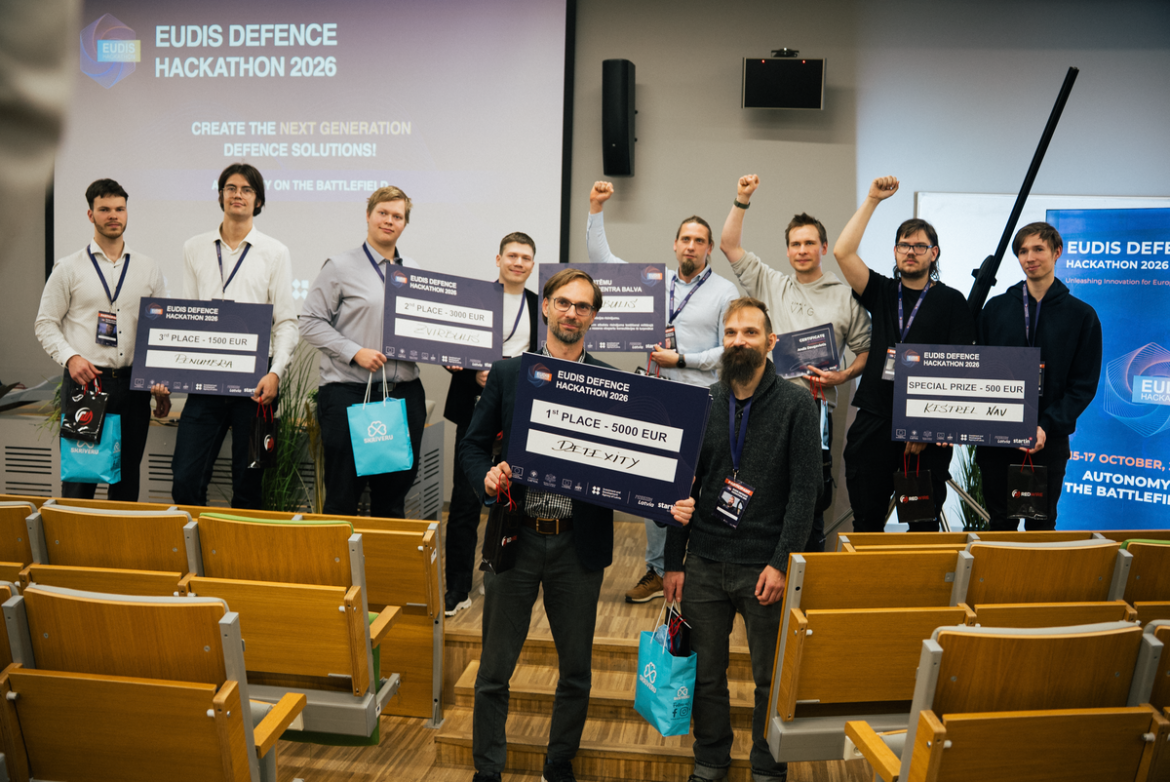
First place and a cash prize of 5,000 euros went to the team “Detexity”, which developed a functioning prototype of an automatic targeting system in approximately 24 hours. In the system, targets are detected by an OrbiScan sensor, while all data processing takes place on the device itself using artificial intelligence solutions. The team’s approach is based on the rapid detection of FPV drones using neuromorphic vision. The victory confirmed the potential of the technology developed by the team and motivated them to continue developing the system so that it can be tested in real-world conditions as soon as possible.
“The victory means a great deal to us. It confirms that our approach – rapid FPV drone detection using neuromorphic vision – is necessary and competitive. We particularly valued the opportunity to work with mentors and defence sector experts, whose feedback helped us better understand the needs of end users,” says the “Detexity” team, thanking the organisers, mentors and jury for their support.
Second place and a cash prize of 3,000 euros went to the team “Zvirbulis” with the solution “Rent an Enemy”, which offers independent testing and assessment of unmanned aerial vehicle readiness. Using target drones developed by the team itself, realistic drone threats can be simulated under controlled conditions, allowing counter-drone systems and critical infrastructure operators to test their ability to detect, track and respond appropriately to such threats. The test results help identify system weaknesses and provide practical recommendations for improving readiness.
“The victory was an excellent recognition of our work. In addition, we particularly value the experience gained, the valuable contacts and the feedback provided by industry professionals. The recognition of our solution gives us even greater motivation to continue developing “Zvirbulis” and take it to the next level,” the team says.
Third place and a cash prize of 1,500 euros went to the team “Penumbra”, which is developing a solution for communication and coordination between autonomous drones using light signals. In the system, drones communicate using LED light signals that are detected by cameras on other drones. This approach allows a group of unmanned aerial vehicles to exchange data and coordinate their actions even in conditions where radio communications and GNSS signals are disrupted.
“The hackathon was a great experience. The workshops were very valuable, and the mentors shared important insights and industry knowledge. We are pleased to be among the winning teams and grateful to EUDIS for the opportunity to continue developing our project,” says the “Penumbra” team.
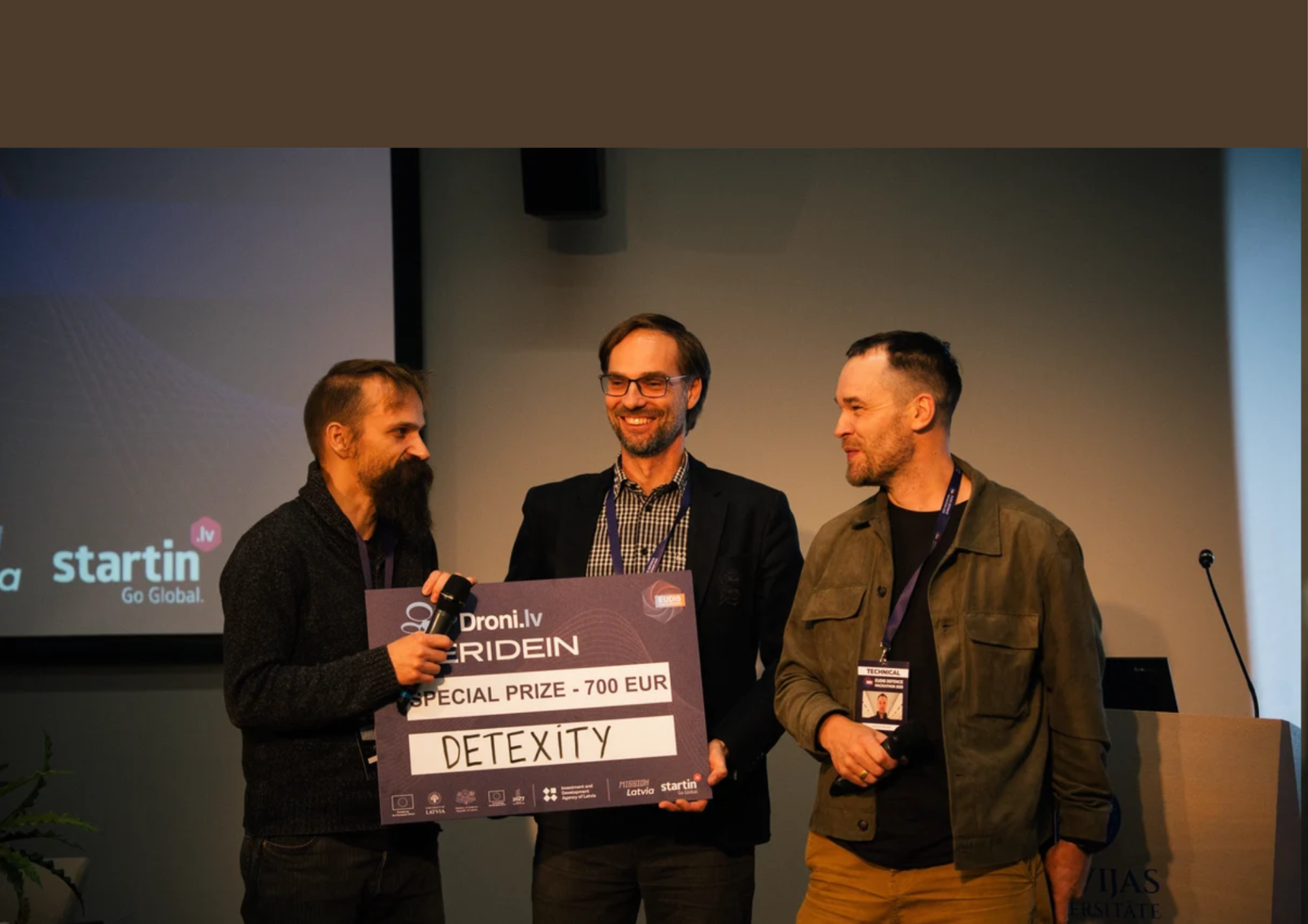
The team “Kestrel Nav” received a special prize of 500 euros. The hackathon partners also provided additional opportunities for the teams’ further development. The Federation of Security and Defence Industries of Latvia (DAIF) awarded a 1,000-euro prize to the team “Rule Breakers V2” for participation in conferences. The Autonomous Systems Competence Centre selected three teams – “Zvirbulis”, “Detexity” and “Bastions” – for further idea testing and consultations. Droni.lv and Meridein awarded the team “Detexity” a prize worth 700 euros for the rental of robots or drones.
A total of 22 teams participated in the hackathon, developing a wide range of solutions in the field of defence technologies, including autonomous navigation systems for operation without a GNSS signal, unmanned aerial vehicle detection and tracking technologies, solutions for coordinating groups of autonomous drones, sensor networks and artificial intelligence-based threat identification systems. The teams also worked on acoustic and radio-frequency detection technologies, border surveillance solutions and simulations of autonomous system operations.
The teams’ work was evaluated by six experts representing higher education, business, the venture capital and start-up ecosystem, technology commercialisation and the defence sector. The jury consisted of Enno Ence, Vice-Rector for Development at the University of Latvia; Matīss Neimanis, representative of Buildit VC; Andris Baumanis, Head of UniLab Defence; Vita Balode-Andrews, Director of the Export and Innovation Services Department at the Investment and Development Agency of Latvia; Major Modris Kairišs, Head of the Autonomous Systems Competence Centre; and Brigadier General Aivars Krjukovs, Commander of the National Guard.
During the hackathon, the teams were supported by six mentors – Armands Krastiņš, Senior Project Manager at the Investment and Development Agency of Latvia; Toms Rostoks, Vice-Rector for Research at the National Defence Academy of Latvia and Associate Professor at the University of Latvia; Jānis Zaltāns, CEO and Co-Founder of Affire; Jānis Jaško, Technology Commercialisation Expert at the University of Latvia and CEO of WeedBot; Mārtiņš Borodušķis, Technology Transfer Expert at the University of Latvia; and Kristīne Cīrule, Ecosystem Cooperation Manager at Latvijas Mobilais Telefons.
EUDIS Defence Hackathon 2026 Latvia was organised by the University of Latvia in cooperation with the Latvian Startup Association Startin.LV. The hackathon was supported by the Ministry of Defence of the Republic of Latvia, the Investment and Development Agency of Latvia, UniLab, GDA Baltic, GDA Ukraine, the Ministry of Education and Science of Ukraine, LMT Defence, the State Centre for Defence Logistics and Procurement, the Autonomous Systems Competence Centre, the Defence Technology and Innovation Centre, MilTech Latvia, the Federation of Security and Defence Industries of Latvia, the University of Latvia Foundation, Droni.lv, Meridein, Redwire and Skrīveru saldumi.
The hackathon demonstrated the importance of interdisciplinary cooperation in the development of defence technologies, creating an environment in which technology developers, researchers, entrepreneurs and industry experts can work together to find solutions to current security challenges.