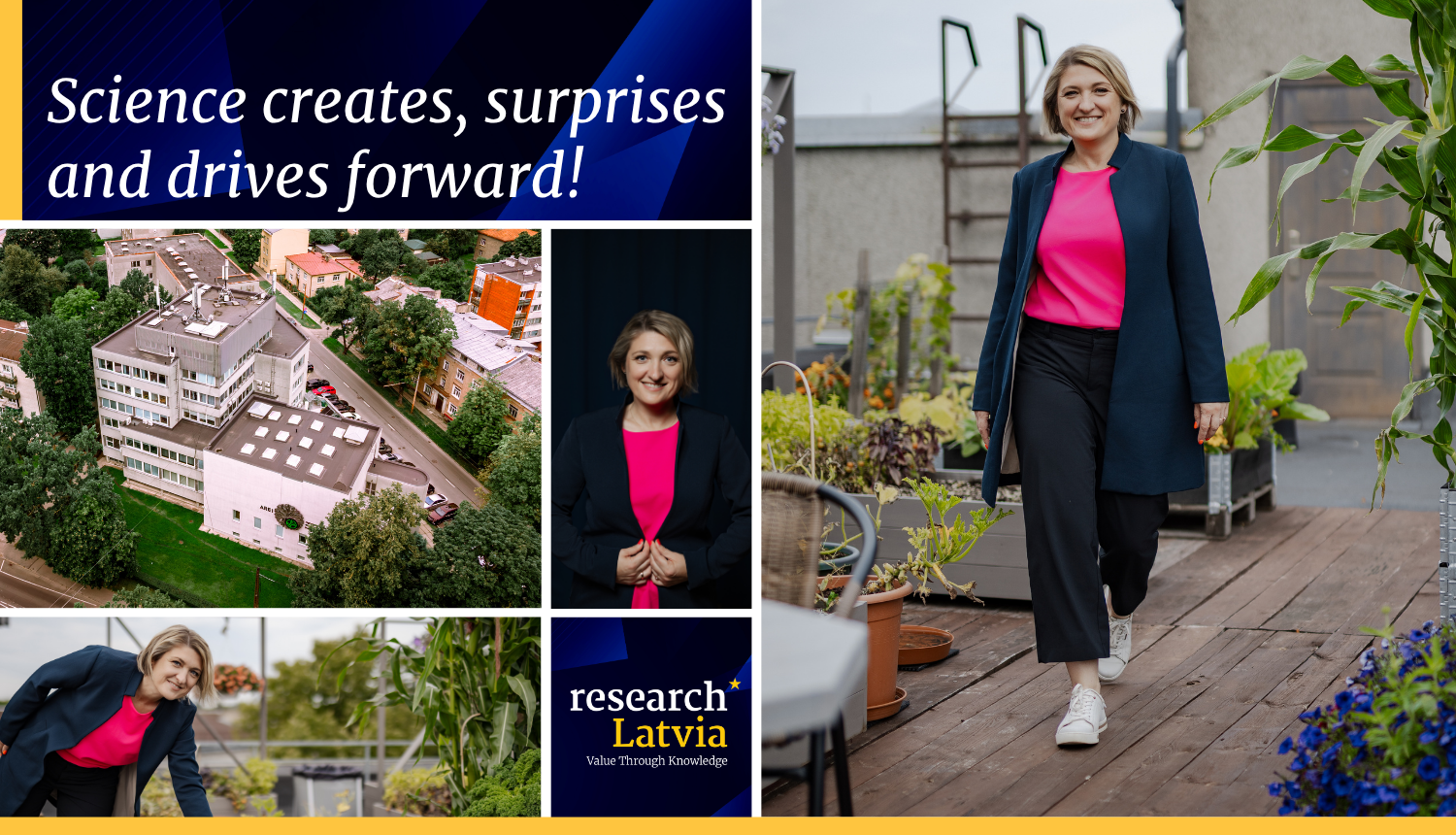
As a Researcher and Project Manager at the Sustainability Research Unit of the Bioeconomy Department at the Institute of Agricultural Resources and Economics (IARE), Mg. soc. sci. Ieva Leimane focuses on sustainable agricultural practices, biodiversity conservation on farmland, socio-economic assessments, and cooperation among stakeholders in agriculture and rural development.
“Science should enable society to progress, encourage us to think more deeply and act more responsibly to create a world that has a future.”
ARE is one of Latvia’s most important research centres in the fields of agriculture, rural development and bioeconomy. The Institute conducts both applied and fundamental research in bioeconomy, crop genetics, agrotechnology and agroecology. Its mission is to generate new knowledge that strengthens the development of sustainable agricultural systems, food production and rural communities.
Ieva’s research examines how environmentally friendly farming practices can be implemented effectively in Latvia, taking into account local natural conditions such as climate, soil and landscape. She emphasises the importance of supporting farmers with science-based, locally tested practices and technologies so that production remains profitable while natural resources are used responsibly.
She explains: “At the Institute, we help entrepreneurs in the agricultural sector by ensuring that they can rely on locally tested practices, technologies and products. This ensures profitability while supporting long-term sustainability. Natural systems are not only the framework for food production – they also support society and businesses as a whole.”
Ieva actively participates in cooperation projects that bring together farmers, consultants and scientists. These projects act as innovation platforms that allow multiple viewpoints, leading to better assessments of economic benefits and risks, as well as environmental and social impacts. This interdisciplinary collaboration helps raise awareness about how land-use decisions made on individual farms influence much broader ecological and economic systems.
One of Ieva’s main research topics is the nitrogen cycle in agriculture – a central global and local challenge. Efficient nitrogen use is essential for crop productivity, but excessive application causes water pollution, eutrophication and greenhouse gas emissions, while also increasing costs for farmers. Ieva explains: “Our research focuses on nitrogen use efficiency and the need to diversify nitrogen sources. Overuse means wasted resources and added environmental risks.”
She highlights that many biodiversity-friendly practices – such as diversified crop rotations, legumes, catch crops, green belts and maintaining field landscape elements – also improve nitrogen efficiency. These practices help increase soil health, reduce environmental pressures and support more resilient agricultural landscapes.
Ieva actively shares research results through public events, scientific publications and collaboration with industry partners. Her work is characterised by a strong commitment to sustainable land management, environmental protection and the long-term resilience of Latvia’s agricultural sector.
Watch the video story highlighting the research of Mg. soc. sci. Ieva Leimane
The science calendar “Research Latvia 2026” and the researcher descriptions were developed within the ERDF-funded project No. http://1.1.1.1/1/24/I/001 “More Efficient Implementation and Management of Latvia‘s Science Policy”, implemented by the Ministry of Education and Science.