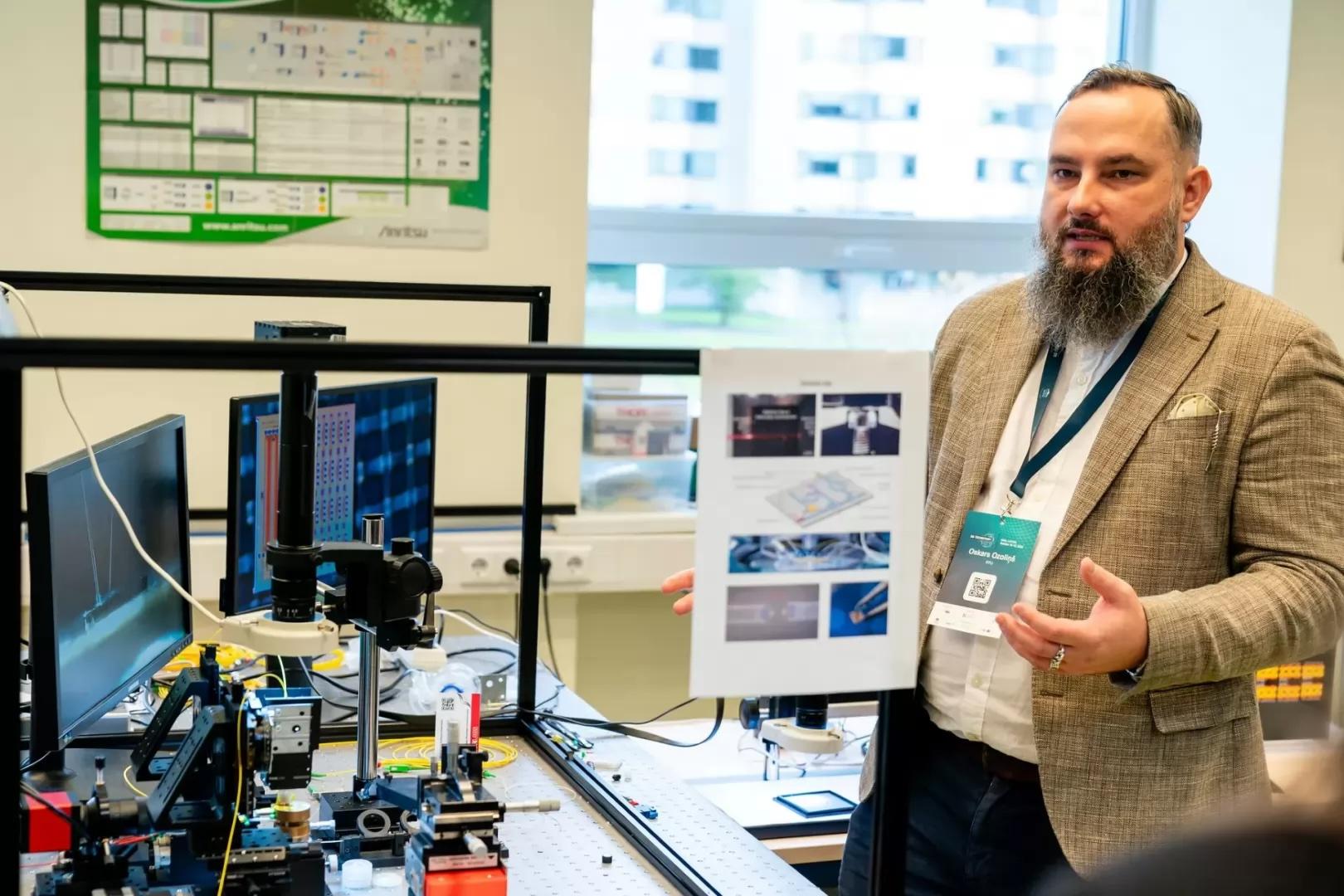
Scientists from the Institute of Photonics, Electronics, and Telecommunications at the Faculty of Computer Science, Information Technologies, and Electrical Engineering at Riga Technical University (RTU), in collaboration with international partners, are presenting a unique imaging system. In the future, it could be used in patient diagnostics, the pharmaceutical industry, and non-destructive testing.
Terahertz (THz) waves are utilized in various imaging applications due to their unique properties, such as high penetration, non-ionizing photon energy, making them a safe tool for non-invasive examinations. Their applications are broad, ranging from medical to industrial and security inspections. However, terahertz imaging technologies currently face challenges in maintaining a balance between key performance indicators—resolution and frame rate.

Photo: Armands Kaņepe, RTU
RTU tenure-track professors Oskars Ozoliņš and Xiaodan Pang, professor Vjačeslavs Bobrovs, and lead researcher Xianbin Yu, in collaboration with colleagues Xing Fang, Lu Zhang, Tianyu Li, Zuomin Yang, and Zhidong Lyu from Zhejiang University (China), are developing an innovative imaging system that simultaneously provides high resolution, strong performance, and a wide field of view. Experiments confirm that the new system is more effective than existing solutions operating in the same frequency range.
O. Ozoliņš explains that these results were achieved through the use of an optical frequency comb and a high-performance terahertz spatial modulator.
The researchers’ work has been published in one of the leading scientific journals in the field of photonics, Optica. More information is available in the article “Rapid photonic THz continuous wave compressive imaging with super-resolution over a large field of view.”
The innovation was developed within the interdisciplinary project “Photonics-Supported Next-Generation Terahertz Hybrid Enhanced Radar Sensing and Communications” (PANTHERS, No. 1.1.1.3/1./24/A/013). Its goal is to design and develop a unified photonics-enabled terahertz system capable of providing both high-speed wireless communications and high-resolution radar sensing simultaneously. The project addresses challenges related to terahertz signal generation, beam shaping, and multiplexing, thereby creating a next-generation platform for communication and sensing applications and contributing to the development of the information and communication technology (ICT), photonics, and smart materials, technologies, and engineering systems sectors.