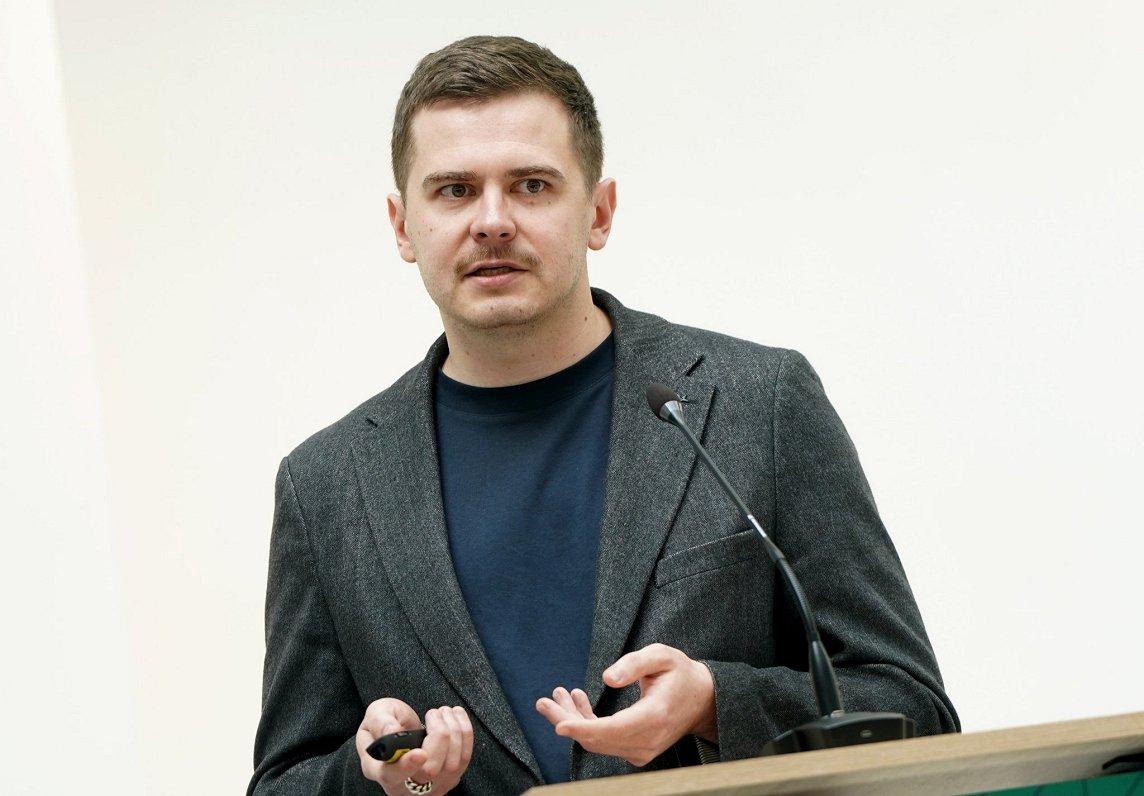
How can cancer cells be destroyed as effectively as possible in radiation therapy for oncological diseases? This is what young physicist Kristaps Paļskis investigated in his doctoral thesis using accelerator technologies. It is currently an experimental approach to radiation therapy that would make it possible to irradiate harmful cancer cells with great precision and in an extremely short time, while minimising damage to healthy cells. The results obtained provide a theoretical basis for future innovations in radiation therapy.
Milliseconds Instead of Minutes
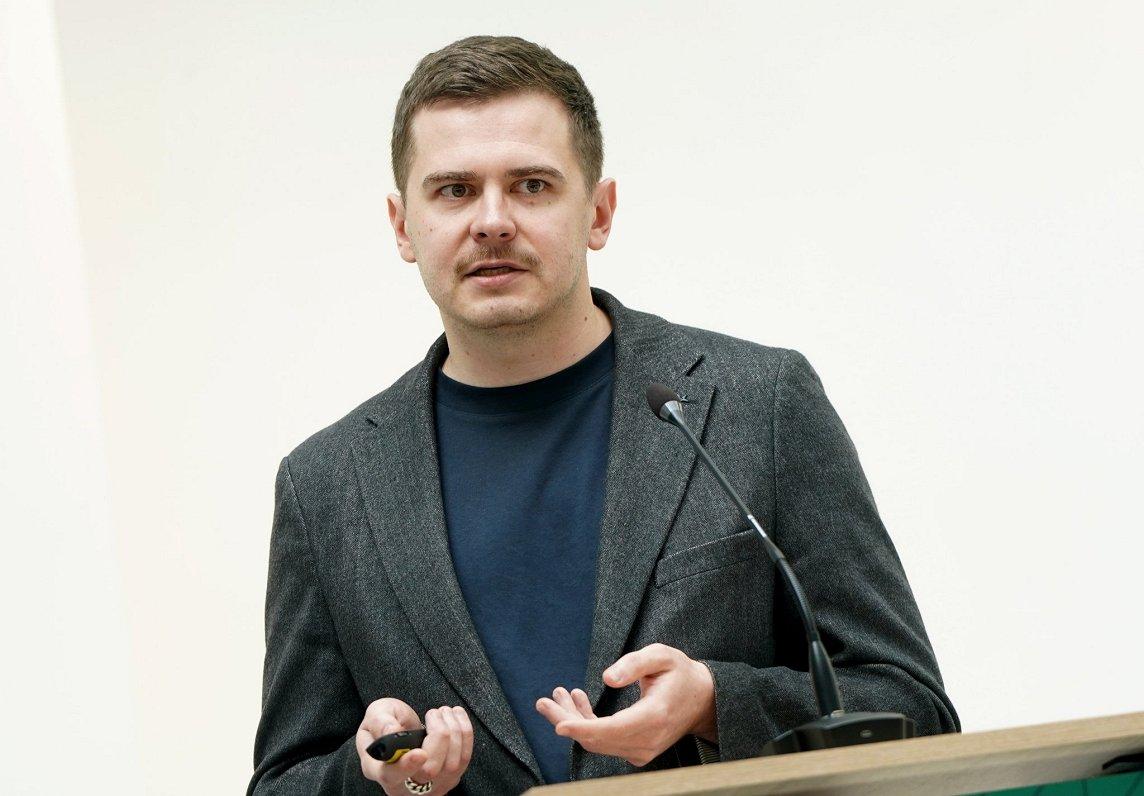
Kristaps Paļskis, a student in the joint doctoral programme in Particle Physics of Riga Technical University (RTU) and the University of Latvia, examines in his doctoral thesis methods for delivering radiation to cancer patients during radiation therapy as quickly and precisely as possible. This is known as the FLASH effect, which has also been widely studied in recent years.
“In conventional therapy, we deliver the radiation over a timescale of minutes, whereas here the entire radiation dose – and one considerably higher than in conventional therapy – would be delivered within a few hundred milliseconds. I also examined this from a technological perspective: how to deliver the radiation so quickly while ensuring very precise dose delivery, how the patient is positioned, and how the patient’s internal physiological movements and similar factors must also be controlled with great precision.”
The young physicist acknowledges that his work has mostly involved programming and mathematical simulations, while chemical experiments were carried out at the German Cancer Research Center. He has mainly worked at the European Organization for Nuclear Research (CERN), where a dedicated working group is exploring how accelerator technologies can be applied in cancer treatment and how conventional X-ray radiation can be replaced with heavier particles – protons, helium ions and carbon ions. In his research, Paļskis has focused specifically on the potential use of helium ions.
“In principle, the patient would benefit from the fact that we would affect the cancer cells in the same way as with conventional radiation therapy, but the advantage of the speed is that the side effects, or the harmful effects of radiation on the surrounding healthy tissues, would be significantly reduced. Of course, clinical trials still lie ahead, because this is only the beginning of the journey. Theoretically, by reducing the impact on the surrounding healthy tissues, we could increase the dose delivered to the tumour while potentially keeping the side-effect profile at the same level as with conventional therapy.”
The researcher emphasises that the theoretical results obtained are only a small piece of the puzzle in making cancer treatment more precise, with modern technologies also being introduced in the future.
“The conventional radiation therapy equipment we use needs to be upgraded. In principle, with X-ray radiation as it is currently delivered using linear accelerators, the FLASH effect has not yet been observed. It is not the case that we can simply achieve this high dose rate and apply it in the usual way, because the volume to which we can deliver it is often limited, as the full technological capabilities are not yet available.”
Precision Needs to Be Improved
Maija Radziņa, Tenure Professor at Rīga Stradiņš University and Vice-President of the Latvian Association of Radiologists, notes that the findings of every researcher are important for further studies on cancer treatment. Current radiation therapy technologies already make it possible to direct the radiation beam precisely at the tumour and from different positions, but it is essential to continue improving this precision, the professor acknowledges.
“Sometimes it is much more important for us to achieve this precision literally down to the millimetre, for example when dealing with brain tumours or tumours somewhere in the facial area. Every tiny structure is located next to another vitally important structure, such as nerves or centres responsible for movement or sensation. That is where precision becomes critically important, and this is where accelerator technologies come in. Such therapies are already being developed around the world, but here in Latvia we currently do not yet have such advanced acceleration capabilities. And that is what Kristaps has been studying – how we could build such devices in the future and exactly which particles we should use, because these particles really need space and distance in which to accelerate in order to reach their maximum effective power,” Radziņa said.
In developing his doctoral thesis, Paļskis involved several students from the Faculty of Civil and Mechanical Engineering at RTU, who also had the opportunity to work at CERN.