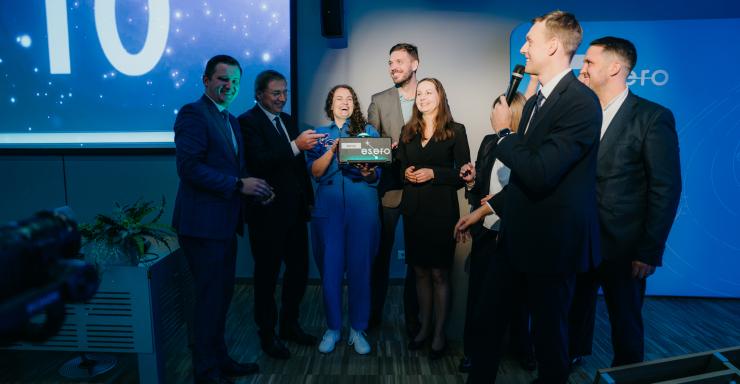
Ieva Siliņa, Parliamentary Secretary of the Ministry of Education and Science, representing Latvia at the International Space Summit in Paris on 9–10 September 2026, emphasised the need to strengthen Europe’s position as a competitive and resilient space power, while also ensuring opportunities for smaller and newer industry players to participate fully in the European space ecosystem.

“Europe’s space capabilities must be built on the potential of the entire European ecosystem. For Latvia, this means investment in research and innovation, the development of new space technologies and services, as well as opportunities for our companies and researchers to participate in the development of Europe’s space sector. Our goal should be to ensure that Europe’s ambitions in space also create opportunities for talent, companies, and research in Latvia,” says Ieva Siliņa.
At the International Summit, particular attention was paid to the role of space in Europe’s security and resilience. Given the changing geopolitical situation, space-based technologies are becoming increasingly important for situational awareness, secure communications, as well as the resilience of society and critical infrastructure. Latvia agrees with European Commission President Ursula von der Leyen, who noted that Europe’s security on Earth increasingly depends on space.
“Latvia, being located on Europe’s eastern border, sees very clearly how important space-based technologies are for our security and resilience. Therefore, space policy is no longer only about technological development – it is also about the ability of our society, infrastructure, and economy to remain resilient,” Siliņa emphasised.
During the summit, Ieva Siliņa also met with Rodrigo da Costa, Executive Director of the European Union Agency for the Space Programme (EUSPA), to discuss the implementation of EU space policy and programmes, including the development of the EU Space Act, opportunities offered by the space programme for crisis and disaster risk management, as well as challenges posed by satellite navigation signal disruptions in the Baltic region. The meeting also covered Latvia’s preparations for its Presidency of the Council of the European Union in 2028.

EUSPA is an important partner for Latvia in the implementation and use of European Union Space Programme services, promoting the use of opportunities provided by space technologies in public administration and the economy, as well as fostering innovation and security.
During her visit to Paris, the Parliamentary Secretary also met with Latvia’s Ambassador to France, Alise Balode, to discuss potential cooperation opportunities for promoting the growth of Latvia’s space sector.
The International Space Summit in Paris brought together government representatives, leaders of space organisations, and industry companies from Europe and other countries around the world to discuss the future of space research, technology, security, and international cooperation.
Latvia joined several international declarations aimed at developing a sustainable, secure, and competitive space ecosystem. They call for strengthening the peaceful and sustainable use of space, promoting international cooperation and the role of the United Nations in space governance, facilitating the open, reliable, and interoperable exchange of scientific space data, as well as supporting the efficient management of the radio-frequency spectrum and satellite orbital resources. The Declaration on Europe as a Space Power of the 21st Century emphasises the need to strengthen Europe’s competitiveness, strategic autonomy, and technological capabilities in the space sector by developing research, innovation, satellite communications, Earth observation, and access to space. These goals closely align with the priorities of Latvia’s Space Strategy, promoting research excellence, international cooperation, and the involvement of Latvian companies in the development of Europe’s space sector.
In a discussion among representatives of European countries, Ieva Siliņa emphasised that the development of European space policy is also closely linked to the development of human capital: “Competitiveness ultimately depends on people. Space policy is also a policy of research, innovation, and STEM education.”
Latvia continues working to ensure that the development of Europe’s space sector creates new opportunities for Latvian researchers, companies, and talent, while strengthening the country’s security, economic competitiveness, and resilience.