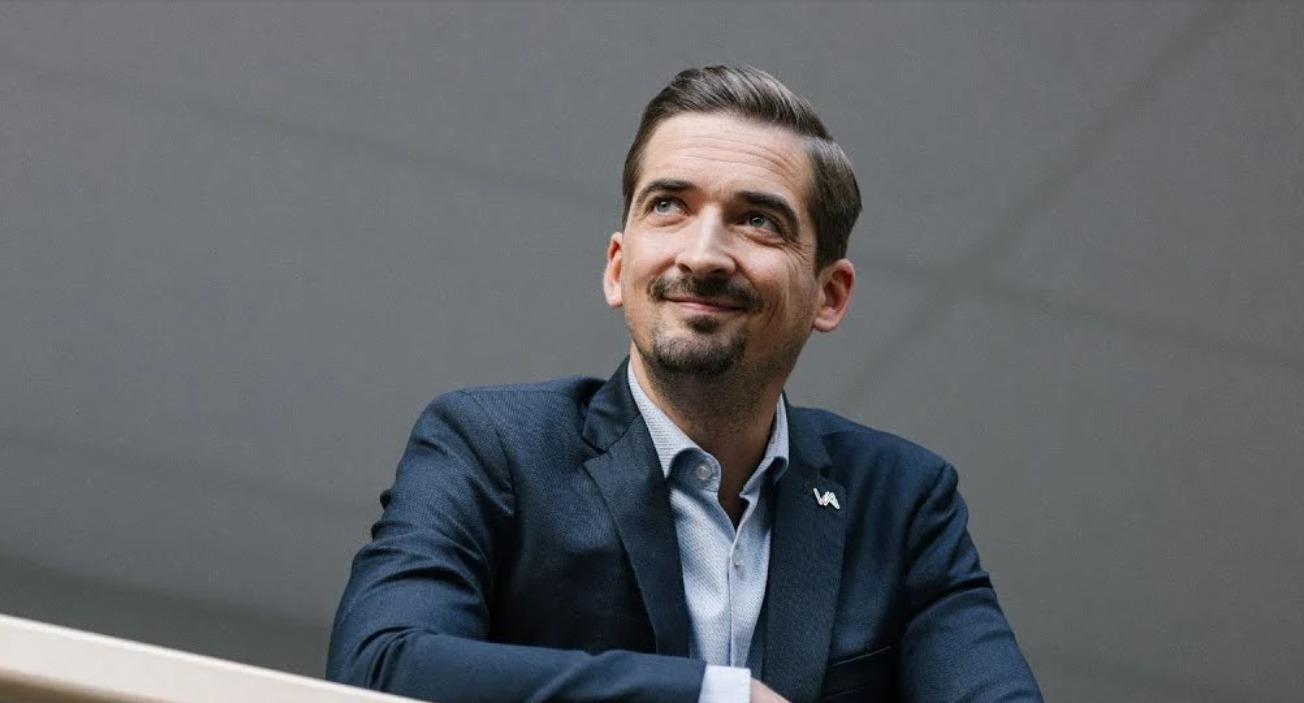
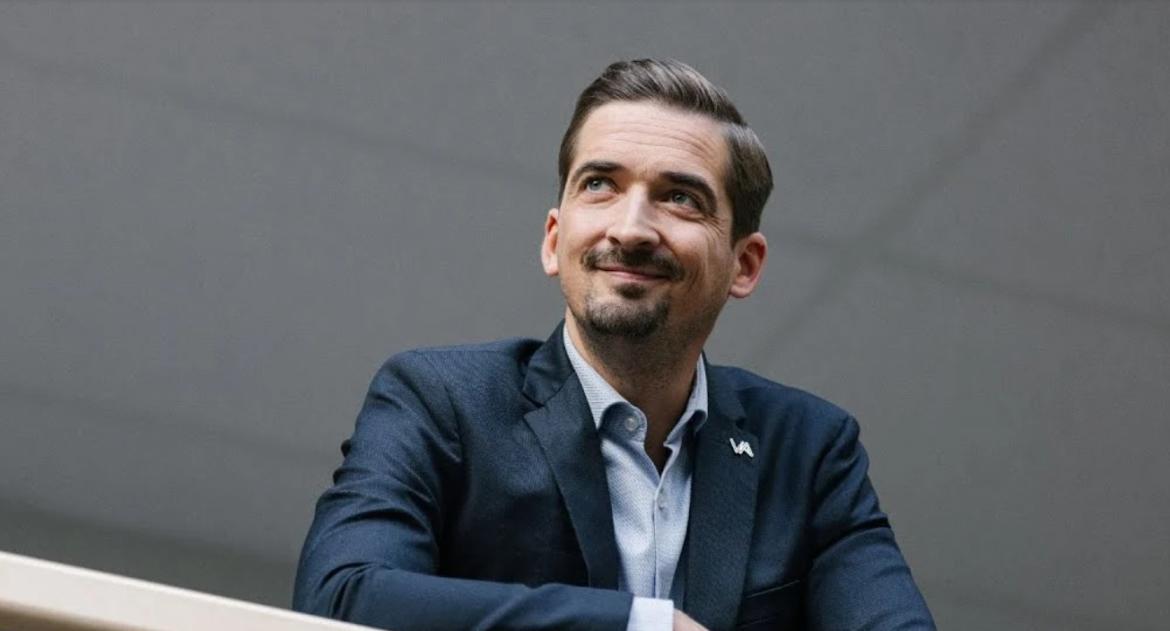
The June researcher of Vidzeme University of Applied Sciences (ViA) is Leading Researcher, Associate Professor and Head of the doctoral study programme, PhD Oskars Java. His research interests are related to simulation modelling, systems analysis and research management, while in his daily work he helps emerging scientists develop their research and coordinates international projects. In the conversation, Oskars talks about his path into research, his recently obtained position of Associate Professor, his work with doctoral students and how innovation emerges both in science and in the kitchen.
What has been your main focus recently?
There have been several recent developments, but the most significant one is certainly obtaining the position of Associate Professor. I will be honest — it was not my initiative. I was encouraged to pursue it by the Dean, because in my everyday work I was already performing all the duties corresponding to this position, just without the actual title. Now, when students call me professor, I no longer feel awkward, because this position has indeed been granted to me. However, that does not mean I can relax for the next six years. To retain the status of Associate Professor, I must continue to work actively — publish scientific articles, become involved in and lead research projects, review students’ work, organise scientific conferences and continue fulfilling a range of other academic duties.
You have been working at Vidzeme University of Applied Sciences for several years now. What was your path into research and work at Vidzeme University of Applied Sciences?
I first became acquainted with Vidzeme University of Applied Sciences in 2004, when I began my bachelor’s studies in tourism. At that time, I was quite lazy — I wanted to study less and have more fun, so it seemed that tourism studies would be the right choice. Compared with other Latvian higher education institutions where it was possible to study tourism at the time, Vidzeme University of Applied Sciences had the strongest competition. At another higher education institution, I was the second-best applicant in the competition, but here I initially remained below the admission threshold. By a fortunate coincidence, several applicants chose to study elsewhere, and one of the few state-funded places became available to me. In my view, this reflected the high quality of the studies, so I chose Vidzeme University of Applied Sciences.
The second time I began studies at Vidzeme University of Applied Sciences was in 2016, when I enrolled in the master’s study programme “Sociotechnical Systems Modelling”. By that time, I had already gone through a certain stage of life and understood that I wanted to continue studying. To be honest, I had no real idea what sociotechnical systems modelling meant, and that was precisely what interested me the most.
Given that I had no prior knowledge of information technology, the first semester was challenging. However, the more I began to understand modelling, the more it captivated me. In my master’s studies, I chose a research topic that combined my interest in environmental protection with the current priorities of the Institute for Environmental Solutions — “The Impact of Leaf Area Cover in Gulbju Island Bog on the Ecosystem Water Balance”. It must be said, however, that Europe had different priorities at the time, so this research topic and the model developed are no longer as relevant today.
Nevertheless, that experience is also useful in your current work, as you lead the doctoral school.
Yes, definitely. My doctoral thesis is still used as a good example, also at certain other higher education institutions, of how to structure a scientific paper.
My relatively recent doctoral studies experience also helps me understand today’s doctoral students much better. I know what mistakes I made myself, and I can help others avoid them. I feel this particularly strongly this week, as Vidzeme University of Applied Sciences is hosting an intensive blended study programme for doctoral students and doctoral degree candidates.
How did your research work at Vidzeme University of Applied Sciences begin? What is your field of research?
My field of research is simulation modelling and the development of simulation models for the analysis of various systems. The most important thing is to understand the boundaries of a system — where it begins and where it ends.
At present, I am increasingly using my experience to support new doctoral students and participate in various research projects. As a result, I am paying increasing attention to research management and the modelling of system management scenarios. Since the application of simulation models is very broad, my research also covers diverse fields.
What fascinates you most in the work of a researcher, and what creates the greatest difficulties?
One of the greatest advantages is the size of the university. It makes it possible to know colleagues, to know each person’s strengths and to understand whom to turn to for help or advice. I also like the environment in which we work. Valmiera is peaceful, the air is clean, and nature is very close by. This creates very pleasant conditions for work. As for the most difficult part... I am still looking for an answer to that question. Several years ago, I had a conversation with the rector of an Austrian university. We discussed that it is bad if you are unsuccessful, but it may be even worse if you are successful, because then there is so much work that it is impossible to manage everything in time.
How does the environment at Vidzeme University of Applied Sciences support your work?
One of the greatest advantages is the size of the university. It makes it possible to know colleagues, to know each person’s strengths and to understand whom to turn to for help or advice.
I also like the environment in which we work. Valmiera is peaceful, the air is clean, and nature is very close by. This creates very comfortable conditions for work.
What characterises you as a person outside research — what helps you restore your energy and inspiration?
I really enjoy being outdoors — walks with my dog are an integral part of my everyday life. Another passion of mine is cooking. I cook a lot, but I almost never follow recipes.
The only exception is Pavlova. I do make that strictly according to the recipe, and my colleagues have also tasted it.
I think that improvisation in cooking is very similar to what happens in research. Often, one must be able to combine seemingly incompatible ideas and find balance. I believe that this is precisely how innovation emerges.
What will be your next significant professional challenge?
My next significant professional challenge will be related to the Horizon Europe project REMAP. It will involve coordinating the project, as this is the first European project of this level in which Vidzeme University of Applied Sciences is the lead organisation, rather than just a partner. The aim of the project is to draw attention to professions that support the research process but often remain unnoticed in society. Usually, the researcher is perceived as the main driver of a project, but behind high-quality science there are also research managers, project coordinators, data management specialists, open science experts and other professionals whose work is essential for successful research and the achievement of results.
At the European level, increasing attention is being paid to the recognition and professional development of these professions. It will be interesting for me to be part of this process and to help create an environment in which research is perceived as teamwork, where every specialist has an important role.
Where do you see yourself in a few years?
I do not set myself goals that I want to achieve in five, ten or fifteen years. I am open to opportunities. There are more of them around than it is possible to pursue, so I first consider whether the specific opportunity interests me thematically, then whether it will contribute to my personal growth, and, before making a final decision, I make sure whether I have free space for it in my planner.
Find out more about the researcher by watching the video created within the framework of the Research Latvia project “Science for Latvia 2025”.