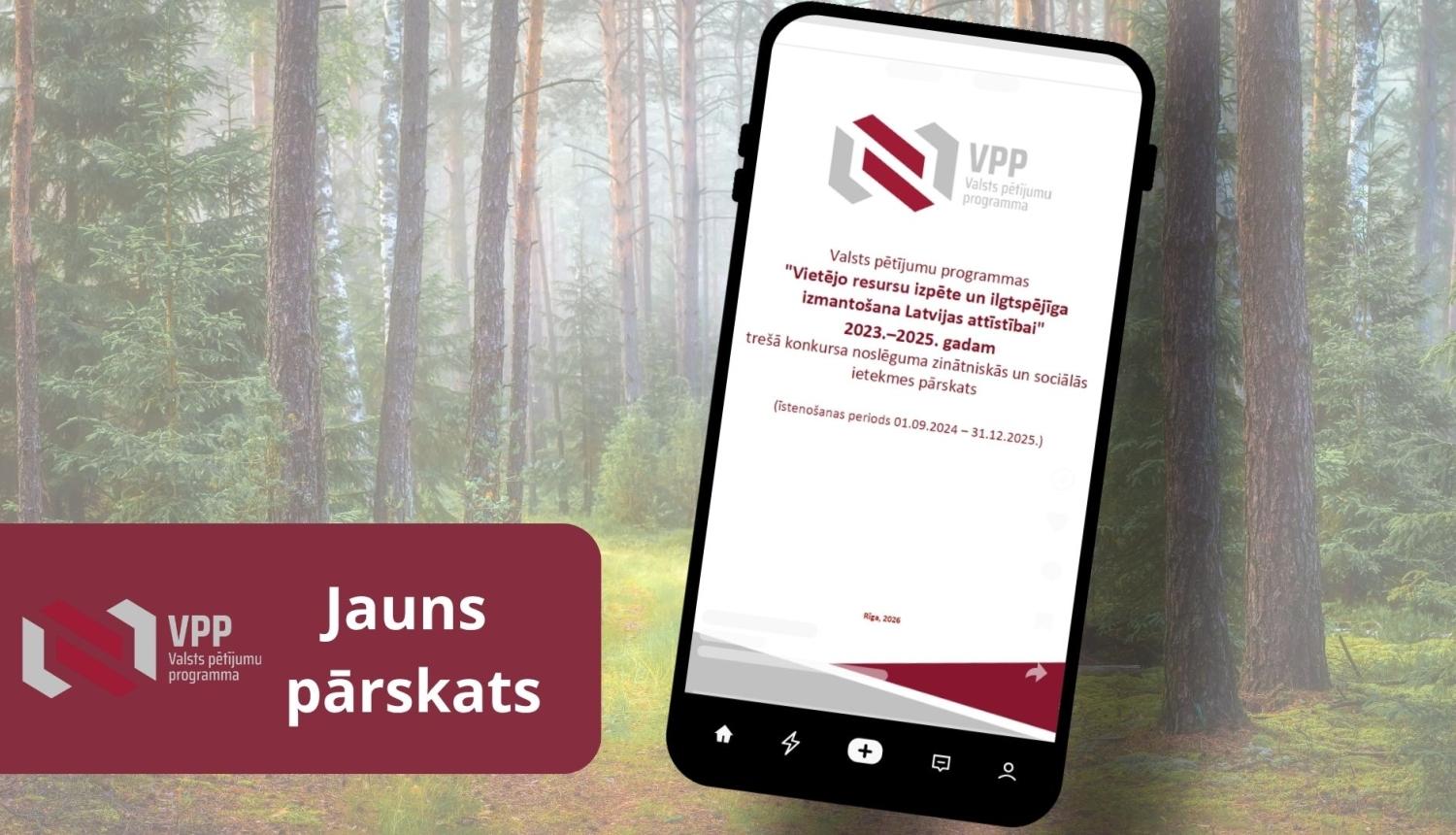
The implementation of the third competition of the National Research Programme “Exploration and Sustainable Use of Local Resources for Latvia’s Development” has been completed, and a report has been prepared summarising the results achieved within the programme, the solutions developed, and their contribution to Latvia’s sustainable development.

The overarching goal of the National Research Programme “Exploration and Sustainable Use of Local Resources for Latvia’s Development” is the sustainable and rational use of natural resources, increasing their added value under changing environmental conditions. The programme aims to expand the knowledge base on technologies for the sustainable use of agricultural resources in the production and processing of high‑quality food raw materials, as well as in the control of raw materials and products in Latvia, in order to provide consumers with healthy and safe locally sourced food products, thereby promoting the growth and competitiveness of the agriculture and food sectors. Another key objective is to ensure sustainable forestry and the rational use of Latvia’s forest resources for the production of globally competitive products, while preserving biological diversity and the social value of forests for future generations.
The projects have made a significant contribution to sustainable agriculture and forestry, the development of the food system, and the promotion of food safety, forest management, environmental sustainability, climate‑resilient resource management, and high value‑added technology development. They have also strengthened Latvia’s scientific capacity and international competitiveness in the fields of bioresources and the bioeconomy.
Within the project “Scientifically Based Solutions for a Sustainable Food System to Achieve the Goals of the European Green Deal (GreenAgroRes)”, scientifically grounded solutions were developed for advancing sustainable agriculture and the food system, significantly reducing the risks associated with pesticide use and environmental pressures while maintaining high yields. New methodologies were created for assessing progress towards the goals of the European Green Deal, including an Agricultural Green Competitiveness Index and sustainable development scenarios up to 2030. The project produced publicly accessible datasets on food composition, packaging, bioactive compounds, and indicators of sustainable agriculture, and developed innovative food technologies and biodegradable material solutions. Important research was carried out in the fields of antimicrobial resistance, food safety, and freshwater resources, resulting in recommendations for policymakers and industry stakeholders.
The project “Innovations in Forest Management and the Wood Processing Value Chain for Latvia’s Growth: New Services, Products, Technologies (Forest4LV)” delivered essential results for the development of climate‑resilient and sustainable forestry. The genetic adaptation of local Scots pine populations to the climatic conditions of the Baltic region was demonstrated, and the impact of improved reproductive material on forest genetic diversity at the landscape level was assessed. New precision forestry approaches were developed, including FTIR spectroscopy methodologies for evaluating tree nutrient status and forest stand responses, as well as advanced remote sensing and drone‑based technologies for early detection of pest damage. The project also made a substantial contribution to forest biodiversity research by analysing the role of microhabitats, retention trees, and deadwood in maintaining forest ecosystem resilience. Significant achievements were made in the fields of bioeconomy and wood processing technologies, including the development of biopolymers, wood composites, thermally modified wood, and bio‑based binders, as well as biorefining technologies for obtaining high value‑added chemical compounds from wood residues and bark extracts. Innovative materials were created for construction and biomedical applications, including wood‑based materials for osteosynthesis implants, and a pilot‑scale production process for the Phlebiopsis gigantea biocontrol agent was developed, reaching technology readiness level TRL 6–7.
The project results have been published in high‑level international scientific journals, presented at international conferences, supported by the creation of open datasets, and strengthened through extensive international cooperation. The results have also been integrated into policy planning, while simultaneously enhancing Latvia’s research capacity and engaging early‑career researchers in the fields of the bioeconomy, forest science, and bioresources.
Overall, the National Research Programme “Exploration and Sustainable Use of Local Resources for Latvia’s Development” has made a substantial contribution to strengthening Latvia’s knowledge‑based economy, bioeconomy, and sustainable development, demonstrating the strategic importance of science in ensuring national security, competitiveness, and long‑term growth. The solutions developed within the programme in agriculture, the food system, forestry, and bioresource processing not only support the achievement of the European Green Deal and climate objectives but also reinforce Latvia’s ability to base its economic development on local resources, knowledge, and high value‑added innovation.
The project results confirm that targeted investments in science enable Latvia to develop internationally competitive technologies, strengthen national research capacity, promote cooperation between science, industry, and the public sector, and ensure data‑driven policy planning for sustainable resource management. At the same time, the programme has made a significant contribution to the development of early‑career researchers and the expansion of international cooperation, thereby strengthening Latvia’s position within the European Research Area and creating the foundations for sustainable, innovation‑driven national development in the future.