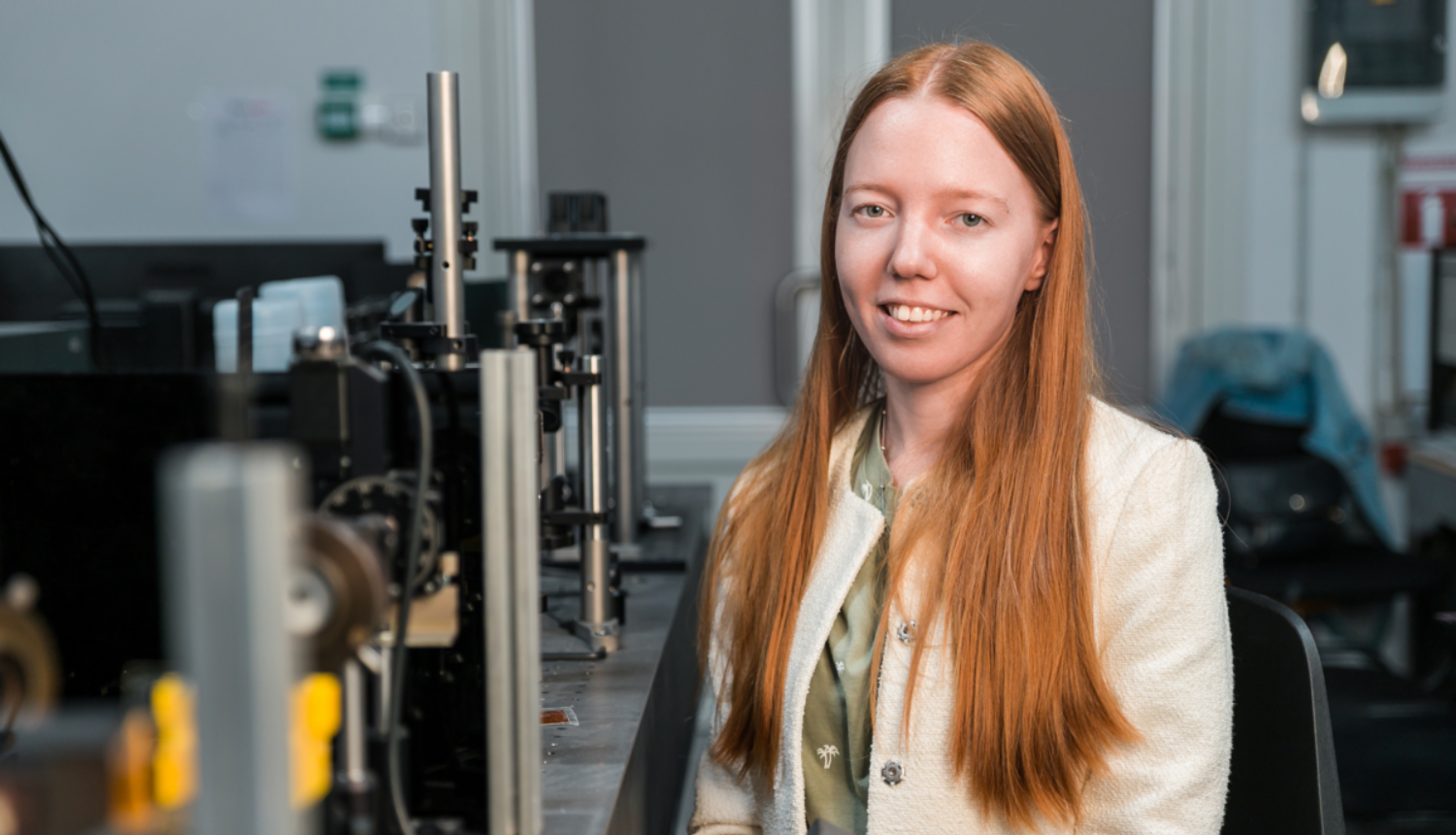
Anete Sapne, a PhD student at the University of Latvia (UL), passionately studies materials that could one day become a key component in optical computers – future technologies capable of processing data much faster than today’s devices. Her research field, nonlinear optics, may seem complex, yet behind the technical terms lies a story of persistence, determination, and the ability to seize every opportunity.
Anete’s love for physics began already in the 8th grade, thanks to an outstanding teacher who not only taught but also inspired.
Although in high school she chose a humanities track, her interest in the natural sciences only grew – she attended additional classes in physics, chemistry, and biology, and participated in the Young Professionals Schools organized by UL. Studying at UL was a logical next step – first in the bachelor’s program, then the master’s, and now in doctoral studies, specializing in materials science.
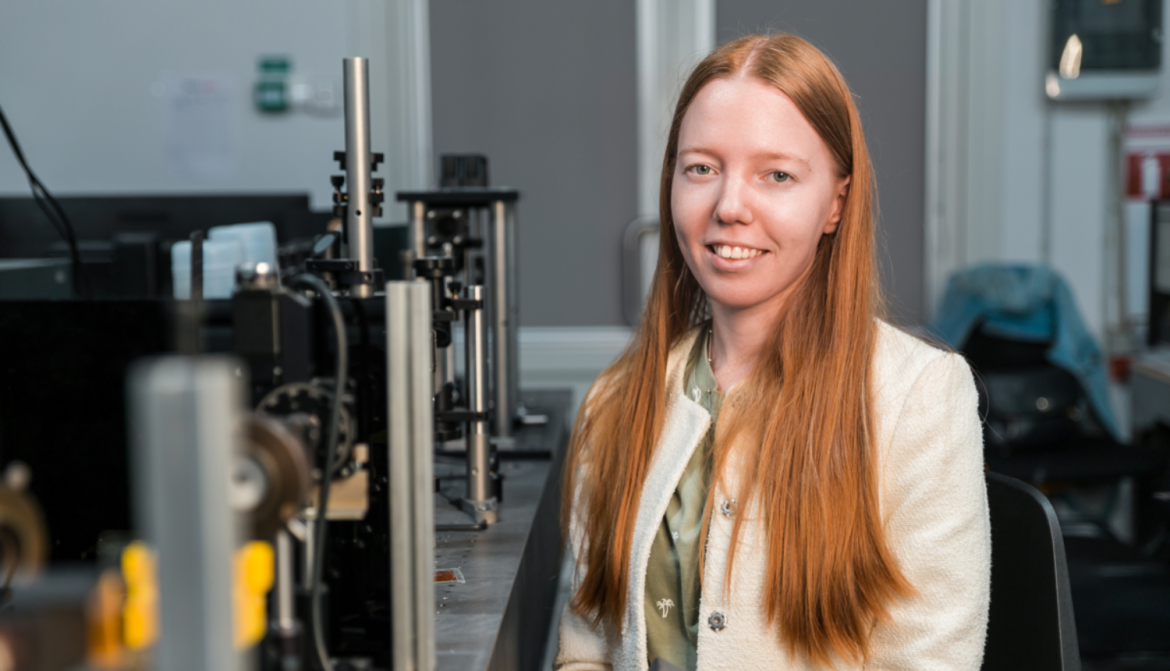
Already during her bachelor’s studies, Anete joined a scientific project focused on developing an optical gas sensor, where she learned thin-film fabrication and optical measurement methods. During her master’s, she turned her attention to third-order nonlinear optical effects, and now in her doctoral studies, these two directions merge – practical material processing combined with in-depth exploration of their optical properties.
Everyday, Anete works at the Laboratory of Organic Materials at the Institute of Solid State Physics, UL, where she has access to state-of-the-art equipment and a supportive, friendly environment.
“For successful doctoral studies, it is important to find a topic that excites you and a place where you feel you belong,” says Anete. She also emphasizes the role of her supervisor and colleagues in the research journey – good collaboration inspires, eases the workload, and strengthens motivation.
“In my doctoral research, I study nonlinear optical phenomena – particularly third-order effects – to understand how different materials interact with intense laser radiation. These materials can alter the properties of light – for example, by causing beam focusing or scattering, or by generating new frequencies,” A. Sapne explains. She identifies and analyzes materials that could be suitable for creating optical components for optical computers, such as frequency combs, entangled photon sources, and optical switches.
Such solutions could in the future be integrated into specialized chips to build computer components that operate with light rather than electricity – making these computers not only significantly faster but also more energy efficient.
Anete’s daily life is diverse – she not only conducts experiments and analyzes results but also assists students, supervises bachelor’s theses and high-school research projects, participates in several international projects, and regularly travels abroad for conferences and research visits - to Italy, France, Sweden, and elsewhere.
Beyond the laboratory, she is also active and creative – she enjoys knitting, crocheting, making polymer clay jewelry, painting, building Lego structures, cycling, and even competing in speed puzzle-solving competitions.
“Creativity is essential in science too – it helps to see unusual solutions and approach problems differently,” she says.
As the Science Affairs Coordinator of the UL Student Council, A. Sapne actively creates opportunities for others – organizing events where school pupils and students can explore different fields and find their own path. She particularly highlights the importance of the Young Professionals Schools at UL, in which she once participated and now helps to organize.
“Don’t miss opportunities – they can be life-changing! Sometimes a single decision can change everything – both in your career and in life,” Anete advises. In her view, pursuing a PhD should come from genuine curiosity and a desire to explore and discover, rather than simply as “the next logical step” after a master’s degree.
Anete still has several years of intensive work ahead, but she is convinced – this journey provides experience that is invaluable not only in science but also in every other sphere of life.