Six Steps to Turn Your Research into a Story

Author
research Latvia

April 22, 2025

science communication

In today's world, where there is an overwhelming amount of information and it is becoming increasingly difficult to hold attention, it is important not only what a researcher communicates, but also how the research is presented. In science communication, storytelling is gaining more and more importance – the ability to turn complex facts and data into a clear and engaging narrative. 
3.png


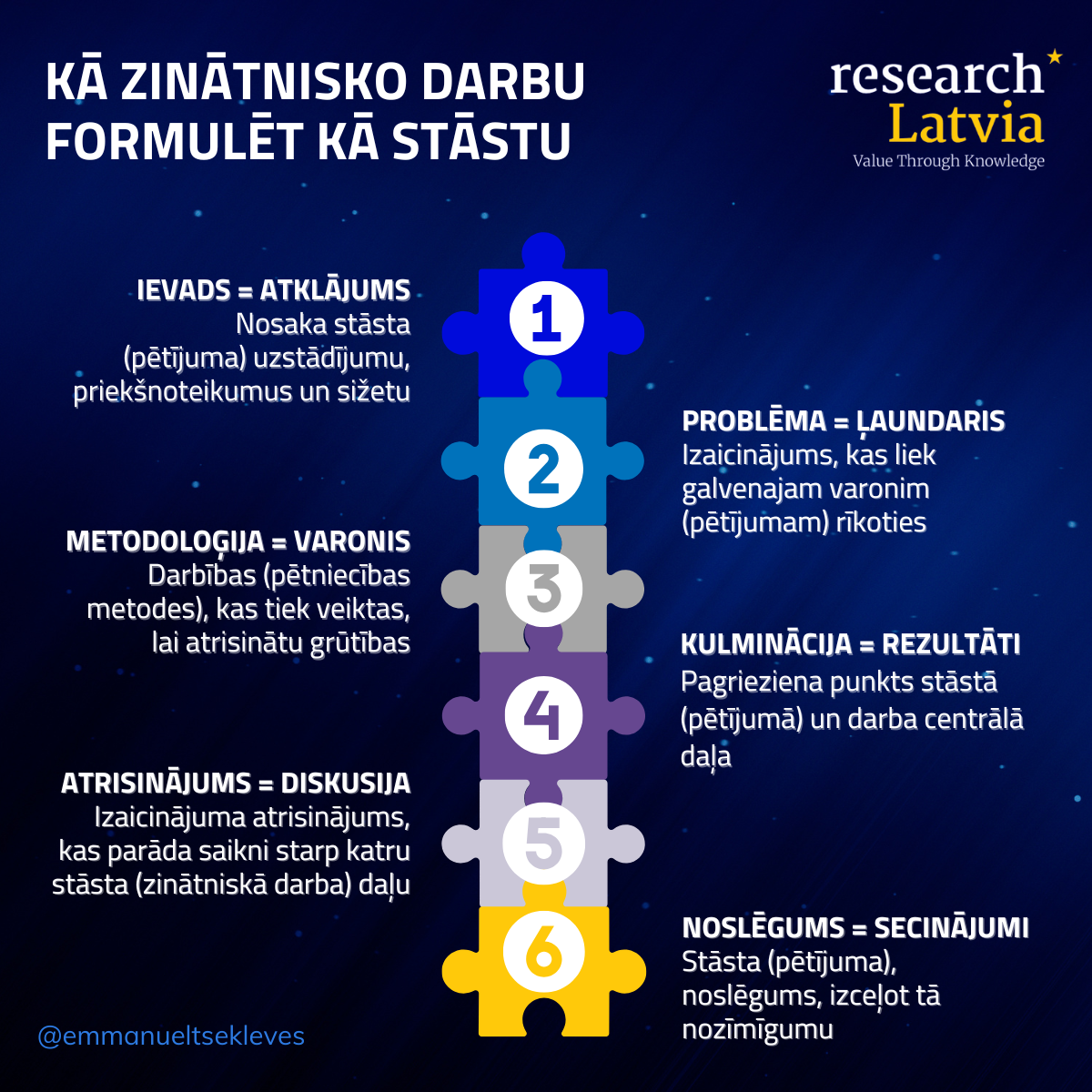
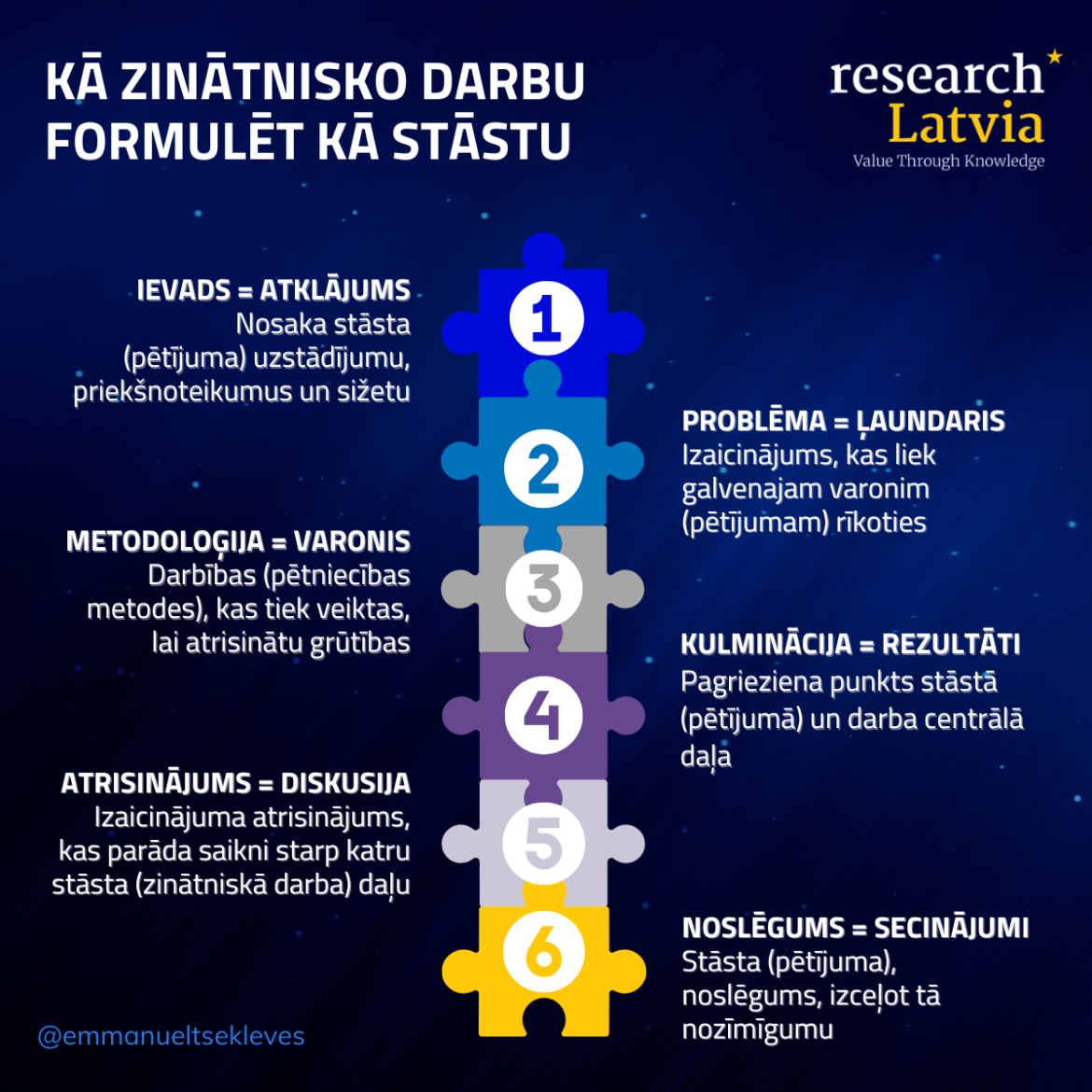
These six steps will help transform your research into a compelling read that captures and retains the reader's attention. 

1. Introduction = Opener, Setting the Scene 

Every great story begins with a captivating introduction. This is the moment where the researcher sets the stage – offering context, relevance, and introducing the unknown question the study aims to answer. 

2. Problem = Villain, Rising Tension 

Every research project addresses a problem. Here, the author can create intrigue – why is this issue important, and why does it need to be solved now? 

3. Methodology = Hero 

Now the story’s protagonist enters – the method chosen by the author. The researcher should explain how challenges will be overcome, what tools will be used, and why. 

4. Results = Climax 

This is the moment of revelation. The researcher’s task is to bring new understanding to an underexplored or unclear topic – this is the “wow” moment for the reader. 

5. Discussion = Resolution, Everything Comes Together 

After the climax, it’s time to reflect. How do the findings fit into the broader scientific context? What do they change? What still needs to be explored? 

6. Conclusions = Ending, the Grand Finale 

Every story must come to an end – and the best ones leave a lasting impression. In the conclusion, the author can emphasize the significance of the research and invite the reader to think further. 

Storytelling in science is a kind of bridge between the researcher and the public. This approach not only helps make scientific work more accessible to a broader audience, but also increases the chances that it will be noticed, read, and appreciated. 
Source: How to Write your Research Paper as a Story 

Recommended articles

science communication

BIOR: Science for Food Safety, Veterinary Medicine, Public and Environmental Health

The Institute of Food Safety, Animal Health and Environment BIOR is an internationally recognized research center that plays a key role in the fields of food safety, veterinary medicine, public health, and environmental research. The institute provides research activities that meet international st…

The Institute of Food Safety, Animal Health and Environment BIOR

March 23, 2026

science communication

World Water Day – The Contribution of Latvian Scientists

World Water Day is celebrated every year on 22 March to raise awareness and draw attention to the availability and quality of water resources, encouraging everyone to recognise the importance of water and to take care of one of our planet’s most essential resources. World Water Day has been organis…

research Latvia

March 20, 2026

research science communication

How Researcher Velga Polinska Is Changing Attitudes Toward Easy Language

"Easy language is not an alternative to literature – it works like glasses for those with poor eyesight," emphasises University of Latvia (UL) researcher Velga Polinska, who in November represented Latvia in an international science communication competition in France, presenting her research on ea…

Ieva Lazdiņa |Editor of the University of Latvia publication "Alma Mater"

March 17, 2026

researcher science communication

March Research Spotlight Žanete Šteingolde: Understanding the Link Between Animal, Human and Environmental Health

As Head of the Microbiology and Pathology Laboratory at the BIOR Institute, Mg. med. vet. Žanete Šteingolde works at the intersection of animal, environmental and public health, advancing research grounded in the One Health approach. Her work focuses on infectious diseases in animals, includin…

researchLatvia

March 16, 2026