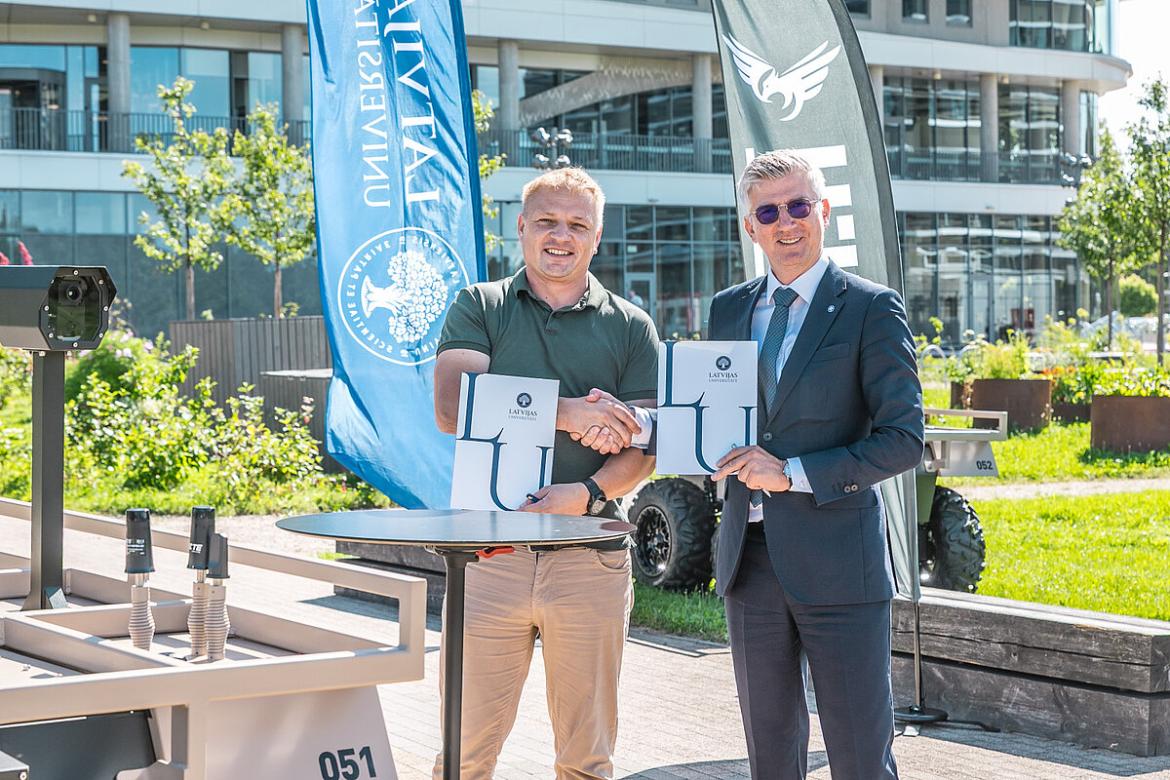
The University of Latvia (UL) and the Latvian high-tech company SIA “LV-Teh” have entered into a long-term strategic partnership in the fields of research, education, innovation, and technology development. The aim of the partnership is to promote the development of defence technologies, autonomous systems, robotics, artificial intelligence, electronics, sensor technologies, and advanced manufacturing solutions, facilitating the transformation of scientific results into practically applicable and internationally competitive products.
As geopolitical challenges in Europe and the Baltic region increase, the ability to develop home-grown technologies for security, defence, and critical infrastructure needs is becoming increasingly important. The European Union and NATO are placing growing emphasis on technological sovereignty, innovation, and cooperation between academia and industry in order to ensure national resilience and the ability to respond quickly to new security challenges.
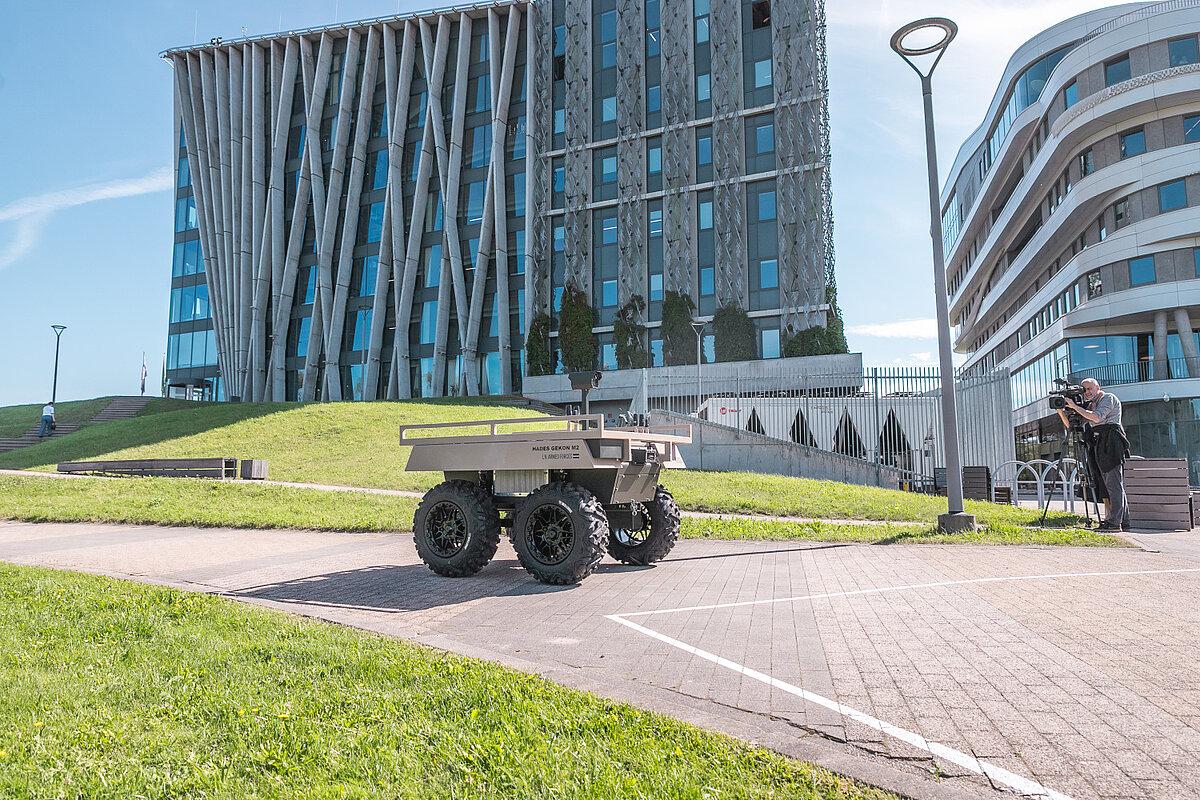
“LV-Teh” specializes in the development of autonomous systems, robotics, unmanned ground platforms, electronics, and defence and security technologies. In cooperation with UL, it is planned to combine the university’s interdisciplinary scientific expertise with the company’s experience in technology development and manufacturing, creating solutions for national defence, civil security, and critical infrastructure needs.
UL will contribute a broad range of interdisciplinary expertise to the cooperation – computer science, artificial intelligence, data science, physics, mathematics, materials science, engineering, optics, photonics, sensor technologies, cybersecurity, and innovation management. This interdisciplinary approach will enable the development of technologies that simultaneously strengthen defence capabilities and create new export opportunities for the Latvian economy.
“Latvia’s and the Baltic region’s security increasingly relies not only on military capabilities, but also on technological excellence, innovation, and the ability to create our own solutions. Cooperation between universities and companies is an essential prerequisite for transforming researchers’ knowledge into technologies that strengthen national resilience, promote economic development, and create high-value-added products for international markets. Therefore, it is important for us to cooperate with a company that develops technologies with practical applications for defence and security needs,” emphasizes UL Vice-Rector for Development Enno Ence.
In turn, LV-Teh notes that today’s security challenges require close cooperation between science and industry, as this is the only way to ensure a rapid transition from research results to practically implementable solutions.
“Sustainable impact in the defence and high-tech sector does not come from individual projects, but from long-term, structured cooperation that ensures the transition from identifying technological challenges to scientifically grounded, validated, and practically implementable solutions. Latvia and the Baltic region have the potential to become a significant innovation centre in the field of defence technologies, and this partnership is an investment in realizing that potential,” says SIA “LV-Teh” Board Member Uģis Svirido.
During the cooperation, UL researchers, students, and doctoral candidates will be able to participate in several high-value-added research and development areas. One of these will be autonomous systems, robotics, and smart platforms – including the research, development, validation, and implementation of robotic platforms, unmanned ground systems, control systems, navigation solutions, and human–machine interaction. Significant attention will also be paid to the development of artificial intelligence, computer vision, data analytics, cybersecurity, digital twin, and simulation solutions, as well as innovations in sensor technologies, materials science, and advanced manufacturing.
The partnership also provides for the implementation of joint national and international research and innovation projects, the use of research infrastructure, prototype development, and technology validation under real-world conditions. The cooperation model is designed to ensure a full innovation cycle: from identifying an industry challenge to prototype development, testing, and bringing the technology to market.
Both parties emphasize that the cooperation will strengthen the technological resilience of Latvia and the Baltic region, promote the development of local expertise in strategically important sectors, and facilitate knowledge transfer between academia and industry. At the same time, it will provide students and young researchers with opportunities to work on real-world challenges and technologies that are shaping the future of security and defence solutions.