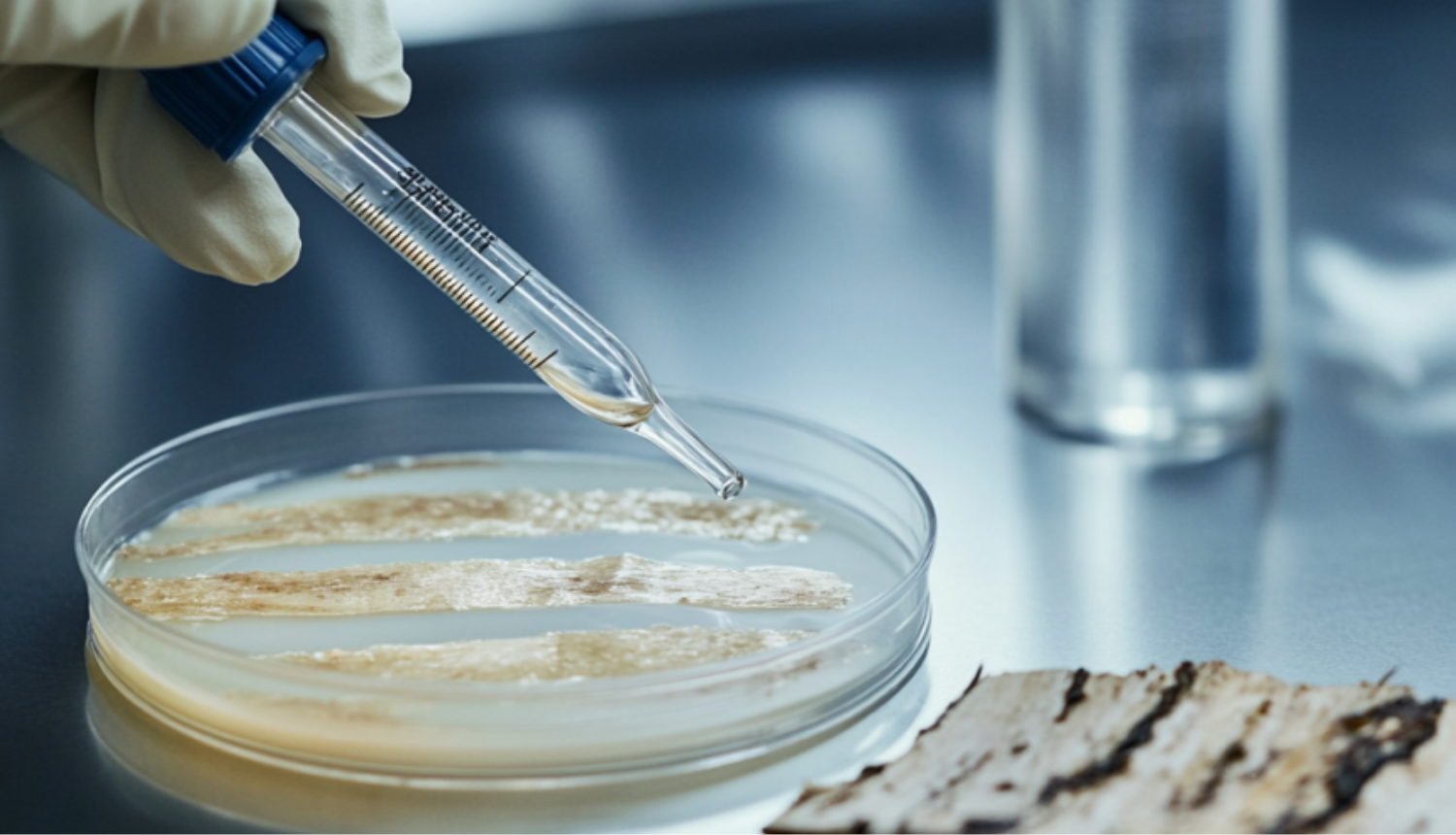
Did you know that chitosan, extracted from Agaricus bisporus mushroom biomass, is one of the rare natural polymers with a positive charge? This unique property makes it an effective barrier against bacteria and moisture, an advantage lacking in many synthetic materials. Meanwhile, industrial hemp, historically used in rope-making and early papermaking, is now being reimagined as a micro- and nanofiber source for strong, renewable materials.
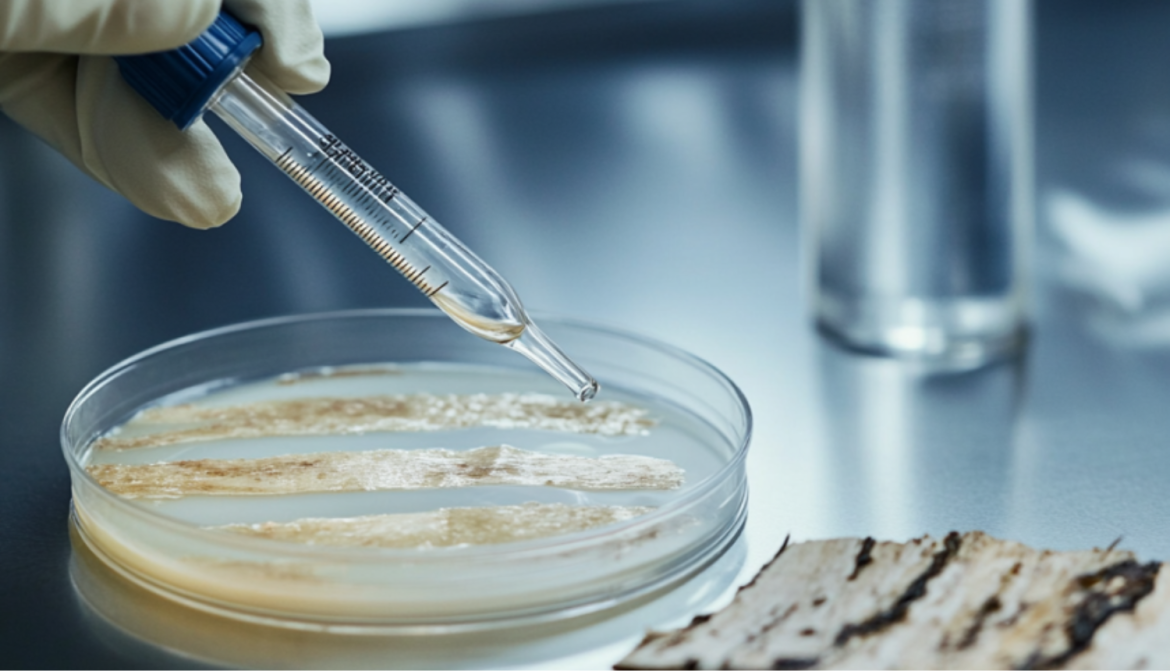
So, what do chitosan, hemp fibres, and suberinic acids from birch bark have in common? They are all components in the BIOHYDROPACK project, where scientists at the Latvian State Institute of Wood Chemistry are developing a fully natural, strong and water-resistant layered packaging material that can be easily composted after use.
The material is constructed in layers:
- a base of cellulose fibres from hemp,
- coatings and interlayers from chitosan and suberinic acids,
- and a top hydrophobic layer formed by electrospinning, a high-voltage technique that mimics spider silk formation and is also used in biomedical applications such as tissue scaffolds.
The biggest scientific challenge of the project is to ensure compatibility between natural polymers and fibres, enabling maximum hydrophobic performance and mechanical strength without synthetic additives.
The project has reached Technology Readiness Level 4 (TRL4) – meaning that functional prototypes are currently being developed and tested in the laboratory. Research results have already been published in two peer-reviewed articles, including in the Journal of Renewable Materials, and presented at the Baltic Polymer Symposium 2024 and RRB 20205 conference.
The BIOHYDROPACK research is led by Dr.sc.ing. Inese Filipova, with the participation of Dr.sc.ing. Ulla Milbreta and Mg.sc.ing. Laura Andže, as part of the Latvian Council of Science Fundamental and Applied Research Project call 2023/1.
Project leader Dr.sc.ing. Inese Filipova on BIOHYDROPACK progress: “The durable hemp fiber paper developed in the project once again demonstrates the potential of our local Latvian resources, while the greatest challenge lies in creating chitosan and suberic acid coatings, as the properties of these substances derived from renewable resources — and especially their interactions — are not yet fully understood, with many discoveries still ahead”
Learn more: Development of Biopolymer-based Hydrophobic Multi-layer Packaging Material from Biomass Waste Streams