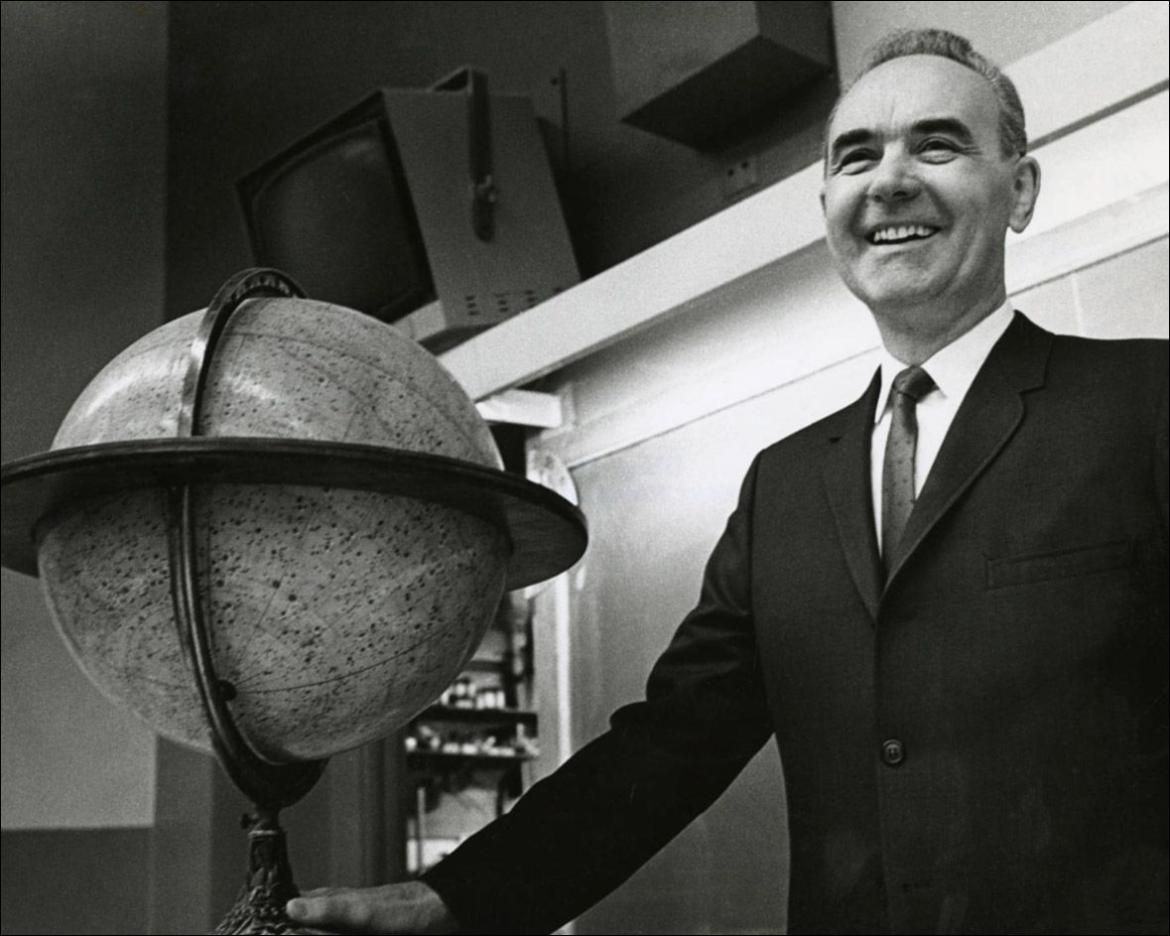
Latvian-born astronomer, graduate of the University of Latvia (UL) Kārlis Kaufmanis (1910–2003) became internationally renowned for his exceptional ability to bridge scientific discoveries with cultural and religious contexts. His famous "Star of Bethlehem Lecture", also aired on the international American broadcasting station "Voice of America", became a beloved Christmas tradition in the United States, delighting thousands of listeners. In this lecture, Kaufmanis provided a scientific explanation for the celestial symbol of the Star of Bethlehem from the Christian tradition, suggesting it may have been the conjunction of Jupiter and Saturn - a rare astronomical event.
Kārlis Kaufmanis, Emeritus Professor of Astronomy at the University of Minnesota, dedicated much of his career to lecturing on the Star of Bethlehem. This celestial phenomenon is central to the Christmas narrative of Christian tradition. He explained that the wise men mentioned in the Gospel of Matthew in the New Testament might not have seen a literal star but rather the Great Conjunction of Jupiter and Saturn.
Kaufmanis’ lectures gained widespread popularity, particularly during Christmas, appealing to believers and those with a scientific interest. As a profoundly religious man, Kaufmanis found the topic to hold special meaning, allowing him to integrate his scientific knowledge with his spiritual worldview.
The Legacy of Kārlis Kaufmanis
Throughout his academic career, Kaufmanis taught two courses at the University of Minnesota, including "Introduction to Astronomy", which was attended by over 26,000 students. Known for his enthusiastic teaching style, Kaufmanis often received standing ovations from his students – a rare honour among lecturers.
Although Kaufmanis authored more than 20 books, he admitted that his passion for teaching left little time for extensive research. Even after retiring, he continued to deliver lectures on the Star of Bethlehem, which became a cherished Christmas tradition for many astronomy enthusiasts, particularly in Minnesota, USA.
Prof. emeritus Kārlis Kaufmanis was admired for his passion for astronomy by both his students at Riga City Gymnasium No. 2 and those at the University of Minnesota. They fondly recalled how his eyes sparkled like the stars he spoke of so passionately. Kaufmanis likened lecturing to performing a beautiful piece of music, emphasizing that it never became tiresome.
Kārlis Kaufmanis left an indelible mark on both Latvian and American academic and cultural life, inspiring people to this day.
From Riga to Minnesota
While studying at the Riga Teachers’ Institute, Kārlis Kaufmanis showed a keen interest in algebra, geometry, and trigonometry – subjects that formed the foundation of his future career. During his studies at the University of Latvia’s Faculty of Mathematics and Natural Sciences (1934 - 1939), he also worked at the university’s Astronomical Observatory, gaining practical experience in star observation.
After graduating, Kaufmanis began teaching at Riga City Gymnasium No. 2, covering various subjects, from algebra and geometry to chemistry and cosmography. His book Pasaules telpā (In the Vastness of Space) was published that same year. While not intended as a textbook, the book offered a structured and accessible introduction to astronomy, making the subject approachable to a broad audience.
In 1949, Kaufmanis and his family emigrated to the United States, where he began teaching mathematics and astronomy at Gustavus Adolphus College in St. Peter, Minnesota. In 1962, he was invited to join the University of Minnesota, where he taught until retirement.