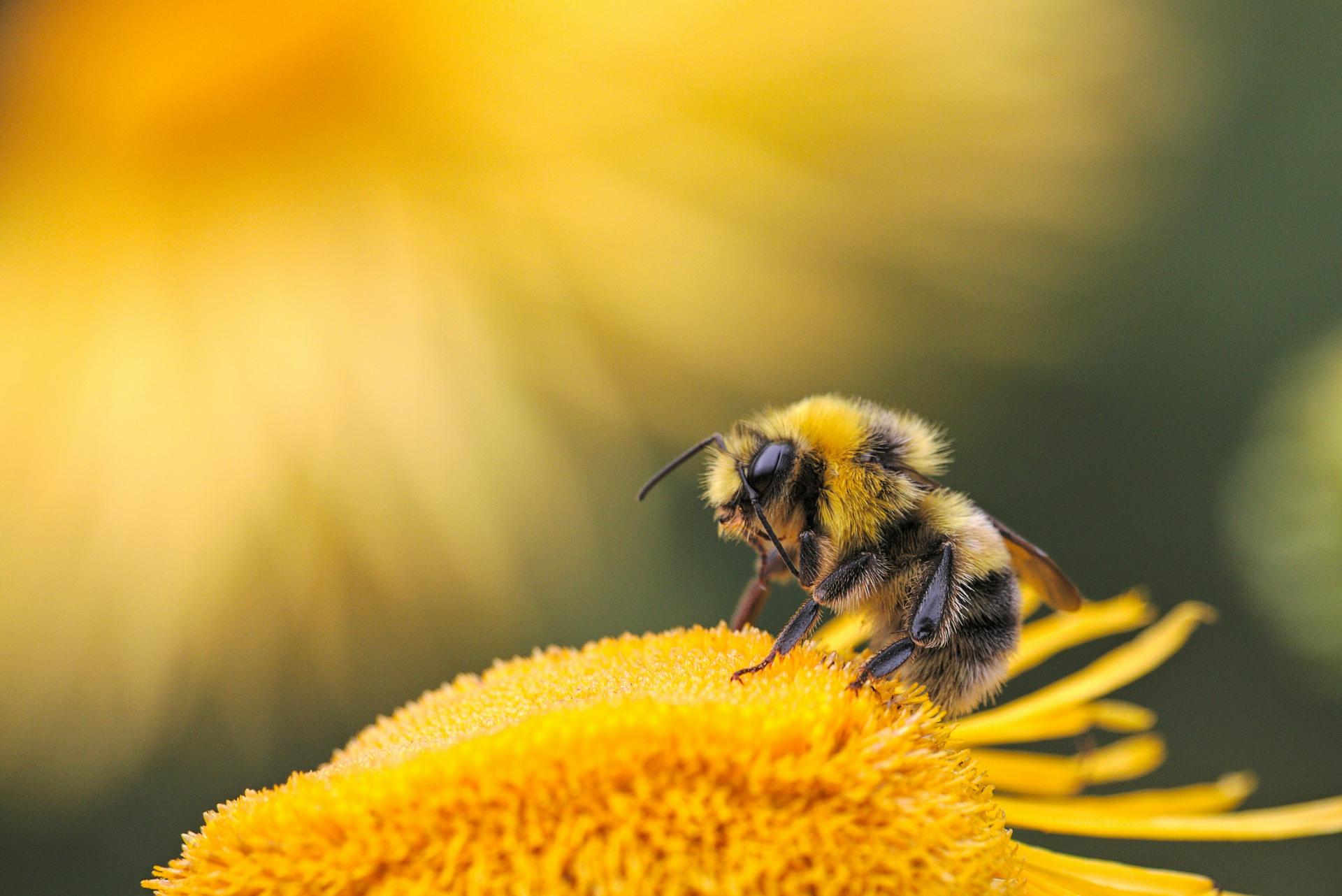
Around 300 bee species are found in Latvia, but only one of them – the European honey bee – is widely known to people because it is associated with beehives and honey production. The remaining species are wild bees, and relatively little is still known about their distribution and ecological needs. Wild bee researcher Betija Rubene, a doctoral student at the University of Latvia (UL) and Scientific Assistant at the Latvia University of Life Sciences and Technologies (LBTU), together with her colleagues, studies what kinds of habitats these species need and where suitable living conditions for them still remain in Latvia.
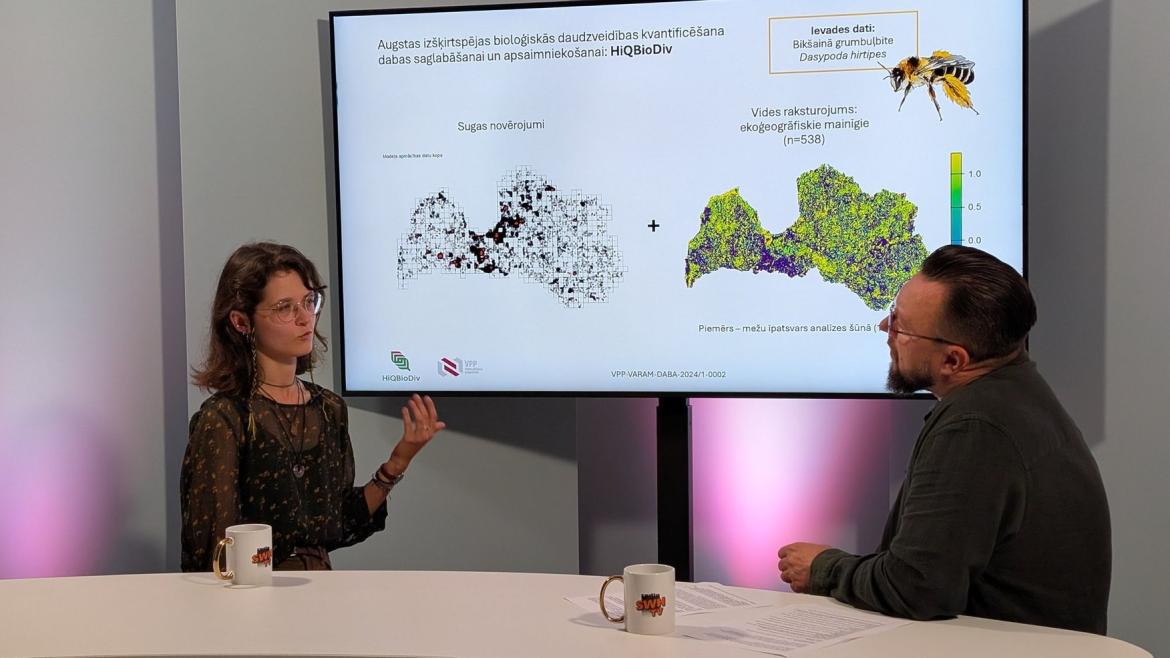
In the first programme of the autumn season of Radio SWH TV’s programme "Latvia in Science", produced in cooperation with "Rietumu Banka", Rubene explains that wild bees are not a uniform group. Bumblebees live in colonies, while most other species are solitary bees – each female builds her own nest and takes care of her own offspring. Some wild bees nest in the soil, while others use small cavities.
This diversity is essential for the stability of pollination – if one species fares worse under particular conditions, others can continue pollinating plants. Pollination, in turn, is necessary for plants to produce seeds and fruit, so preserving wild bees is not only a matter of nature conservation – it is also important for agriculture. As studies show, wild bees are highly effective pollinators, and it is precisely their species diversity that ensures the stability of pollination as an ecosystem service.
Bees need not only flowers, but also a place to live
Wild bees need both flowering plants from which to obtain food and suitable places for nesting. When large areas are managed intensively, such places may become less abundant.
Therefore, even seemingly small landscape elements – roadsides, ditch edges, trees, shrubs and uncultivated strips – are important. Rubene points out that a diverse landscape provides more suitable living conditions for wild pollinators. This does not mean abandoning agriculture, but rather seeking a balance.
From individual observations to habitat suitability maps
For some wild bee species in Latvia, the only available information consists of just a few species observations. This does not necessarily mean that the species is truly very rare – it may simply not have been studied sufficiently.
In cooperation with LBTU and Daugavpils University, the University of Latvia is modelling the habitat suitability of various species across Latvia within the "HiQBioDiv" project (High-resolution Quantification of Biodiversity for Nature Conservation and Management). Within this project, Rubene is responsible for 17 wild bee species.
To characterise the environment across the territory of Latvia, the modelling uses 538 different ecogeographical variables (for example, the proportion of arable land or forests in the landscape, distance from permanent grasslands, etc.), resulting in habitat suitability maps with a resolution of one hectare, or 100 by 100 metres. In addition, environmental response curves are also obtained, showing exactly which conditions determine higher or lower suitability of a location.
"Accordingly, we can zoom in on the maps we have obtained and, at a resolution of 1 ha (a 100 x 100 metre cell), see the predicted habitat suitability for a specific species anywhere in Latvia."
Science that helps decide what to preserve
By combining models for many species, it is possible to identify areas that are particularly important for wild bees overall and to understand where it would be most important to concentrate nature conservation measures. In addition, these models can also help identify areas where pollination may be insufficient due to a lack of suitable habitats for bees.
Rubene emphasises that the aim is not to set nature conservation and agriculture against each other. More precise data can help find a compromise – to protect areas important for pollinators in a more targeted way, while also taking economic interests into account.
Monitoring is needed in the long term
It is currently difficult to reliably assess how wild bee populations in Latvia have changed over a longer period of time, as there is a lack of a sufficient volume of historical data. Therefore, wild bee ecology research currently also has a preventive significance: to understand what needs to be preserved in the Latvian landscape so that the situation does not worsen in the future.
At the "Agrihorts" Institute of Plant Protection Research of LBTU, a bee monitoring methodology is being tested this year. Valters Brusbārdis, Chairman of the Board of the Latvian Beekeepers' Association, emphasizes the importance of continuity—if monitoring is interrupted after a few years, the opportunity to compare data and notice long-term changes disappears.
This knowledge helps to understand where wild bees need to have their habitats preserved in the Latvian landscape. A ditch bank, a meadow, a shrub strip, or an uncultivated field edge may seem like a trifle, but for pollinators, it can provide food or a nesting site – and this is important not only for nature, but also for agriculture.
The Radio SWH TV program "Latvia in Science" introduces Latvian scientists, researchers, and innovators whose ideas and achievements shape future technologies and solutions, while simultaneously revealing science as an exciting and human process. Conversations with scientists are created in collaboration with Rietumu Bank – excellence is never a coincidence. The scientists are supported by the University of Latvia Foundation.