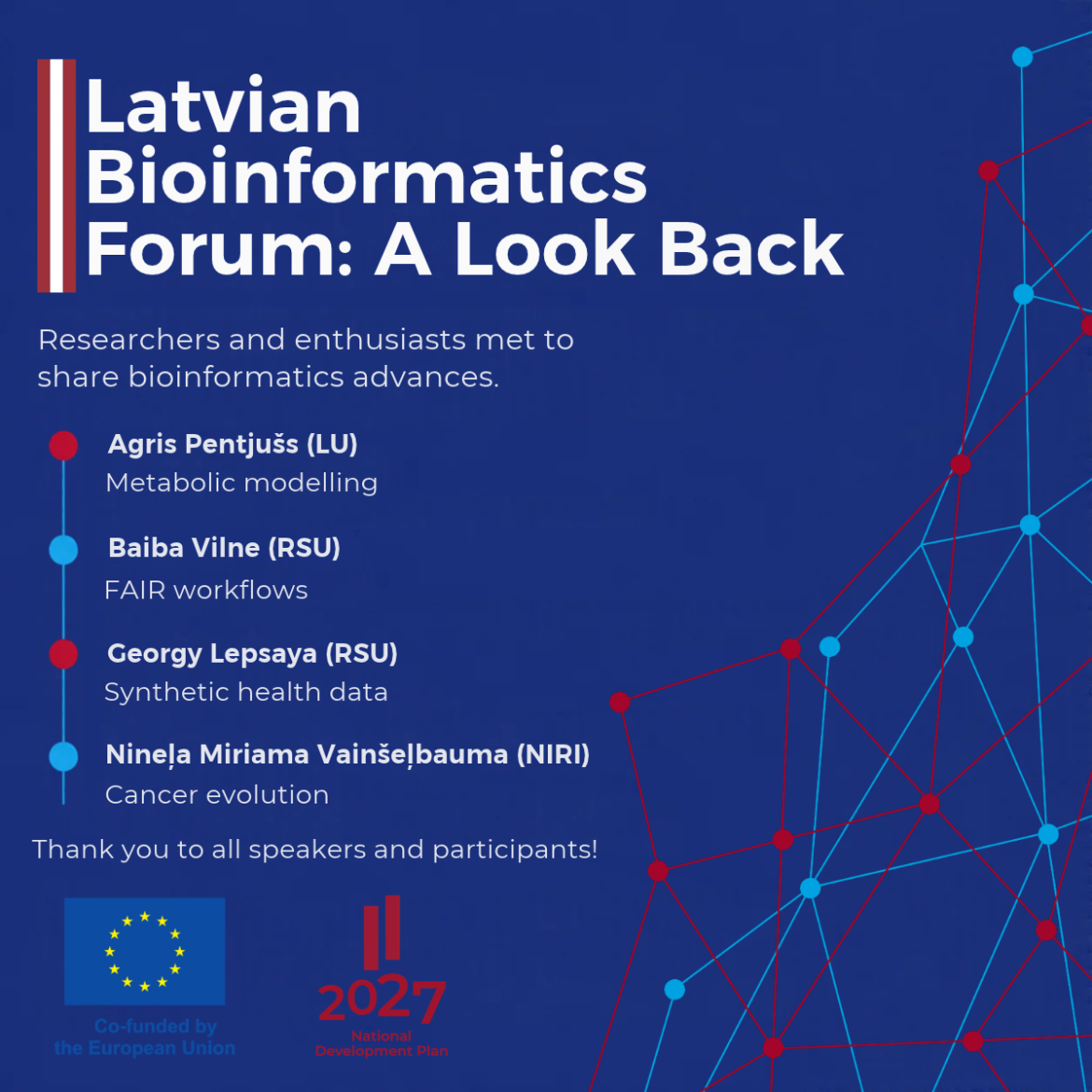
Latvian Bioinformatics Forum Brings Together Local Community
23. novembris, 2026. gads
On November 17, the Latvian Bioinformatics Forum brought together researchers and others interested in bioinformatics from across Latvia to share current work, discuss methodologies, and exchange ideas on ongoing developments in the field.
The program featured four presentations covering a range of computational and biological topics:
Metabolic Modeling of Extremophiles – Agris Pentjušs (University of Latvia) presented a genome-scale metabolic model of the extremophilic red algae Galdieria sulphuraria, demonstrating how integrating quantitative transcriptomics data can be used to study its adaptation to extreme temperature shifts.
FAIR Principles for Computational Workflows – Baiba Vilne (Rīga Stradiņš University) outlined practical steps for applying FAIR (Findable, Accessible, Interoperable, Reusable) principles to computational workflows. The talk covered version control, containerization, and provenance tracking, while clarifying how FAIR standards apply to sensitive biomedical data.
Synthetic Health Data and Privacy – Georgy Lepsaya (Rīga Stradiņš University) introduced a Nextflow-orchestrated pipeline for generating and evaluating synthetic health data. He discussed the trade-offs between privacy preservation and downstream utility, as well as packaging outputs as FAIR Research Object Crates.
Systems Bioinformatics in Cancer Evolution – Nineļa Miriama Vainšeļbauma (National Institute of Research and Innovation) discussed systems bioinformatics methods for studying tumor heterogeneity and therapy resistance, showing how network analysis and epigenetic modeling help reveal how aggressive tumors co-opt embryonic and reproductive pathways.
Following the talks, participants discussed ways to maintain regular collaboration and knowledge exchange within the local community. Going forward, the Latvian Bioinformatics Forum is planned to take place 1–2 times a year, with future sessions also featuring guest speakers from the European Molecular Biology Laboratory (EMBL).
Thank you to all speakers and participants for their presentations and contributions to the discussion.
NIRI is implementing Project No. 1.1.1.5/3/24/I/006, “Development of Latvia’s Research Potential by Strengthening the Integration of the Latvian Biomedical Research and Study Centre into European Research Infrastructures and Scientific Networks,” on the basis of the “Action Plan of the Latvian National Contact Point for the European Molecular Biology Laboratory (EMBL),” approved by the Ministry of Education and Science on 16 December 2024.